
Free reader powered by your browser. Available voices may vary by device.
He Buried His Wife and Swore Never to Love Again… Until the Apache Widow Changed Everything.
The shovel hit the frozen Wyoming dirt and rang like a bell, and Eli Carter kept digging while his wife’s body lay wrapped in a quilt beside the hole, and their newborn son screamed until his voice broke inside a wooden apple crate three feet away.
He did not stop. He did not pray. He did not look at the boy. The wind was cutting through Redstone Valley that October morning nineteen years ago, and the men who had come to help stood back because grief that quiet is terrifying to watch.
If this is your first time hearing one of my stories, welcome. Do me a favor and hit that like button, like my page, and please watch till the end because this one will break you before it heals you. Comment below where you are listening from, London, Texas, I read every single one, and tell me honestly, do you believe love after loss is betrayal or is it survival?
Now let me tell you how we got there.
Grace Carter was not born for ranch life. She was the schoolteacher’s daughter from town, twenty-two years old when she married Eli, with soft hands and a laugh that made horses calm down. Her dream was simple and it was everything. She wanted to be loved fully, to be respected not just as Eli’s wife but as herself, to finally become a mother, and to survive the hard years without losing the gentle person she was inside.
Eli was twenty-six then, already respected, already building the Carter ranch with his father. He loved her in the way quiet men love, by fixing the porch step before she tripped, by leaving wildflowers on her sewing table, by learning her favorite hymn.
The trouble started with his mother, Evelyn Carter.
Evelyn ran the women’s circle at the little white church and she ran her family the same way. On their wedding night she took Grace’s hands and said, “A Carter woman gives this valley sons. Don’t make my boy wait too long.”
Grace smiled because she thought it was a blessing. It was a deadline.
Year one passed. No baby. Year two. Year three. The whispers started in town. At quilting bees the church women would pat her stomach and ask if she had seen the doctor in Cheyenne. At Sunday dinner Evelyn would set an extra plate “just in case the Lord blesses us soon” and then clear it away untouched while looking at Grace.
Eli never blamed her. That was the pain of it. He would find her crying in the barn and just hold her, saying nothing, which made Grace love him more and hate herself more at the same time.
She fought back the only way she knew how. She planted a garden that fed three neighboring families during a dry summer. She learned to mend torn saddle leather better than the men. She sat with old Mrs. Abernathy when her husband died and read Psalms to her for three nights straight until the woman could sleep. She was earning respect, inch by inch, but in her own heart the empty cradle in their bedroom was louder than any praise.
Samuel, the ranch hand’s boy, once asked her why she worked so hard. She told him, “Because if I cannot give this place a child yet, I will give it everything else I have, so I do not disappear.”
That was Grace. Pain did not make her bitter. It made her deeper.
After seven years of trying, of teas and prayers and silent drives home from the doctor, Grace missed her monthly and did not tell anyone for three weeks because she was terrified to hope. When she finally whispered it to Eli in the kitchen, he dropped to his knees and pressed his forehead to her belly and cried. It was the first time she had ever seen him cry.
For eight months the valley saw a different Eli Carter. He smiled. He whistled. He built that cradle himself from pine and sanded it until it was smooth as glass. Evelyn baked every day and told everyone God had finally answered. Grace glowed, but she was also scared. She would wake at night holding her stomach, praying, “Let me live long enough to be his mother.”
The labor came early in October. It snowed the night before, a freak storm. The midwife could not get through the pass. It was just Eli, Evelyn, and old Doc Miller who rode three hours through drifts.
It went wrong fast. Too much blood. Too much pain. Grace knew. In between contractions she grabbed Eli’s hand and she was not crying for herself. She said, “Promise me you will love him out loud. Promise me you will not become stone. Promise me you will let yourself live.”
Eli promised. He lied without meaning to.
At 4:17 in the morning Samuel Carter was born screaming. At 4:29 Grace Carter died with her hand still in her husband’s.
He kept his ranch. He raised his boy. He paid his debts. He went to church. But the man who whistled was gone.
For sixteen years he functioned. Then three years ago, on Samuel’s sixteenth birthday, Samuel asked why there were no pictures of his mother in the main house, only in the back bedroom. Eli could not answer. That night he sat in the barn and realized he had not truly smiled, not from the belly, in three solid years. Not since he stopped pretending.
That is the man the town talks about now. Eli Carter, fifty-two, respected, rich in land and cattle, cold as the well water in January. He works from dark to dark. He avoids town gatherings. He speaks when necessary and no more. Samuel, now nineteen and tall like his father, begs him to come to dances, to consider Mrs. Whitaker who lost her husband last spring, to live again. Eli refuses every time.
“Loving another woman would be spitting on your mother’s grave,” he told his son last Christmas. Samuel slammed the door so hard the windows shook.
That is where our story really begins. On a bitter autumn that felt like winter coming early.
Eli was riding the far fence line where his property backs up to Cottonwood Creek. He found tracks that were not cattle. Small moccasin prints, dragged heels, and then blood on snow, not a lot, just drops. He followed because thieves had been hitting ranches all month.
Behind a fallen pine, half covered in brush, he found them.
A woman, maybe forty, Apache by her dress and her braids, though the town would later call her a half-breed just to make it easier to hate her. She was holding a teenage girl who was burning with fever, shivering despite the sweat on her forehead. The woman had a knife in her hand, not raised, just held, and her eyes were not begging. They were daring him to be cruel.
He knew her face from trading days. Anna. Her husband, Thomas, had been the one peaceful trader who carried letters between the reservation families and the settlers. He had been found shot two weeks earlier near the south pass. Everyone said it was thieves. Everyone also whispered that he had it coming for mixing.
Anna’s voice was hoarse. “We will go. My daughter is sick. We needed water. We did not steal.”
Eli looked at the girl, Lily, fourteen and light as a bird, her lips cracked. He saw Grace for half a second, not in features, but in the way a mother tries to hide her terror behind strength.
He should have ridden back and told the sheriff. The town already blamed Apache families for the cattle tensions. Sheltering them would be social suicide. Evelyn, still alive and sharp at seventy, would call it dishonor. Samuel would see it as his father trying to replace his mother.
Eli wanted no trouble. He had buried enough.
But Lily coughed, a deep, wet sound, and Anna pulled her closer and whispered in their language, a prayer, and Eli heard the exact same break in her voice that he had heard in his own throat nineteen years ago over a fresh grave.
He dismounted. He did not touch the knife. He said, “There is an old guest cabin on the far side of my north pasture. No one goes there since my father died. It has a stove. It has wood.”
Anna stared. “Why?”
He did not have an answer that made sense. He said, “Because the girl will die out here tonight.”
Pride fought need in her face. Finally she nodded once.
He helped them up onto his horse, Lily in front of him, Anna walking beside with her hand on her daughter’s leg the whole way, as if letting go would mean losing her. He took the long way, through the trees, so no one from the road would see.
He got them inside, lit the stove, left stew, blankets, medicine from his own cabinet. He was polite but distant. Anna was guarded and painfully aware she was unwanted. She thanked him in English, formal and cold.
“I will leave when she can walk,” she said.
“You will leave when it is safe,” Eli answered, and he left before he could change his mind.
That night Samuel saw the light on in the north cabin from his bedroom window. He came downstairs and found his father sitting at the kitchen table with his hands wrapped around a coffee cup, staring at nothing.
“Who is out there?” Samuel asked.
Eli did not lie. “A woman and her girl. They needed shelter.”
Samuel’s face went red. “Ma has not even been gone twenty years and you are bringing women onto her property?”
Eli flinched at the word Ma. Grace had been gone nineteen years, but to Samuel she was a saint in a photograph, not a memory.
“They will be gone soon,” Eli said quietly.
Samuel shook his head, hurt turning into anger. “Everyone in town already says grief made you lifeless. Now they will say it made you a traitor too.”
He walked out, slamming the back door.
Eli sat alone, and for the first time in three years his hands were shaking, not from cold but from fear. He could hear Evelyn’s voice in his head, the church women’s gossip already forming, the ranchers at the feed store spitting the word “squaw-lover.”
Up in the north cabin, Anna was bathing her daughter’s forehead with a cool cloth, humming low. She did not know that by morning, Mrs. Whitaker would see smoke from that chimney on her way to church and tell Evelyn Carter, and by noon the whole valley would know that Eli Carter had hidden an Apache widow on the land where he buried his wife.
And Eli, the cowboy who had not smiled in three years, lay awake that night not thinking about reputation, but about the way Anna’s hand had not left her daughter’s leg, and how for one moment, carrying that feverish child through the snow, he had felt something other than stone in his chest.
He was terrified of what it meant.
By sunrise the smoke from the north cabin had already told on Eli Carter.
Mrs. Whitaker saw it on her way to early prayer, a thin grey line where no chimney should be burning in October. She did not go home first. She went straight to Evelyn Carter’s kitchen and she did not even take off her coat.
“Evelyn, your son has got someone living in the old guest house,” she said, and by the time the church bell rang at nine, every woman in Redstone knew an Apache woman was sleeping on Carter land.
If you have ever lived in a small town, you know how fast a whisper can travel faster than a horse. By lunch the feed store men had a new reason to hate Eli. By supper they had a story.
Listen, family, this is where the pain really starts.
Evelyn came up the ranch road that afternoon with her back straight as a fence post. She is seventy now, but her eyes are still sharp enough to cut. She found Eli in the barn shoeing a mare.
“Is it true?” she asked. No hello.
Eli did not look up. “They needed shelter.”
“They,” Evelyn repeated. “A squaw and her girl. On the land where I watched my daughter-in-law bleed to death giving you a son.”
That name, Grace, was a weapon and she knew it. Eli’s hammer missed the nail.
“Mother, the girl had fever.”
“And what will fever matter when this town decides you have dishonored your wife’s memory?” Evelyn stepped closer. “Grace waited seven years to give you Samuel. She prayed for that boy. She died for that boy. And now you bring another woman into her house while her son is still under your roof?”
Eli finally looked at her. “It is not her house anymore. It is a cabin a quarter mile away.”
Evelyn’s voice dropped. “It is her memory. And you are spitting on it.”
She left him standing in cold horse smell and guilt so heavy he could taste it.
That guilt is important, because guilt is what kept Eli polite but distant for the next two weeks. He would leave food on Anna’s porch, knock once, walk away. He would not sit. He would not talk. He told himself he was protecting his reputation. The truth was he was terrified of how calm he felt when he was near her.
Anna understood distance. She is proud in a way that does not need to shout. She never asked for more. She just started helping, quietly, the way Grace used to.
The first time was the clothes. Eli left his winter coat on the cabin chair after checking on Lily’s fever. Anna found a torn lining and a missing button. The next morning the coat was folded on his porch, mended with tiny perfect stitches, the button replaced with carved bone. No note.
The second time was the horses. A late thunder storm rolled in and the young geldings panicked in the corral. Eli and Samuel were struggling in the rain when Anna walked out of the trees in a borrowed oilskin, no fear at all. She did not shout. She sang low in her language, a steady sound, and put her hand on the lead gelding’s nose. The horse stopped kicking. The others followed. In five minutes the corral was calm.
Samuel stared at her like she had done witchcraft. Eli just watched her hands.
The third time was his hands. Years of rope and cold had swollen Eli’s knuckles until he could barely close them at night. Anna saw him wincing while splitting wood. That evening she left a small tin on his porch. Inside was a green salve that smelled like pine and mint.
He threw it in the trash the first night. Pride. The second night his hands ached so bad he could not hold a coffee cup. He dug it out, rubbed a little on, and slept without pain for the first time in three years. He never thanked her. He just left the empty tin back on her porch. The next day it was full again.
While the adults were dancing around each other, the kids were doing something more honest.
Lily got better. Fever broke on day four. She is fourteen, thin, watchful, with her father’s quiet eyes. She started following Samuel at a distance while he did chores. At first he ignored her. Then he snapped.
“What are you looking at?” he said one afternoon by the woodpile.
“You miss her too,” Lily answered in clear English. “Your mother.”
Samuel flinched. “You don’t know anything about my mother.”
“I know what it is to watch your father try not to cry,” she said. “My father was killed two weeks ago. Yours died nineteen years ago. Grief does not have a calendar.”
That shut Samuel up. The next day he left one of Grace’s old readers on the cabin step, the one with the prairie flowers pressed inside. Lily left him a small leather cord braided in the Apache way. They did not become friends fast. They became two people who understood the same hole in the house.
But the town did not care about quiet kindness.
On the third Sunday, Pastor James asked Eli to step outside after service. Three ranchers were waiting by the hitching post, men Eli had known twenty years.
“Eli, we respect you,” Tom Whitaker started, “but you have an Indian woman living on Carter land. Folks are saying you have dishonored Grace. Folks are saying you are choosing them over us, especially with the thefts.”
“She is a widow,” Eli said. “Her husband traded fair with all of us.”
“Her husband is dead,” another man said. “And now she is in your cabin. Send her back to the reservation before trouble finds you.”
Eli wanted to argue. Instead he said nothing, because part of him believed them. That silence cost him everything.
That night Samuel finally exploded. He found Eli at the kitchen table rubbing Anna’s salve into his hands.
“So this is what we do now?” Samuel shouted. “You sit here using her medicine, wearing clothes she fixed, while Ma’s picture faces the wall in the back room?”
Eli stood slowly. “Watch your tone.”
“No! You watch yours! You told me loving another woman would be betrayal. Was that a lie? Are you trying to replace her with an Apache?”
The back door was open. Neither of them knew Anna was on the porch with a basket of eggs she had gathered from the henhouse to repay them. She heard every word.
She did not come in. She set the eggs down, walked back to the cabin in the dark, and started packing their small bundle. Lily watched her mother fold the same two dresses with shaking hands.
“We are unwanted here,” Anna whispered. “I will not have my daughter feel shame for being alive. We leave at first light.”
Lily did not argue. She just held the braided cord Samuel had given her.
Anna wrote no note. She planned to slip away before Eli could do the polite thing and offer more charity.
God had other plans.
At two in the morning the temperature dropped thirty degrees in three hours. A wind came down from the mountains that sounded like a train. By dawn Redstone Valley was locked in the earliest blizzard anyone over sixty could remember. Snow was waist high by breakfast. The creek froze solid. The sky was white and blind.
Livestock started dying by noon. Cows piled against fences and froze standing up. The Miller family three miles west got snowed into their house with no wood. The Whitakers’ roof started to cave. The telephone line went dead.
And the thieves came back.
They knew isolated ranches could not call for help in a storm. Tom Whitaker rode through whiteout to Eli’s door at dusk, half frozen, his arm bleeding.
“They hit us,” he gasped. “Four men. Same ones who burned the trader’s camp. They took our winter stores. They shot my dog. They are moving ranch to ranch in this storm.”
Eli got him inside, sent Samuel for blankets. While Samuel worked, Tom looked past Eli and saw Anna standing in the kitchen doorway holding a steaming pot of broth. His face twisted.
“You,” he said. “You brought this on us. Your people—”
“My people are freezing too,” Anna said calmly, setting the pot down. “And those men killed my husband. They are not my people.”
Eli stepped between them. “Enough.”
But Anna was not looking at Tom anymore. She was looking out the window at the white hell.
“You will all die if you stay in your houses,” she said quietly. “This is a white winter. My husband Thomas taught me. There is a box canyon behind Red Rock, two miles north. Hot springs run through it. The walls cut the wind. My family wintered there when I was a girl. It will hold fifty people and livestock.”
Samuel scoffed. “We are not following an Indian trail in a blizzard.”
Anna turned to him, not angry, just tired. “Your mother died in a storm like this, trying to bring life. Do you want more mothers to die tonight because of pride?”
The room went silent. Eli felt that sentence hit his chest like the shovel had hit frozen ground nineteen years ago.
Tom Whitaker stood up, shaking. “I am not taking my wife and baby to some Apache hole.”
“Then they will freeze in your house by morning,” Anna said. “Choose.”
Eli looked at the faces around his kitchen. His mother Evelyn, still alive and sharp at seventy, would call it dishonor. Samuel would see it as his father trying to replace his mother.
Eli wanted no trouble. He had buried enough.
But Lily coughed, a deep, wet sound, and Anna pulled her closer and whispered in their language, a prayer, and Eli heard the exact same break in her voice that he had heard in his own throat nineteen years ago over a fresh grave.
He dismounted. He did not touch the knife. He said, “There is an old guest cabin on the far side of my north pasture. No one goes there since my father died. It has a stove. It has wood.”
Anna stared. “Why?”
He did not have an answer that made sense. He said, “Because the girl will die out here tonight.”
Pride fought need in her face. Finally she nodded once.
He helped them up onto his horse, Lily in front of him, Anna walking beside with her hand on her daughter’s leg the whole way, as if letting go would mean losing her. He took the long way, through the trees, so no one from the road would see.
He got them inside, lit the stove, left stew, blankets, medicine from his own cabinet. He was polite but distant. Anna was guarded and painfully aware she was unwanted. She thanked him in English, formal and cold.
“I will leave when she can walk,” she said.
“You will leave when it is safe,” Eli answered, and he left before he could change his mind.
That night Samuel saw the light on in the north cabin from his bedroom window. He came downstairs and found his father sitting at the kitchen table with his hands wrapped around a coffee cup, staring at nothing.
“Who is out there?” Samuel asked.
Eli did not lie. “A woman and her girl. They needed shelter.”
Samuel’s face went red. “Ma has not even been gone twenty years and you are bringing women onto her property?”
Eli flinched at the word Ma. Grace had been gone nineteen years, but to Samuel she was a saint in a photograph, not a memory.
“They will be gone soon,” Eli said quietly.
Samuel shook his head, hurt turning into anger. “Everyone in town already says grief made you lifeless. Now they will say it made you a traitor too.”
He walked out, slamming the back door.
Eli sat alone, and for the first time in three years his hands were shaking, not from cold but from fear. He could hear Evelyn’s voice in his head, the church women’s gossip already forming, the ranchers at the feed store spitting the word “squaw-lover.”
Up in the north cabin, Anna was bathing her daughter’s forehead with a cool cloth, humming low. She did not know that by morning, Mrs. Whitaker would see smoke from that chimney on her way to church and tell Evelyn Carter, and by noon the whole valley would know that Eli Carter had hidden an Apache widow on the land where he buried his wife.
And Eli, the cowboy who had not smiled in three years, lay awake that night not thinking about reputation, but about the way Anna’s hand had not left her daughter’s leg, and how for one moment, carrying that feverish child through the snow, he had felt something other than stone in his chest.
He was terrified of what it meant.
By sunrise the smoke from the north cabin had already told on Eli Carter.
Mrs. Whitaker saw it on her way to early prayer, a thin grey line where no chimney should be burning in October. She did not go home first. She went straight to Evelyn Carter’s kitchen and she did not even take off her coat.
“Evelyn, your son has got someone living in the old guest house,” she said, and by the time the church bell rang at nine, every woman in Redstone knew an Apache woman was sleeping on Carter land.
If you have ever lived in a small town, you know how fast a whisper can travel faster than a horse. By lunch the feed store men had a new reason to hate Eli. By supper they had a story.
Listen, family, this is where the pain really starts.
Evelyn came up the ranch road that afternoon with her back straight as a fence post. She is seventy now, but her eyes are still sharp enough to cut. She found Eli in the barn shoeing a mare.
“Is it true?” she asked. No hello.
Eli did not look up. “They needed shelter.”
“They,” Evelyn repeated. “A squaw and her girl. On the land where I watched my daughter-in-law bleed to death giving you a son.”
That name, Grace, was a weapon and she knew it. Eli’s hammer missed the nail.
“Mother, the girl had fever.”
“And what will fever matter when this town decides you have dishonored your wife’s memory?” Evelyn stepped closer. “Grace waited seven years to give you Samuel. She prayed for that boy. She died for that boy. And now you bring another woman into her house while her son is still under your roof?”
Eli finally looked at her. “It is not her house anymore. It is a cabin a quarter mile away.”
Evelyn’s voice dropped. “It is her memory. And you are spitting on it.”
She left him standing in cold horse smell and guilt so heavy he could taste it.
That guilt is important, because guilt is what kept Eli polite but distant for the next two weeks. He would leave food on Anna’s porch, knock once, walk away. He would not sit. He would not talk. He told himself he was protecting his reputation. The truth was he was terrified of how calm he felt when he was near her.
Anna understood distance. She is proud in a way that does not need to shout. She never asked for more. She just started helping, quietly, the way Grace used to.
The first time was the clothes. Eli left his winter coat on the cabin chair after checking on Lily’s fever. Anna found a torn lining and a missing button. The next morning the coat was folded on his porch, mended with tiny perfect stitches, the button replaced with carved bone. No note.
The second time was the horses. A late thunder storm rolled in and the young geldings panicked in the corral. Eli and Samuel were struggling in the rain when Anna walked out of the trees in a borrowed oilskin, no fear at all. She did not shout. She sang low in her language, a steady sound, and put her hand on the lead gelding’s nose. The horse stopped kicking. The others followed. In five minutes the corral was calm.
Samuel stared at her like she had done witchcraft. Eli just watched her hands.
The third time was his hands. Years of rope and cold had swollen Eli’s knuckles until he could barely close them at night. Anna saw him wincing while splitting wood. That evening she left a small tin on his porch. Inside was a green salve that smelled like pine and mint.
He threw it in the trash the first night. Pride. The second night his hands ached so bad he could not hold a coffee cup. He dug it out, rubbed a little on, and slept without pain for the first time in three years. He never thanked her. He just left the empty tin back on her porch. The next day it was full again.
While the adults were dancing around each other, the kids were doing something more honest.
Lily got better. Fever broke on day four. She is fourteen, thin, watchful, with her father’s quiet eyes. She started following Samuel at a distance while he did chores. At first he ignored her. Then he snapped.
“What are you looking at?” he said one afternoon by the woodpile.
“You miss her too,” Lily answered in clear English. “Your mother.”
Samuel flinched. “You don’t know anything about my mother.”
“I know what it is to watch your father try not to cry,” she said. “My father was killed two weeks ago. Yours died nineteen years ago. Grief does not have a calendar.”
That shut Samuel up. The next day he left one of Grace’s old readers on the cabin step, the one with the prairie flowers pressed inside. Lily left him a small leather cord braided in the Apache way. They did not become friends fast. They became two people who understood the same hole in the house.
But the town did not care about quiet kindness.
On the third Sunday, Pastor James asked Eli to step outside after service. Three ranchers were waiting by the hitching post, men Eli had known twenty years.
“Eli, we respect you,” Tom Whitaker started, “but you have an Indian woman living on Carter land. Folks are saying you have dishonored Grace. Folks are saying you are choosing them over us, especially with the thefts.”
“She is a widow,” Eli said. “Her husband traded fair with all of us.”
“Her husband is dead,” another man said. “And now she is in your cabin. Send her back to the reservation before trouble finds you.”
Eli wanted to argue. Instead he said nothing, because part of him believed them. That silence cost him everything.
That night Samuel finally exploded. He found Eli at the kitchen table rubbing Anna’s salve into his hands.
“So this is what we do now?” Samuel shouted. “You sit here using her medicine, wearing clothes she fixed, while Ma’s picture faces the wall in the back room?”
Eli stood slowly. “Watch your tone.”
“No! You watch yours! You told me loving another woman would be betrayal. Was that a lie? Are you trying to replace her with an Apache?”
The back door was open. Neither of them knew Anna was on the porch with a basket of eggs she had gathered from the henhouse to repay them. She heard every word.
She did not come in. She set the eggs down, walked back to the cabin in the dark, and started packing their small bundle. Lily watched her mother fold the same two dresses with shaking hands.
“We are unwanted here,” Anna whispered. “I will not have my daughter feel shame for being alive. We leave at first light.”
Lily did not argue. She just held the braided cord Samuel had given her.
Anna wrote no note. She planned to slip away before Eli could do the polite thing and offer more charity.
God had other plans.
At two in the morning the temperature dropped thirty degrees in three hours. A wind came down from the mountains that sounded like a train. By dawn Redstone Valley was locked in the earliest blizzard anyone over sixty could remember. Snow was waist high by breakfast. The creek froze solid. The sky was white and blind.
Livestock started dying by noon. Cows piled against fences and froze standing up. The Miller family three miles west got snowed into their house with no wood. The Whitakers’ roof started to cave. The telephone line went dead.
And the thieves came back.
They knew isolated ranches could not call for help in a storm. Tom Whitaker rode through whiteout to Eli’s door at dusk, half frozen, his arm bleeding.
“They hit us,” he gasped. “Four men. Same ones who burned the trader’s camp. They took our winter stores. They shot my dog. They are moving ranch to ranch in this storm.”
Eli got him inside, sent Samuel for blankets. While Samuel worked, Tom looked past Eli and saw Anna standing in the kitchen doorway holding a steaming pot of broth. His face twisted.
“You,” he said. “You brought this on us. Your people—”
“My people are freezing too,” Anna said calmly, setting the pot down. “And those men killed my husband. They are not my people.”
Eli stepped between them. “Enough.”
But Anna was not looking at Tom anymore. She was looking out the window at the white hell.
“You will all die if you stay in your houses,” she said quietly. “This is a white winter. My husband Thomas taught me. There is a box canyon behind Red Rock, two miles north. Hot springs run through it. The walls cut the wind. My family wintered there when I was a girl. It will hold fifty people and livestock.”
Samuel scoffed. “We are not following an Indian trail in a blizzard.”
Anna turned to him, not angry, just tired. “Your mother died in a storm like this, trying to bring life. Do you want more mothers to die tonight because of pride?”
The room went silent. Eli felt that sentence hit his chest like the shovel had hit frozen ground nineteen years ago.
Tom Whitaker stood up, shaking. “I am not taking my wife and baby to some Apache hole.”
“Then they will freeze in your house by morning,” Anna said. “Choose.”
Eli looked at the faces around his kitchen. Evelyn, still alive and sharp at seventy, would call it dishonor. Samuel would see it as his father trying to replace his mother.
Eli wanted no trouble. He had buried enough.
But Lily coughed, a deep, wet sound, and Anna pulled her closer and whispered in their language, a prayer, and Eli heard the exact same break in her voice that he had heard in his own throat nineteen years ago over a fresh grave.
He dismounted. He did not touch the knife. He said, “There is an old guest cabin on the far side of my north pasture. No one goes there since my father died. It has a stove. It has wood.”
Anna stared. “Why?”
He did not have an answer that made sense. He said, “Because the girl will die out here tonight.”
Pride fought need in her face. Finally she nodded once.
He helped them up onto his horse, Lily in front of him, Anna walking beside with her hand on her daughter’s leg the whole way, as if letting go would mean losing her. He took the long way, through the trees, so no one from the road would see.
He got them inside, lit the stove, left stew, blankets, medicine from his own cabinet. He was polite but distant. Anna was guarded and painfully aware she was unwanted. She thanked him in English, formal and cold.
“I will leave when she can walk,” she said.
“You will leave when it is safe,” Eli answered, and he left before he could change his mind.
That night Samuel saw the light on in the north cabin from his bedroom window. He came downstairs and found his father sitting at the kitchen table with his hands wrapped around a coffee cup, staring at nothing.
“Who is out there?” Samuel asked.
Eli did not lie. “A woman and her girl. They needed shelter.”
Samuel’s face went red. “Ma has not even been gone twenty years and you are bringing women onto her property?”
Eli flinched at the word Ma. Grace had been gone nineteen years, but to Samuel she was a saint in a photograph, not a memory.
“They will be gone soon,” Eli said quietly.
Samuel shook his head, hurt turning into anger. “Everyone in town already says grief made you lifeless. Now they will say it made you a traitor too.”
He walked out, slamming the back door.
Eli sat alone, and for the first time in three years his hands were shaking, not from cold but from fear. He could hear Evelyn’s voice in his head, the church women’s gossip already forming, the ranchers at the feed store spitting the word “squaw-lover.”
Up in the north cabin, Anna was bathing her daughter’s forehead with a cool cloth, humming low. She did not know that by morning, Mrs. Whitaker would see smoke from that chimney on her way to church and tell Evelyn Carter, and by noon the whole valley would know that Eli Carter had hidden an Apache widow on the land where he buried his wife.
And Eli, the cowboy who had not smiled in three years, lay awake that night not thinking about reputation, but about the way Anna’s hand had not left her daughter’s leg, and how for one moment, carrying that feverish child through the snow, he had felt something other than stone in his chest.
He was terrified of what it meant.
By sunrise the smoke from the north cabin had already told on Eli Carter.
Mrs. Whitaker saw it on her way to early prayer, a thin grey line where no chimney should be burning in October. She did not go home first. She went straight to Evelyn Carter’s kitchen and she did not even take off her coat.
“Evelyn, your son has got someone living in the old guest house,” she said, and by the time the church bell rang at nine, every woman in Redstone knew an Apache woman was sleeping on Carter land.
If you have ever lived in a small town, you know how fast a whisper can travel faster than a horse. By lunch the feed store men had a new reason to hate Eli. By supper they had a story.
Listen, family, this is where the pain really starts.
Evelyn came up the ranch road that afternoon with her back straight as a fence post. She is seventy now, but her eyes are still sharp enough to cut. She found Eli in the barn shoeing a mare.
“Is it true?” she asked. No hello.
Eli did not look up. “They needed shelter.”
“They,” Evelyn repeated. “A squaw and her girl. On the land where I watched my daughter-in-law bleed to death giving you a son.”
That name, Grace, was a weapon and she knew it. Eli’s hammer missed the nail.
“Mother, the girl had fever.”
“And what will fever matter when this town decides you have dishonored your wife’s memory?” Evelyn stepped closer. “Grace waited seven years to give you Samuel. She prayed for that boy. She died for that boy. And now you bring another woman into her house while her son is still under your roof?”
Eli finally looked at her. “It is not her house anymore. It is a cabin a quarter mile away.”
Evelyn’s voice dropped. “It is her memory. And you are spitting on it.”
She left him standing in cold horse smell and guilt so heavy he could taste it.
That guilt is important, because guilt is what kept Eli polite but distant for the next two weeks. He would leave food on Anna’s porch, knock once, walk away. He would not sit. He would not talk. He told himself he was protecting his reputation. The truth was he was terrified of how calm he felt when he was near her.
Anna understood distance. She is proud in a way that does not need to shout. She never asked for more. She just started helping, quietly, the way Grace used to.
The first time was the clothes. Eli left his winter coat on the cabin chair after checking on Lily’s fever. Anna found a torn lining and a missing button. The next morning the coat was folded on his porch, mended with tiny perfect stitches, the button replaced with carved bone. No note.
The second time was the horses. A late thunder storm rolled in and the young geldings panicked in the corral. Eli and Samuel were struggling in the rain when Anna walked out of the trees in a borrowed oilskin, no fear at all. She did not shout. She sang low in her language, a steady sound, and put her hand on the lead gelding’s nose. The horse stopped kicking. The others followed. In five minutes the corral was calm.
Samuel stared at her like she had done witchcraft. Eli just watched her hands.
The third time was his hands. Years of rope and cold had swollen Eli’s knuckles until he could barely close them at night. Anna saw him wincing while splitting wood. That evening she left a small tin on his porch. Inside was a green salve that smelled like pine and mint.
He threw it in the trash the first night. Pride. The second night his hands ached so bad he could not hold a coffee cup. He dug it out, rubbed a little on, and slept without pain for the first time in three years. He never thanked her. He just left the empty tin back on her porch. The next day it was full again.
While the adults were dancing around each other, the kids were doing something more honest.
Lily got better. Fever broke on day four. She is fourteen, thin, watchful, with her father’s quiet eyes. She started following Samuel at a distance while he did chores. At first he ignored her. Then he snapped.
“What are you looking at?” he said one afternoon by the woodpile.
“You miss her too,” Lily answered in clear English. “Your mother.”
Samuel flinched. “You don’t know anything about my mother.”
“I know what it is to watch your father try not to cry,” she said. “My father was killed two weeks ago. Yours died nineteen years ago. Grief does not have a calendar.”
That shut Samuel up. The next day he left one of Grace’s old readers on the cabin step, the one with the prairie flowers pressed inside. Lily left him a small leather cord braided in the Apache way. They did not become friends fast. They became two people who understood the same hole in the house.
But the town did not care about quiet kindness.
On the third Sunday, Pastor James asked Eli to step outside after service. Three ranchers were waiting by the hitching post, men Eli had known twenty years.
“Eli, we respect you,” Tom Whitaker started, “but you have an Indian woman living on Carter land. Folks are saying you have dishonored Grace. Folks are saying you are choosing them over us, especially with the thefts.”
“She is a widow,” Eli said. “Her husband traded fair with all of us.”
“Her husband is dead,” another man said. “And now she is in your cabin. Send her back to the reservation before trouble finds you.”
Eli wanted to argue. Instead he said nothing, because part of him believed them. That silence cost him everything.
That night Samuel finally exploded. He found Eli at the kitchen table rubbing Anna’s salve into his hands.
“So this is what we do now?” Samuel shouted. “You sit here using her medicine, wearing clothes she fixed, while Ma’s picture faces the wall in the back room?”
Eli stood slowly. “Watch your tone.”
“No! You watch yours! You told me loving another woman would be betrayal. Was that a lie? Are you trying to replace her with an Apache?”
The back door was open. Neither of them knew Anna was on the porch with a basket of eggs she had gathered from the henhouse to repay them. She heard every word.
She did not come in. She set the eggs down, walked back to the cabin in the dark, and started packing their small bundle. Lily watched her mother fold the same two dresses with shaking hands.
“We are unwanted here,” Anna whispered. “I will not have my daughter feel shame for being alive. We leave at first light.”
Lily did not argue. She just held the braided cord Samuel had given her.
Anna wrote no note. She planned to slip away before Eli could do the polite thing and offer more charity.
God had other plans.
At two in the morning the temperature dropped thirty degrees in three hours. A wind came down from the mountains that sounded like a train. By dawn Redstone Valley was locked in the earliest blizzard anyone over sixty could remember. Snow was waist high by breakfast. The creek froze solid. The sky was white and blind.
Livestock started dying by noon. Cows piled against fences and froze standing up. The Miller family three miles west got snowed into their house with no wood. The Whitakers’ roof started to cave. The telephone line went dead.
And the thieves came back.
They knew isolated ranches could not call for help in a storm. Tom Whitaker rode through whiteout to Eli’s door at dusk, half frozen, his arm bleeding.
“They hit us,” he gasped. “Four men. Same ones who burned the trader’s camp. They took our winter stores. They shot my dog. They are moving ranch to ranch in this storm.”
Eli got him inside, sent Samuel for blankets. While Samuel worked, Tom looked past Eli and saw Anna standing in the kitchen doorway holding a steaming pot of broth. His face twisted.
“You,” he said. “You brought this on us. Your people—”
“My people are freezing too,” Anna said calmly, setting the pot down. “And those men killed my husband. They are not my people.”
Eli stepped between them. “Enough.”
But Anna was not looking at Tom anymore. She was looking out the window at the white hell.
“You will all die if you stay in your houses,” she said quietly. “This is a white winter. My husband Thomas taught me. There is a box canyon behind Red Rock, two miles north. Hot springs run through it. The walls cut the wind. My family wintered there when I was a girl. It will hold fifty people and livestock.”
Samuel scoffed. “We are not following an Indian trail in a blizzard.”
Anna turned to him, not angry, just tired. “Your mother died in a storm like this, trying to bring life. Do you want more mothers to die tonight because of pride?”
The room went silent. Eli felt that sentence hit his chest like the shovel had hit frozen ground nineteen years ago.
Tom Whitaker stood up, shaking. “I am not taking my wife and baby to some Apache hole.”
“Then they will freeze in your house by morning,” Anna said. “Choose.”
Eli looked at the faces around his kitchen. His mother Evelyn, who had arrived an hour earlier and was now sitting stone-faced in the corner. Tom, bleeding and scared. Samuel, nineteen and furious and terrified. And Anna, the woman the whole town called a threat, holding the only map that could save them.
For nineteen years Eli had chosen reputation. He had chosen silence. He had chosen the memory of Grace over the life Grace had begged him to live.
He thought of Grace’s last words. Promise me you will let yourself live.
He thought of his son’s red face shouting about betrayal.
He thought of Anna’s hands on a panicked horse, on his aching knuckles, on her daughter’s fevered head.
The wind screamed against the windows. Somewhere out in that white, the thieves were riding toward the next ranch.
Eli Carter made his choice. He did not make it with a speech. He walked across his kitchen, took the wool coat Anna had mended from the hook, and placed it around her shoulders in front of everyone.
“Show us,” he said, his voice rough from three years of not using it. “Show us the way.”
Evelyn gasped. Tom stepped back. Samuel stared at his father’s hand on Anna’s shoulder and his eyes filled with tears he refused to shed.
Anna looked up at Eli, and for the first time since he found her in the brush, her guarded pride cracked. She was not just a widow anymore. She was not just unwanted. She was needed.
Outside, the blizzard howled louder, and through the snow they could hear horses coming fast up the north road, not the sheriff’s horses.
Anna pulled her daughter close and whispered, “They are here.”
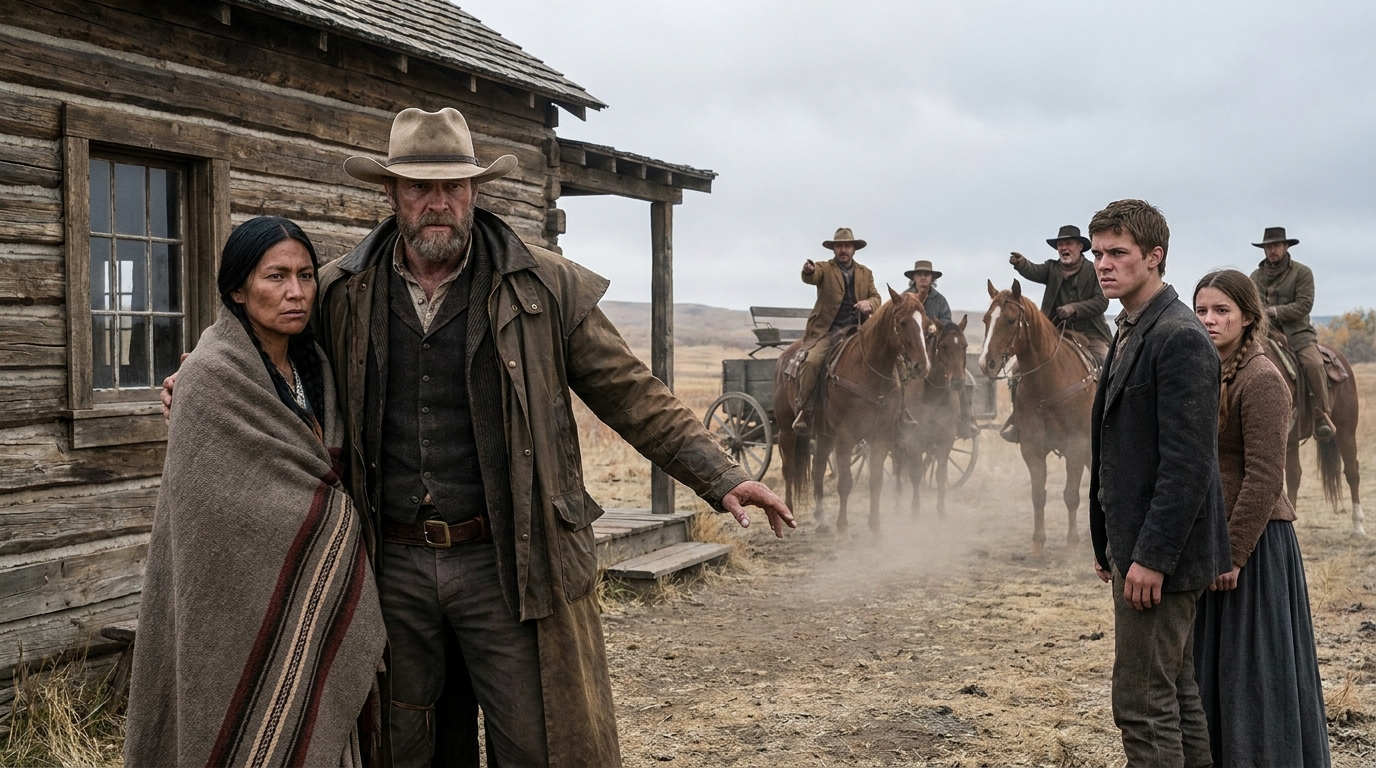
The horses did not slow down at the gate. They came hard through the white, four riders hunched low, and the sound hit the kitchen windows like gunfire.
Anna did not flinch. She pulled Lily behind her and looked straight at Eli.
“They are the same men,” she said. “The ones who shot Thomas. I know the lead horse. It has a white stocking on the left front.”
Tom Whitaker went pale. “Lord help us.”
Samuel grabbed the rifle above the fireplace. Evelyn stood up so fast her chair tipped over. For a second everyone in that kitchen was exactly what fear makes us, alone.
Eli did something he had not done in nineteen years. He reached out and took Anna’s hand in front of all of them. His palm was rough, hers was cold, and he held on.
“We are not fighting them in the open,” he said. “Anna, show us.”
That was the moment he chose her publicly. Not with a speech, with an action.
Anna nodded once, squeezed his hand, and let go. “We go now. Single file. No lanterns. Follow my feet, not your eyes.”
Evelyn opened her mouth to argue. Eli looked at his mother. “Mother, you can stay and explain to those men why you are alone, or you can trust the woman you told me to throw out.”
Evelyn’s lips trembled. She picked up her shawl. That was her first consequence, having to follow the very woman she had condemned.
They went out the back into a wall of snow. Samuel carried Tom’s infant son because Tom’s arm was useless, then Tom, then Evelyn leaning on a walking stick. The wind tried to push them over. You could not see five feet ahead.
Anna did not guess. She counted paces to the old lightning-split pine, turned left at the frozen creek where the ice sang, kept the ridge to her right shoulder. She had learned this trail from Thomas when she was a girl. She moved like someone walking home.
Half a mile in they found the Millers. The family of five was huddled against their overturned wagon, the mother holding a baby that was not crying anymore. The father was shouting for help that could not hear him.
Samuel yelled, “We cannot stop!”
Anna stopped anyway. She knelt in the snow, took off her own wool coat, the one Eli had mended, and wrapped the Miller baby. She showed the mother how to breathe warm air into the child’s mouth, how to tuck pine boughs inside their coats for insulation. She spoke calm and sure, and the baby coughed, then wailed.
That wail broke Samuel.
He had spent nineteen years hearing stories about his sainted mother Grace. He had spent three weeks hating Anna for trying to take her place. In that moment he watched an Apache widow give her own heat to a white baby in a blizzard while the town that called her a threat stood by and watched.
He dropped to his knees in the snow next to her and helped hold the boughs. He did not say sorry yet. His hands said it.
They got the Millers up and kept moving, now twelve people in a line.
The box canyon behind Red Rock is a place most settlers do not believe exists until they see it. The walls rise straight up a hundred feet and cut the wind completely. Hot springs run along the base and steam rises off the water even in January. The ground stays soft. Thomas had shown it to Anna years ago and told her, “If the white winter ever comes, bring our people here.”
They stumbled in just as dark fell. The steam hit their frozen faces like a blessing. People fell to their knees and wept. Children who had not spoken in hours started to laugh at the warm water.
Eli turned in a slow circle, looking at the families his town had said would die, all alive because of the woman they told him to hate. He felt something crack open in his chest, something that had been locked since he put Grace in the ground.
The thieves found the trail an hour later. They rode into the canyon mouth thinking they had cornered easy prey. Four men with rifles, faces wrapped in scarves.
The lead rider, the one on the horse with the white stocking, shouted, “Carter! We know you are hiding them Indians in here! Send them out and we leave the rest of you alone!”
Eli stepped forward, rifle up. So did Tom, and two other ranchers. But Anna walked past all of them. She walked into the open, alone, with her hands empty.
“You killed my husband at South Pass,” she said, her voice carrying off the stone walls. “You shot him in the back while he carried medicine for your own sick children. I know your face, Caleb Boone.”
The rider pulled his scarf down. It was Caleb, a local man everyone thought was honest.
The canyon went dead quiet.
“You burned our camp because Thomas would not sell you whiskey to trade illegally,” Anna continued. “You told the town Apache did it. You have been stealing cattle all autumn and blaming my people.”
Caleb raised his rifle. “Shut your mouth, squaw.”
Eli moved to shoot. Anna put her hand up to stop him. She did not beg. She stood tall.
“You will have to shoot me in front of these witnesses,” she said. “In front of the pastor’s wife. In front of Evelyn Carter. In front of children. Then everyone will know who you are.”
Caleb hesitated. That hesitation cost him.
Samuel, who had been standing behind a rock with Lily, threw a heavy branch into the hot spring pool. The water exploded into steam, a white cloud that blinded the riders for three seconds. In those three seconds Eli and Tom tackled two men off horses. The other two panicked, their horses rearing on the slick rock.
It was over fast and messy and nobody died, which was Anna’s doing because she kept shouting, “Do not kill them! Let the law see them!”
They tied the thieves with their own ropes and sat them by the spring where everyone could watch them.
That night, with the storm still howling outside the canyon walls but warm inside, Pastor James asked everyone to gather. Twelve families, cold, hungry, alive.
Evelyn Carter stood up slowly. Her hands shook. She looked at Anna, who was holding Lily asleep in her lap.
“I told my son he dishonored his wife by sheltering you,” Evelyn said, and her voice broke. “I told Grace for seven years she was failing because she could not give me a grandson. I watched that girl die trying to meet my expectations. And I have spent nineteen years polishing her memory into a weapon to keep my son lonely.”
She turned to Eli, tears running down her lined face. “I was wrong about Grace. And I was wrong about you, Anna. You did not come to replace her. You came to finish what she started, keeping this valley’s children alive.”
That was her consequence, to confess her cruelty in front of the town she had led in gossip.
Then Eli stood. He had not planned words. He just spoke from the place that had been stone.
“Three years ago I stopped smiling because I thought loving again would be betrayal,” he said. “Grace’s last words to me were, promise me you will let yourself live. I broke that promise for nineteen years.”
He looked down at Anna. “This woman mended my coat when I would not speak to her. She calmed my horses when I was too proud to ask for help. She put salve on hands I pretended did not hurt. She led your wives and babies through a whiteout while you called her a threat. She is not my dead wife. She never will be. Love after loss is not betrayal. It is obedience to the ones we buried.”
He reached down and took Anna’s hand again, this time and held it up where everyone could see. “If you have a problem with her being on my land, you have a problem with me.”
No one spoke. Tom Whitaker, his arm bandaged, stood and nodded once. Then the Millers. Then the pastor. One by one.
Samuel was last. The nineteen-year-old boy who had worshipped a photograph walked over to where Anna sat and dropped to his knees in the warm dirt. He did not care who saw.
“I thought you were trying to erase my mother,” he sobbed, his head bowed. “Tonight I watched you save Tom’s baby the way I wish someone could have saved her. I am so sorry. I am so ashamed.”
Anna put her free hand on his hair, the way a mother does. “Grief makes us cruel to protect our love,” she whispered. “Your mother would be proud of the man who carried a baby through a storm.”
Samuel broke. He cried like the newborn he once was, and Lily put her small hand on his back, and Eli put his hand on his son’s shoulder, and for the first time in three years, Eli Carter smiled, and it reached his eyes.
The storm broke two days later. The sheriff rode in and took the thieves away in chains. Caleb Boone confessed to killing Thomas and to the raids. The town listened.
Spring came late that year, but it came.
They did not have a big wedding. That was not the story. One warm afternoon in May, Eli took Anna and Samuel and Lily out to the small fenced plot on the hill where Grace was buried. Wildflowers were growing over the stone.
Eli knelt and brushed dirt off the name.
“Grace,” he said quietly, “I kept my promise. I am living. This is Anna. She is not you. She is the woman who taught me I could love again without letting go of you. And this is Lily. And you know Samuel.”
Anna stepped forward and laid a small bundle of sage on the grave, a sign of respect from her people. “Thank you for raising a good man,” she said. “I will help take care of what you loved.”
Samuel put his arm around Lily’s shoulders. Evelyn, who had come up the hill slowly, laid a knitted blanket she had made for Lily on the fence post.
They stood there, two families made from loss, not replacing each other, just making room.
By summer the valley did something it had never done. At the Founder’s Day picnic, Pastor James called Anna Carter-Whitethorn to the front, using both her married names to honor both her husbands, and presented her with a quilt every woman in town had sewn a square for. In the center square Evelyn had embroidered in shaky stitches: “The woman who saved Redstone.”
The town that once whispered “squaw” now stood and clapped until their hands hurt.
That night on the porch of the north cabin, which was no longer the guest cabin but their home, Eli sat in his rocking chair with his hands, no longer aching, wrapped around a coffee cup. Anna sat next to him mending a shirt. Lily and Samuel were in the yard teaching each other to throw a rope.
Eli looked over at Anna and smiled, that real deep smile.
“What?” she asked.
“Nothing,” he said. “Just thinking how the cowboy who buried his wife thought his life was over. Turns out it was just waiting for the Apache widow he was told to hate.”
Anna leaned her head on his shoulder. “You were told to hate me.”
“I was told a lot of foolish things,” Eli said. “I am done listening.”
And up on that hill, under the Wyoming sky, I like to think Grace heard him and finally rested easy.
The end.
Reader question: At what exact moment did you feel Eli stopped guarding grief like a promise and started finally letting himself live again?**
Leave a Reply