
Free reader powered by your browser. Available voices may vary by device.
Apache Love Story: She Loved the Warrior They Wanted Dead.
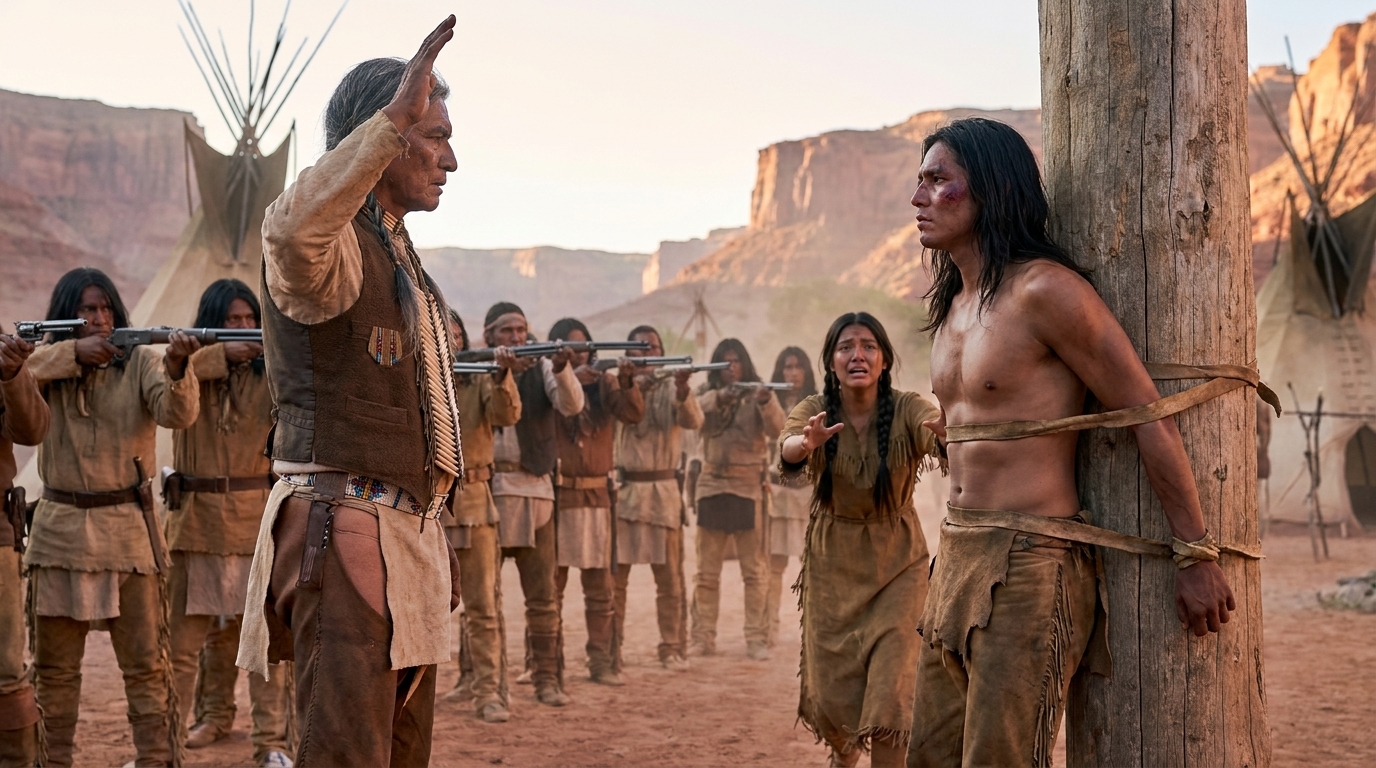
They had my Thomas tied to the cottonwood post at sunrise, his wrists raw and bleeding from the rawhide, his shirt torn open, and twelve rifles pointed straight at his chest. The whole camp was silent except for the wind moving through the canyon. My own father, Samuel, stood in front of him with his hand raised, ready to drop it and give the order to fire. I screamed his name and pushed through the crowd, and Thomas lifted his head just enough to look at me. He didn’t beg. He didn’t cry. He just mouthed one word to me, “don’t.”
My heart broke right there in the dust.
If this is your first time hearing one of my stories, welcome. Please take a second to like this video and subscribe to the channel, because these are the true-feeling stories of the old west they don’t teach you in school. I need you to stay with me till the very end of this one, because what I found that morning changed everything our people believed. Comment below and tell me where in the world you’re listening from, and tell me honestly, would you have run into those rifles for the man you loved?
My name is Grace, and I was the quiet daughter of a respected elder. I wasn’t loud, I wasn’t pretty like the other girls, I just wanted four simple things my whole life. To be loved. To be respected. To finally become a mother. And to survive all of it without losing who I was inside.
I met Thomas when I was seventeen. Our band lived in the red rocks of Arizona Territory, in 1878, when the Army was everywhere and every sunrise felt dangerous. Thomas was twenty, the son of Ruth, a woman everyone feared. He was brave in a way that wasn’t loud. He didn’t brag after raids. He came back and checked the horses first, then the old people, then the children. He taught me how to hold a rifle without flinching. He taught me how to ride bareback through the wash without fear.
Our early days were simple and good. We married under the cottonwood in the spring. He built us a small brush hut behind his mother’s, and he promised me, “Grace, we will fill this place with children.” I believed him. I wanted to be a good wife so badly it hurt. I cooked, I hauled water, I learned the healing herbs from the old women. I thought if I was faithful and quiet and strong, love would be enough.
It wasn’t.
After two years with no baby, his mother Ruth started her war on me. She would stand in front of the other women at the fire and say loud enough for me to hear, “Some women are born empty. They take a man’s strength and give nothing back.” She humiliated me every single day. She told Thomas I was a curse. She told my father Samuel that our family was weak. The pressure in our camp to have sons was like a knife at your throat.
Then Ruth brought Clara into our home.
Clara was nineteen, a widow whose husband had died of fever. She was pretty, she was loud, and she knew how to please the elders. Ruth announced at council that Thomas would take Clara as a second wife, so our bloodline would not die with a barren woman. I sat there while my own husband looked at the ground and said nothing. That was the first time Thomas became my enemy too, not because he didn’t love me, but because he wouldn’t fight for me. He told me that night, “Grace, it’s easier if you accept it. Don’t make this harder.” He chose peace with his mother over respect for his wife.
I felt rejection like I’d never known. I was living in the same hut, sleeping on the same mat, but I was invisible. Clara moved in within a week. She got the new blankets. She got the seat next to Ruth at meals. She got the smiles. I got the chores and the silence. But I did not lose myself. I prayed every night, not for Thomas to love me again, but for God to show me who I really was if I wasn’t going to be a mother.
Then came the ambush at Dry Creek.
Our men went out to meet with an Army captain who promised peace talks. Twelve of our best warriors went, including my younger brother Daniel. Thomas was their scout. They rode out at dawn. Only Thomas rode back at dusk, his horse lathered, his arm bleeding, his eyes wild. Behind him, soldiers dragged the bodies on travois.
Twelve men dead. My brother Daniel was one of them.
The camp went mad with grief. And in grief, people need someone to blame.
Ruth was the first to point her finger. She stood over Daniel’s body and screamed, “He led them into it! My own son sold us to the bluecoats!” Clara, the new wife, started crying and told the council she had seen Thomas talking to two soldiers near the spring three days before. She swore it on her dead husband’s name.
My father Samuel, who was supposed to be a man of wisdom, listened to the mothers wailing and made a fast judgment. He declared Thomas a traitor to the people. They stripped his rifle, his knife, his name. They locked him in the old goat pen to be executed at sunrise.
Even my own family warned me to stay away. My mother grabbed my arm and said, “Grace, you have shamed us enough by being empty. Do not shame us by loving a traitor. Let him die.” My father said if I went to him, I would be exiled with him.
But I knew the man I married. I had watched him come home with fever to carry water for the elders. I had watched him risk his life for a lost child in a snowstorm. A traitor does not do those things. A traitor does not look at you the way Thomas looked at me when he thought no one was watching.
So that night, while Clara slept in my husband’s bed and Ruth stood guard at the council fire, I risked everything. I snuck to the goat pen with a gourd of water. The guard was my cousin, and he turned his back for me.
Thomas was broken. His face was bruised. When he saw me, he didn’t smile. He got angry. “Grace, why are you here? Do you want to die with me? Go back. Go be with your family. Forget me.”
That was the pain that cut deepest. Not the rifles, not Ruth, not Clara. My own husband telling me to leave him to die alone.
I grabbed his face through the poles. “I will not forget you. I will not let them kill you for something you didn’t do. Tell me what happened at Dry Creek.”
He shook his head. “We were set up. Someone told the soldiers exactly where we would stop to water the horses. Exactly what time. They were waiting behind the rocks. It was not a fight, Grace. It was a slaughter. Only someone at the council fire could have known.”
Someone at the council fire. That meant my father Samuel. That meant Ruth. That meant Jacob, the chief’s son. That meant Clara, who always sat and listened.
I left him water and I made a promise I wasn’t sure I could keep. I would find the truth before sunrise.
I went back to our hut. Ruth and Clara were asleep. I started searching, not like a jealous wife, but like a woman fighting for her life. In Ruth’s parfleche trunk, under her beaded dresses, I found something that made my blood go cold. A brand new US Army pocket watch, silver, engraved with the initials “J.T. – 7th Cavalry.” And wrapped in cloth next to it, a piece of blue Army coat, still stained with dark blood.
Ruth had never owned anything from the soldiers. She hated them more than anyone.
My hands were shaking. I put it back and went to Clara’s side of the hut. Under her sleeping mat I found a small bundle of letters. I can’t read the white man’s writing well, but I recognized the Army seal at the bottom. And I recognized the drawing, a rough map of Dry Creek, with an X where our men watered their horses.
Clara wasn’t just a new wife. She was a listener. A messenger.
I took the map and ran to my father’s lodge. I shook him awake. I showed him what I found. I begged him, “Father, you are about to kill an innocent man. Look! The real traitor is sleeping in his hut!”
Samuel looked at the map, then at me, and his face went hard. He didn’t look surprised. He looked scared. He grabbed my wrist so tight it bruised. “Grace, you will say nothing about this. Do you hear me? You will go back to your hut, you will keep your mouth shut, and you will let justice happen in the morning. If you speak one word, I will banish you myself. You will never be respected in this camp. You will never be a mother here. You will die alone in the desert.”
My own father threatened me to protect a lie.
That was the moment I understood. The real betrayal wasn’t about Thomas at all. It was about power. It was about land deals the elders were making with the Army. Twelve men, including my brother, were sacrificed so that Samuel and Ruth could keep their position.
I ran out into the dark, the map clutched to my chest. I went back to the goat pen. The guard was gone. The pen was empty. Thomas had escaped, or someone had taken him.
I followed the drag marks in the sand out past the canyon, toward the salt flats where they sometimes did killings in secret. The moon was high. I was alone, a woman with no child, no husband’s protection, no family’s love, chasing the only truth I had left.
About a mile out, I found his broken rifle in the sand, the stock carved with the little bird he always made for me. Next to it was a fresh boot print, not moccasin, Army boot. And dropped beside it, half-covered, was the silver pocket watch from Ruth’s trunk, ticking.
He was alive. And whoever took him had just been here.
I picked up the watch and stood up, and that’s when I heard horses behind me. I turned, my heart in my throat, thinking it was Thomas.
It wasn’t.
It was Ruth and Clara, both on horses, both with rifles aimed right at my chest. Ruth’s face was twisted with hate. Clara was smiling.
Ruth cocked her rifle and said, “We knew you were too stupid to stay quiet, Grace. We weren’t going to let you ruin this for us.”
They weren’t there to save Thomas.
They were there to make sure I never told anyone what I’d found.
The rifle didn’t waver. Ruth had it aimed right at my heart, and in the moonlight I could see her finger turning white on the trigger. Clara sat beside her on her pony, holding her own rifle lower, but smiling like this was a game she had already won.
Ruth said, “Drop that watch, Grace. Drop the map. You were always a quiet little mouse. Be quiet now, one last time.”
If you stayed with me, thank you. This is the part where everything turns, so please stay till the very end. I need you to hear how a woman who was called empty and barren and cursed finally got her respect back.
I didn’t drop anything. I held that silver pocket watch up so it caught the moon. It was still ticking. Tick. Tick. Tick. Like a small heart in my hand.
“I know what you did,” I said, and my voice didn’t shake the way I thought it would. “You sold our men at Dry Creek for this watch and for Army flour. You told the soldiers where to wait. My brother Daniel died because of you. Thomas almost died because of you.”
Clara’s smile slipped. Ruth spat in the sand. “You don’t know anything about survival, girl. You couldn’t even give my son a baby. The Army captain promised us protection if we gave him the war chiefs. It was supposed to be a clean trade. Twelve men for the lives of the rest of us. Your father agreed. It was wisdom.”
Wisdom. She called the murder of my brother wisdom.
That was when I heard the rock slide behind them. Thomas came up out of the arroyo like a ghost, bleeding from his temple, his hands still raw from the rawhide, holding nothing but a heavy stone. He didn’t yell. He just swung that stone into the side of Clara’s horse. The horse reared. Clara screamed and her rifle went off wild into the sky.
Ruth turned her rifle toward him, and I threw myself forward. I didn’t think. I hit her leg with my shoulder. The rifle fired. The bullet burned past my cheek so close I felt the heat, and slammed into the sand.
Thomas was on her in one second. He pulled her off the horse and wrestled the rifle away. He was weak from being tied up all night, but he was angry in a way I’d never seen. Not the quiet brave Thomas who checked the horses. This was a man fighting for his wife’s life.
We got them both on the ground. My cousin Eli, the guard who had let me see Thomas earlier, came running over the ridge. He had cut Thomas loose after my father ordered the secret killing. He helped us tie Ruth’s hands with her own shawl, and Clara’s with a piece of rawhide.
Clara was crying now, real tears. “Ruth made me do it! She said if I carried the messages to the soldier camp, Thomas would be made a chief and I would be his first wife! She promised me!”
Ruth just stared at me with pure hate. “You ruined everything. You were supposed to stay in that hut and be nothing.”
Thomas looked at his mother, and his face broke. That was his painful consequence. Not a beating, not a bullet. Watching the woman who gave him life confess she traded other mothers’ sons for safety. He didn’t hit her. He just said, “You let them tie me up to hide yourself.”
We walked them back toward camp as the sun was coming up, the same sunrise they had planned to kill him in. I carried the watch, the map, and the piece of blue Army cloth. Thomas walked beside me, not in front of me, not behind me. Beside me.
The whole tribe was already gathered at the cottonwood post, waiting for an execution. My father Samuel stood there with his hand raised again, ready to lie to his people.
When they saw us coming, dragging Ruth and Clara tied up, the crowd went silent.
Samuel shouted, “What is this?”
I walked into the middle of that circle, into the dust where my husband was supposed to die. My legs were shaking, but I did not lose myself. I had spent two years trying to be loved by being quiet. I spent two years trying to be respected by being obedient. I spent two years praying to become a mother while they called me empty. That morning I decided I would survive by speaking.
I held up the watch. “This belongs to Captain J.T. of the 7th Cavalry. I found it in Ruth’s trunk.”
I held up the map. “This is Dry Creek, drawn in white man’s ink. I found it under Clara’s sleeping mat.”
I held up the blue cloth. “This is Army wool, stained with my brother Daniel’s blood. It was wrapped with the watch.”
Then I pointed at my own father. “And Samuel, my father, knew. He told me to keep my mouth shut or be banished.”
The people gasped. Jacob, the chief’s son, stepped forward. He said, “I saw Clara riding to the soldier fort three nights before the ambush. I thought she was visiting her cousin.”
Ruth tried to stand tall even with her hands tied. “I did it for us! The Army was going to burn our winter camp! The captain said give us the names of the fighters and he would let the women and children live! It was a trade!”
Thomas stepped forward then, his voice raw. “A trade? You traded twelve of our men, including Grace’s brother, for flour and a watch? And then you let them blame me? Your own son?”
Clara was sobbing into the dirt. “She told me Thomas would be spared if I helped. She lied.”
My father Samuel fell to his knees. He didn’t beg for his life. He just looked at me and said, “I was afraid of losing my place as elder. Forgive me.”
That was the moment the tribe turned. Not with rifles this time, but with truth.
The council did not kill Ruth and Clara that day. Our people don’t kill women, even traitors. They did something worse for women like them who lived for status. They were shaved, they were stripped of their beads, and they were banished from the red rocks forever. They were given one skin of water and told to walk to the Army fort that they loved so much. No one would speak their names again in our camp.
Ruth screamed for Thomas as they led her away. He did not answer. He just held my hand.
That was her painful consequence. To lose her son, her home, and her honor in front of everyone she had humiliated.
Clara looked back at me once. I felt no joy, only pity. She had wanted to be first wife so badly she sold her soul for it. She got exactly what she chased, nothing.
My father Samuel was removed as elder. He was made to sit with the old men and tend the fire for the rest of his days, never to speak at council again. He lived, but he lived small. That was his consequence.
And Thomas? My husband, the warrior they wanted dead? He stood in that circle, bruised and bleeding, and did something no man in our band had ever done. He turned to the people and said, “I was wrong.”
He looked at me. “Grace, I let my mother bring another woman into our hut because I was a coward. I told you to accept it because it was easier for me. I told you to leave me in that pen because I thought you were weak. I was wrong about everything. You are not empty. You are the strongest person I know. If you will still have me, I will spend my life earning back your respect.”
The women who had called me barren started crying. The men who had raised rifles to kill him lowered their heads.
I finally got what I had prayed for since I was seventeen. Not because I begged for it. Because I stood up.
To be loved? Thomas loved me that day in front of everyone, not in secret.
To be respected? The chief’s wife put her own turquoise necklace around my neck and called me sister.
To survive without losing myself? I walked into that desert a quiet mouse, and I walked out still Grace, but a Grace who knew her own voice.
We left Ruth’s old hut that week. Thomas built us a new one by the cottonwood creek, far from his mother’s shadow. We worked side by side. We laughed again.
And to finally become a mother? That part took a little longer, and it didn’t happen the way I expected.
Three moons after the banishment, Eli’s sister died of fever, leaving a newborn baby girl with no one to feed her. The council brought her to me, the woman they once called empty. They asked if I would take her.
I took that baby into my arms, and she stopped crying the second she heard my heartbeat. We named her Hope. Not because life was easy, but because we had earned it.
A year later, I gave birth to a son of my own. Thomas held my hand the whole time and whispered, “You see? You were never cursed.”
Now our little house by the creek is full of noise and feet and life. My father Samuel comes and sits by our fire in the evenings. He doesn’t speak much, but he carves little wooden birds for his grandchildren, the same birds Thomas used to carve for me. Sometimes I catch him watching me with Hope on my hip, and I know he is asking for forgiveness without words. I give it to him, because I survived without becoming bitter.
Ruth and Clara? We heard later that the Army turned them away at the fort. They live now in a border town, washing soldiers’ laundry for coins. They got the protection they traded for. Just not the honor.
This is why I tell you my story. I was the quiet daughter who just wanted to be loved. They tried to shame me for not being a mother, they tried to silence me for loving the wrong man, they tried to kill the only man who ever saw me. But truth is louder than rifles in the end.
If you are listening to this and you feel empty, or rejected, or like your own family has turned against you, I want you to remember Grace from the red rocks. Speak, even if your voice shakes. Stay, even when they tell you to leave. Love, even when they call you a fool for it.
Thank you for watching till the end. I read every comment, so tell me where you’re listening from and tell me what part of this story hit your heart the hardest. And if you want more old west stories told the way they really felt, please like this video and subscribe. I will see you on the next one.
My Thomas is calling me in for supper now, and Hope is trying to steal the bread. I have to go be a mother.
Reader question: At what exact moment did you feel Grace stopped surviving other people’s judgment and started standing fully inside her own worth?**
Leave a Reply