
Free reader powered by your browser. Available voices may vary by device.
The Sheriff Arrested His Own Son… But What Happened Next Broke the Entire Town.
The Sheriff Dropped His Gun When the Outlaw Took Off His Hat
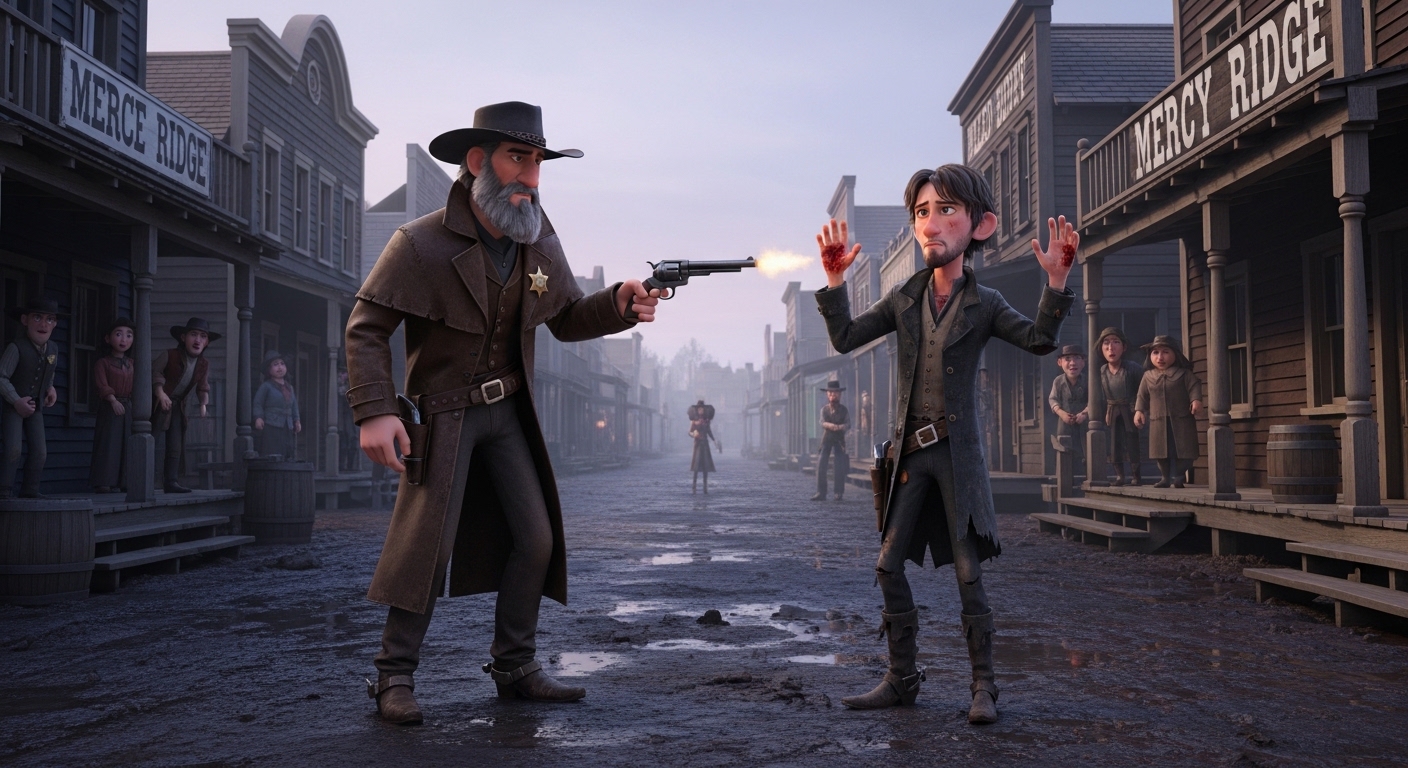
The sheriff had his gun pointed at the outlaw’s chest.
One shot had already been fired.
Smoke still floated in the cold morning air.
The outlaw stood in the middle of Mercy Ridge Street with his hands raised. His black coat was torn. His boots were covered in mud. Blood ran from a cut above his eye, but he did not wipe it away. He only stared at Sheriff Caleb Holt like a man who had been waiting for this exact moment.
Behind Caleb, the whole town was frozen.
Nobody moved.
Nobody breathed loud.
For seven years, this outlaw had robbed trains, stolen gold, and vanished into the mountains like smoke. Men feared his name. Mothers used his story to scare children at night. They called him the Winter Wolf, because he only struck when the weather turned cruel.
Now Caleb had caught him.
The great sheriff of Mercy Ridge had finally caught the man no one else could stop.
But something felt wrong.
The outlaw did not beg.
He did not curse.
He did not reach for another gun.
He only smiled, weak and sad, like he had lost everything before Caleb ever found him.
Caleb stepped closer, his boots sinking into the wet dirt.
“Take off your hat,” Caleb said.
The outlaw’s fingers moved slowly to the brim.
The town leaned forward.
The hat came off.
And Sheriff Caleb Holt dropped his gun.
Because the outlaw was not a stranger.
The outlaw was his son.
Jonah Holt.
The boy who had been missing for fifteen years.
The boy Caleb had buried in his heart.
The boy Caleb had told everyone was dead.
For one long second, nobody in Mercy Ridge made a sound.
Then Jonah looked at his father and whispered, “Hello, Pa.”
Before we continue, if you enjoy emotional Wild West stories like this, please subscribe to my channel, like this story, and comment where you are listening from. Are you driving, working, resting, or listening at night? Share this story with someone who loves powerful family stories, because what happens next will not leave your heart quickly.
Caleb could not move.
His hand shook beside his empty holster. His eyes stayed on Jonah’s face, searching for the little boy he once knew. The boy with bright eyes. The boy who used to run barefoot through the yard. The boy who called him Pa like it was the safest word in the world.
But this man in front of him was thin, tired, and marked by hard years.
Jonah had a scar from his cheek to his jaw.
His beard was rough.
His eyes looked older than thirty-two.
And still, Caleb knew him.
A father knows.
Even when years have changed the face.
Even when sin has changed the hands.
Even when shame stands between them like a wall.
Deputy Amos Reed stepped beside Caleb. Amos was Caleb’s only deputy, a quiet man with a kind face and a nervous hand.
“Sheriff,” Amos said softly, “what do we do?”
That question cut Caleb deeper than any bullet.
What do we do?
The town wanted justice.
The law wanted a hanging.
Caleb’s badge wanted one thing.
His heart wanted another.
Jonah lowered his hands a little, but Amos raised his rifle.
“Hands up,” Amos warned.
Jonah obeyed.
He did not look at Amos.
He looked only at Caleb.
“I came back,” Jonah said.
Caleb swallowed hard. “Why?”
Jonah’s mouth opened, but no answer came out.
Then a woman’s voice cried from the wooden walkway.
“Sheriff, lock him up!”
That voice broke the silence. Others joined it.
“He robbed my brother’s train!”
“He killed men!”
“He stole from this town!”
“Hang him!”
The words hit Caleb from every side.
Jonah stood still in the middle of the anger.
Caleb bent down, picked up his gun, and forced his voice to become hard.
“Jonah Holt,” Caleb said, and the name shook as it left his mouth, “you are under arrest.”
Jonah closed his eyes.
For a strange moment, he looked relieved.
That scared Caleb more than the shouting.
Because no outlaw should look relieved when chains are coming.
Amos stepped forward and tied Jonah’s wrists. The iron cuffs clicked around Jonah’s hands. That sound made Caleb think of a door closing forever.
Jonah’s face twisted with pain, but not from the cuffs.
He coughed into his shoulder.
It was a deep cough.
A wet cough.
Caleb noticed a dark stain on Jonah’s sleeve when he lowered his arm.
Blood.
Caleb saw it.
Jonah saw Caleb see it.
And Jonah quickly hid his sleeve behind his back.
Caleb’s chest tightened.
“What happened to you?” Caleb asked under his breath.
Jonah gave him that same sad smile.
“Winter happened, Pa.”
Caleb’s face went pale.
Because that word carried a memory he had tried to bury for fifteen years.
Winter.
Not just any winter.
The winter Jonah disappeared.
But Caleb could not speak of it in the street. Not with the town watching. Not with men already tying a rope in their minds.
So Caleb turned to Amos.
“Take him to the jail.”
Amos nodded and pulled Jonah forward.
Jonah stumbled once.
Caleb almost reached out to catch him, but he stopped himself.
The whole town was watching.
If Caleb acted like a father, they would say he was weak.
If Caleb acted like sheriff, he would break his own blood.
So Caleb walked behind Jonah with his gun in his hand and his heart in pieces.
Every step to the jail felt longer than the last.
People followed at a distance.
Not close enough to touch.
Close enough to judge.
The jail sat at the end of the street, small and gray, with two cells and one back room. Caleb had locked many men inside those bars. Drunk men. Thieves. Killers. Men who cried. Men who laughed. Men who spat in his face.
But never his son.
Amos opened the cell door.
Jonah stepped inside.
The door shut.
The key turned.
And the sound nearly made Caleb fall.
Amos looked at Caleb with pity.
“I’ll stand outside,” Amos said.
Caleb nodded.
When Amos left, the room became too quiet.
Only Caleb and Jonah remained.
Father and son.
Sheriff and outlaw.
Law and blood.
Jonah sat on the narrow cot. He looked smaller now, like the bars had pulled the strength out of him. Caleb stood outside the cell, not knowing if he wanted to shout, cry, or unlock the door.
Jonah looked around the jail.
“Same place,” he said softly. “You used to let me sweep this floor for a penny.”
Caleb’s throat tightened.
“Don’t do that.”
“Do what?”
“Don’t talk like we are still family.”
Jonah looked at him. “Are we not?”
Caleb gripped the cell bars. “You robbed trains, Jonah.”
“Yes.”
“You shot men.”
“I shot back.”
“You made this town fear the dark.”
Jonah nodded. “I know.”
“Then why are you here?”
Jonah looked down at his cuffed hands.
“To tell you what happened.”
Caleb laughed once, but there was no joy in it.
“What happened? You vanished. Your mother cried herself sick. I searched until my horse nearly died. Then years later, a criminal rose in the hills. And now I find out that criminal is my son.”
Jonah’s eyes sharpened.
“You searched?”
Caleb stepped back like he had been struck.
“What?”
Jonah stood slowly.
“You searched for me?”
Caleb stared at him.
“Of course I did.”
Jonah’s face changed.
For the first time, real anger came through.
“No,” Jonah said. “No, you did not.”
Caleb’s voice dropped. “Be careful.”
Jonah stepped closer to the bars.
“I was seventeen, Pa. Seventeen. Ma was dead. The ranch was failing. You blamed me for every empty plate and every dead cow. Then came the storm. You remember?”
Caleb’s jaw tightened.
Yes.
He remembered.
And now the past opened like an old wound.
Before Jonah Disappeared
Fifteen years before, Caleb Holt was not yet the gray-haired sheriff people respected. He was a rancher with a badge in his drawer and debt on his land. He had a wife named Mary, gentle and strong, with dark hair and a laugh that could soften even hard days.
Caleb had met Mary outside a church in a town two counties away.
She had been carrying a basket of apples.
Caleb had been trying to act brave in front of his friends.
A wheel broke on Mary’s wagon, and apples rolled across the dirt. Caleb picked them up one by one, but Mary caught him staring and smiled.
“You planning to help,” she asked, “or just fall in love with my apples?”
Caleb had turned red.
Mary laughed.
That was how it started.
Not with thunder.
Not with a gunfight.
Just apples in the dust and a smile Caleb never forgot.
Caleb visited that town every Sunday after that. At first, he said it was for supplies. Then he stopped lying. He brought Mary small gifts. A blue ribbon. A tin cup. Once, a wildflower pressed inside a book because he had no money for anything better.
Mary loved it more than gold.
They married in spring.
Caleb built their first home with his own hands. It had a crooked porch, a leaking roof, and one room that smelled of fresh wood. Mary called it a palace. Caleb called her crazy. But when she danced barefoot on that porch, Caleb believed her.
Then Jonah was born.
Mary held him by the window and cried quietly.
Caleb thought something was wrong.
Mary smiled through tears and said, “No, Caleb. I am just happy.”
For years, they were poor but warm.
Mary cooked beans and cornbread.
Caleb worked the land.
Little Jonah chased chickens, climbed fences, and followed Caleb everywhere.
At night, Caleb told Jonah stories about brave men and honest work. Jonah would sit wide-eyed, holding a wooden toy horse Caleb carved for him.
“Will I be brave like you, Pa?” Jonah asked once.
Caleb lifted him high and said, “Braver.”
Those were good years.
But good years can die slowly.
First, the rain stopped.
Then cattle grew thin.
Then the bank came asking for money.
Then Mary got sick.
Caleb sold two horses for medicine that did not save her.
Mary died in winter with Caleb holding one hand and Jonah holding the other.
After Mary died, the house changed.
No songs.
No laughter.
No warm bread in the morning.
Only Caleb’s silence and Jonah’s grief.
Jonah tried to help.
He burned breakfast.
He patched fences badly.
He talked too much because the quiet scared him.
But Caleb saw Mary in Jonah’s eyes, and that made loving him hurt.
So Caleb worked longer.
Spoke less.
Drank more coffee.
Slept with his boots on.
And Jonah became a boy living beside a father who was still alive, but far away.
Then came the worst winter Mercy Ridge had seen in twenty years.
Snow buried the fences.
Cattle froze standing up.
Food ran low.
A group of men from the mountain pass came to Caleb’s door one night asking for shelter. Caleb said no. He had one son to feed and barely enough firewood.
But Jonah opened the barn for them anyway.
He gave them hay, water, and some of the last dried meat.
When Caleb found out, rage took him.
“You want us to starve?” Caleb shouted.
“They would have died!” Jonah shouted back.
“And we may die because of you!”
Jonah’s face broke.
Caleb saw it, but he did not stop.
“You are soft,” Caleb said. “Too soft for this land.”
Jonah whispered, “Ma would have helped them.”
That name changed everything.
Caleb slapped him.
The room went silent.
Jonah touched his cheek.
Caleb wanted to take it back at once.
But pride is a cruel lock.
So Caleb pointed toward the door.
“Go cool your head in the barn,” he said.
Jonah stared at him.
“In this storm?”
“Go.”
Jonah grabbed his coat.
Caleb told himself it was only for a few minutes.
Only until both of them cooled down.
But the storm grew worse.
The wind screamed.
The snow covered the yard.
By morning, Jonah was gone.
At first, Caleb thought the boy was hiding.
Then he saw the barn door open.
Horse tracks led toward the white hills.
Caleb rode after him.
For three days, he searched.
He found Jonah’s horse dead near a frozen creek.
He found the coat Mary had sewn for Jonah caught on a branch.
But he did not find Jonah.
After that, people said the boy must have died in the storm.
Caleb never said otherwise.
Because saying his son was dead was easier than saying he had sent him out.
Back in the Jail
Now, fifteen years later, Jonah stood behind bars.
And the past stood between them.
Caleb’s lips trembled.
“I searched,” Caleb said again, but softer now.
Jonah’s eyes were wet, but hard.
“You found my coat,” Jonah said.
Caleb went still.
“How do you know that?”
“Because I left it where you could find it.”
Caleb stared.
Jonah’s voice dropped.
“I wanted to see if you would keep looking after you found it.”
Caleb whispered, “I did.”
Jonah shook his head.
“No. You stopped after three days.”
Caleb’s hand tightened around the bars.
“I thought you were dead.”
“I wasn’t dead,” Jonah said. “I was in a hunter’s shack ten miles north with frostbite in my feet and fever in my head. I waited for you. Every sound outside, I thought it was you. Every morning, I told myself, Pa will come today.”
Caleb could not breathe.
Jonah kept his eyes on the floor.
“But you did not come.”
Caleb’s voice cracked. “I did not know.”
Jonah turned back fast.
“You did not want to know!”
The words filled the jail like a gunshot.
Outside, the town was still murmuring. Caleb could hear boots on the walkway. He could hear men talking about court, rope, justice, and blood.
Inside, Caleb was back in that winter.
Back in the house.
Back at the door.
Back watching his son walk into snow.
“What happened after the shack?” Caleb asked.
Jonah sat again, suddenly weak.
“A man found me. Not a good man. His name was Silas Boone. He was a thief, but he kept me alive. He fed me. He taught me how to shoot. He taught me how to take from trains. He said the world had already taken from me, so I had the right to take back.”
Caleb closed his eyes.
Silas Boone.
That name was poison.
Silas had led the first train robberies in the hills before the Winter Wolf ever appeared.
Caleb had hunted Silas for years too.
“Where is Silas now?” Caleb asked.
“Dead.”
“By whose hand?”
Jonah looked at him.
“Mine.”
Caleb stepped back.
Jonah did not smile.
“He started killing people who did not fight back. A young clerk. A mother with a baby. I told him no. He laughed. So I stopped him.”
Caleb tried to hold on to the anger.
He needed the anger.
Without it, all he had left was guilt.
“You still robbed trains after that.”
“Yes.”
“Why?”
Jonah looked at his hands.
“Because by then, I did not know how to be anything else.”
That answer was plain.
Too plain.
And it hurt because Caleb believed it.
A shout came from outside.
“Sheriff! We want him tried by sunset!”
Another voice yelled, “No special treatment because he is your blood!”
Caleb looked toward the window.
His town had trusted him for years.
They had voted for him.
They had brought him their troubles.
They had slept better because Caleb wore the badge.
If Caleb protected Jonah, he would lose everything.
His badge.
His name.
The town’s trust.
Maybe even peace in Mercy Ridge.
But if Caleb handed Jonah over, he might lose the last living piece of Mary.
Jonah coughed again.
This time he turned away too late.
Blood spotted the floor.
Caleb saw it clearly.
He moved closer.
“Jonah.”
“I’m fine.”
“You are coughing blood.”
Jonah wiped his mouth with the back of his hand.
“I said I’m fine.”
Caleb’s voice hardened. “Do not lie to me.”
Jonah laughed weakly.
“That is rich, Pa.”
Caleb flinched.
Jonah leaned back against the wall and closed his eyes. For a moment, the outlaw disappeared, and Caleb saw a sick boy trying not to scare anyone.
Caleb reached for the keys.
Then he stopped.
The law stood in his way.
So did the town.
So did fifteen years of pride.
Amos opened the jail door and stepped in.
“Sheriff,” Amos said, “they are gathering outside. The mayor is with them. They want a hearing today.”
Caleb turned. “Today?”
Amos nodded. “They say if we wait, folks will think you are hiding him.”
Jonah opened his eyes.
“Let them try me.”
Caleb looked at him sharply.
“What?”
Jonah’s face was calm.
“Let them try me. Let them hang me if that is what they want.”
Caleb felt cold.
“Why would you say that?”
Jonah looked at the small window, where gray light fell across the floor.
“Because I am tired.”
Caleb heard something behind those words.
Not just shame.
Not just defeat.
Something deeper.
Something Jonah was still hiding.
Amos shifted on his feet.
“Sheriff, there is more.”
Caleb turned to him.
Amos lowered his voice.
“When we searched his saddlebag, we found letters.”
Jonah’s head snapped toward Amos.
Caleb noticed.
“What letters?”
Amos looked unsure.
“Letters with your name on them.”
Caleb slowly faced Jonah.
Jonah’s jaw tightened.
“You read them?” Jonah asked Amos.
“No,” Amos said. “They were sealed.”
Caleb’s heart began to pound.
“How many?”
“Fifteen,” Amos said. “One for every year.”
The jail went silent.
Caleb looked at Jonah through the bars.
Fifteen letters.
One for every year his son had been gone.
Jonah had written to him.
Maybe every year.
Maybe every birthday.
Maybe every winter.
But Caleb had never received one.
“Where are they?” Caleb asked.
“In your office,” Amos said.
Caleb took one step toward the back room.
Jonah stood, gripping the bars.
“Do not read them.”
Caleb stopped.
His son’s voice had changed.
It was not anger now.
It was fear.
Real fear.
Caleb turned slowly.
“Why?”
Jonah’s face lost color.
“Because some truths are better left dead.”
Caleb moved closer.
“What truth?”
Jonah said nothing.
Amos looked between them.
Outside, the crowd grew louder.
Inside, the three men stood trapped by the past.
Then Caleb heard a sound from the street.
A horse running hard.
Fast.
Too fast for town.
Men shouted.
A woman screamed.
Amos rushed to the window.
“Sheriff,” he said, “someone is coming.”
Caleb stepped beside him.
A rider came through the mud, bent low over his horse. The man nearly fell as he reached the jail. His shirt was soaked with sweat. His face was white with fear.
Caleb knew him.
Eli Ward.
A train guard from the north line.
Eli stumbled off his horse and rushed into the jail without knocking.
“Sheriff!” Eli gasped. “You caught the wrong end of the snake!”
Caleb’s eyes narrowed. “Speak plain.”
Eli pointed a shaking finger at Jonah.
“He ain’t the worst one. The Winter Wolf gang is coming here tonight. They think he betrayed them. And they are bringing fire.”
Amos cursed under his breath.
The crowd outside went quiet as the words spread.
Caleb looked at Jonah.
Jonah lowered his head.
Caleb stepped closer to the cell.
“You knew.”
Jonah did not answer.
Caleb’s voice dropped to a whisper.
“You knew they were coming.”
Jonah finally looked up.
His eyes were full of pain.
“Yes.”
Caleb’s hand went to the bars.
“Why did you let me arrest you?”
Jonah’s lips trembled.
Before Jonah could answer, he coughed again.
Harder this time.
He fell to one knee.
Blood hit the floor.
Caleb grabbed the bars.
“Jonah!”
Jonah lifted his face slowly.
And then, in a broken voice, he said the words that stopped Caleb’s heart.
“Because I did not come back to run, Pa. I came back to die where you could see me.”
The Night Everything Turned
Caleb Holt stood outside the jail cell with both hands wrapped around the iron bars.
His son was on one knee.
Blood was on the floor.
And outside, the whole town had just heard that the Winter Wolf gang was coming to burn Mercy Ridge before nightfall.
For a moment, Caleb forgot the crowd.
He forgot the badge.
He forgot the law.
All he saw was Jonah, his missing boy, fighting for breath like every breath had thorns inside it.
“Amos!” Caleb shouted.
Deputy Amos Reed rushed forward.
“Get Doc Miller,” Caleb said. “Now.”
Amos hesitated. “Sheriff, the crowd—”
“Now!”
Amos ran out the door.
Jonah tried to stand, but his legs shook.
Caleb unlocked the cell without thinking.
The key scraped in the lock.
The door swung open.
Jonah lifted his head, surprised, like he had never expected his father to open anything for him again.
Caleb stepped inside and caught Jonah before he fell.
Jonah was too light.
That scared Caleb.
This was not the strong outlaw people feared. This was a sick man who had been riding on anger, pride, and one final wish.
“Why did you not tell me?” Caleb asked.
Jonah leaned against him, weak and cold. “Would you have listened?”
That question hurt because Caleb did not know the answer.
Outside, men were shouting now.
“He opened the cell!”
“The sheriff is helping him!”
“Caleb Holt has chosen blood over justice!”
Caleb heard every word. Each one was a stone thrown at his name. But for the first time in years, Caleb did not care about his name first.
He cared about the son breathing against his shoulder.
Jonah tried to pull away. “Don’t hold me like this. Not in front of them.”
Caleb gripped him tighter.
“I should have held you fifteen years ago.”
Jonah froze.
Those words did not fix anything.
They could not bring back the lost years.
But they broke something open.
Jonah’s face twisted, not with hate this time, but with pain he had carried too long.
Caleb helped him sit on the cot.
Then Caleb turned to the open jail door and shouted, “Everyone back!”
The mayor pushed through the crowd. Mayor Thomas Vale was a thin man with a silver watch and a sharp mouth. He cared more about order than mercy, and Caleb knew that look on his face.
“Sheriff,” Mayor Vale said, “step away from the prisoner.”
Caleb stood in the cell doorway.
“No.”
The town went quiet.
Mayor Vale blinked. “No?”
Caleb’s voice was firm. “This man is sick. He will be seen by the doctor.”
“This man is a criminal,” Mayor Vale said. “And now his gang is coming because of him.”
Jonah coughed behind Caleb.
Mayor Vale pointed at him. “You see? He brought danger to our door.”
A woman in the crowd cried, “My children are at home!”
A man shouted, “Hang him before they get here!”
Caleb stepped forward.
“If you hang him now, the gang still comes,” Caleb said. “And we lose the one man who knows how they think.”
That stopped the crowd.
Caleb turned and looked at Jonah.
Jonah looked back, pale but awake.
“You can help us,” Caleb said.
Jonah gave a bitter smile. “Now I am useful.”
Caleb accepted the blow. He deserved it.
“Yes,” Caleb said. “You are useful. But more than that, you are still my son.”
The whole room held its breath.
Jonah stared at him.
The words were simple.
But after fifteen years, they sounded impossible.
Mayor Vale shook his head. “Sheriff, if you release him, I will have your badge.”
Caleb removed the badge from his vest.
The silver star looked dull in his hand.
He had worn it through storms, gunfights, funerals, and trials. People had looked at that badge and seen safety. Caleb had looked at it and used it to hide from his own shame.
He held it out to Mayor Vale.
“Then take it.”
A murmur passed through the crowd.
Mayor Vale did not move.
Caleb placed the badge on the desk.
“But until this town is safe,” Caleb said, “I am still the best shot you have.”
No one answered.
That was the truth, and everybody knew it.
The Letters
Doc Miller arrived soon after, carrying his black bag and breathing hard. He was an old doctor with tired eyes and gentle hands. He had delivered babies, pulled bullets, and watched too many men die from pride.
He entered the cell and checked Jonah’s chest.
Jonah tried to joke. “Bad, Doc?”
Doc Miller did not smile.
He listened to Jonah’s breathing.
He looked at the blood on the cloth.
Then he turned to Caleb.
“His lungs are in bad shape,” Doc Miller said quietly. “This did not start today.”
Caleb’s stomach dropped.
“How long?”
Doc Miller sighed. “Months, maybe longer. Cold, hard riding, no rest, old sickness from frostbite and fever. His body is worn down.”
Jonah looked away.
Caleb’s voice shook. “Can you save him?”
Doc Miller looked at Jonah first, then Caleb.
“I can try. But he needs rest. Medicine. Warmth. And he cannot ride or fight tonight.”
Jonah laughed weakly. “That is bad news, because fighting is the only reason I am still useful.”
Caleb turned on him.
“No.”
Jonah met his eyes.
“Pa, listen to me. They are coming for me. Not just the town. Me. Their new leader is a man named Rusk Bell. He thinks I hid part of the last train money. He thinks I came here to trade it for a clean pardon.”
“Did you?”
Jonah shook his head.
“No. I came here because I knew I was dying. I wanted to see you before the end. But I also knew Rusk would follow. I thought if you caught me, the town would lock me up, Rusk would come, and maybe I could warn you before it was too late.”
Caleb stared at him.
“You planned to be caught.”
Jonah nodded.
“That is why you did not shoot me.”
“I could never shoot you,” Jonah said.
Caleb closed his eyes.
That one sentence cut deeper than any blame.
For fifteen years, Caleb had pictured his son as dead. Then as a criminal. Then as a stranger. But Jonah had stood in the street with a gun and still chosen not to fire.
Jonah had come home dying.
And Caleb had almost handed him to the rope.
Doc Miller wrapped Jonah in a blanket and gave him medicine from a small bottle. Jonah swallowed, then leaned back, exhausted.
Caleb picked up the sealed letters from the desk.
Fifteen letters.
Each one had his name.
Caleb Holt.
Written in Jonah’s hand.
Jonah saw them and turned his face away.
“Do not,” Jonah whispered.
Caleb held the first letter gently.
“I need to know.”
Jonah’s voice was small. “You will hate yourself.”
Caleb looked at him.
“I already do.”
The jail became quiet again.
Outside, townspeople rushed to carry water, hide children, and block doors. Amos moved through the street, telling men where to stand and where to place wagons. The danger was now real, and fear made people obey faster than pride.
Caleb opened the first letter.
The paper was old and yellow.
His hands shook as he read.
Pa,
I am alive. I am in a hunter’s shack north of the creek. My feet hurt bad. I am scared. I left my coat so you would find it and know where to look. I am sorry I opened the barn. I only wanted those men not to die. Please come before the snow gets worse. I do not want to be alone.
Caleb stopped reading.
The room blurred.
Jonah kept his eyes on the floor.
Caleb opened another letter.
Pa,
A man named Silas found me. He is rough, but he gave me food. I asked him to take me home. He laughed and said home is where people come looking. I still think you will come. I am leaving marks on trees when we move. Maybe you will see them.
Caleb’s knees nearly gave way.
Marks on trees.
Caleb remembered seeing strange cuts on pine bark during the search.
He had thought they were old trapper signs.
He had ridden past his son’s voice carved into wood.
He opened a later letter.
Pa,
Today I robbed my first train. I hated it. Silas said I did good. I threw up behind a rock. I keep hearing Ma’s voice. I do not know if you are alive. I do not know if you still hate me. I am trying to hate you back, but some nights I cannot.
Caleb pressed the letter to his chest.
Jonah’s eyes were wet now.
“I wrote them,” Jonah said, “but I never sent them.”
“Why?”
“Because every year I became worse. And every year I thought, what kind of son writes home after becoming a thief?”
Caleb sat beside him.
“A son who still wanted his father.”
Jonah’s mouth trembled.
For a moment, neither of them spoke.
The town outside prepared for war, but inside that small jail, a different fight was ending. The fight between pride and truth. The fight between a father’s excuse and a son’s wound.
Caleb took Jonah’s cuffed hands and unlocked them.
Jonah looked down at his free wrists.
“You should not do that,” Jonah said.
“I should have done many things sooner,” Caleb said.
Then Caleb did something he had not done since Jonah was a boy.
He put his arms around his son.
Jonah sat stiff at first.
Then his body broke.
He grabbed Caleb’s shirt like a child holding on in a storm.
“I waited,” Jonah whispered.
“I know.”
“I was so cold.”
“I know.”
“I thought you did not want me.”
Caleb’s voice cracked.
“I wanted you every day. I was just too proud and too broken to admit I had failed you.”
Jonah cried then.
Not loud.
Not wild.
Just deep, shaking breaths against his father’s shoulder.
Caleb held him through every one.
When the Gang Came
Outside, a gunshot rang out.
Both men pulled apart.
Amos burst through the door.
“They are here!”
Caleb stood at once.
“How many?”
“Eight riders,” Amos said. “Maybe more behind them. They are coming from the south road.”
Jonah tried to stand, but Caleb pushed him back.
“No.”
Jonah coughed. “You do not know Rusk.”
“I know men like him.”
“No,” Jonah said. “Rusk does not want only money. He wants fear. He will set fire to the hotel first, then force people into the street. He will make you choose between saving the town and saving me.”
Caleb’s eyes narrowed.
“How do you know?”
“Because that was his plan when I left.”
A cold feeling passed through Caleb.
“Then we change the plan.”
Caleb stepped out of the cell and spoke fast.
“Amos, move the women and children to the stone church. Put water barrels at both ends of the street. Tell the men not to stand in the open. Rusk wants fear. We give him empty streets.”
Amos nodded and ran.
Caleb looked back at Jonah.
“You stay here with Doc.”
Jonah shook his head.
“Pa.”
“No.”
“There is one more thing.”
Caleb stopped.
Jonah reached under the cot mattress and pulled out a small folded map.
Caleb stared.
“How did you get that?”
Jonah gave a weak smile. “I was an outlaw, Pa. Cells do not scare me.”
Caleb almost smiled too, but fear was too close.
Jonah unfolded the map.
“I hid the last train money, but not for Rusk. I hid it because most of it belonged to people in this town. Wages. Land payments. Medicine money. Rusk thinks I kept it for myself.”
Caleb stared at the map.
“You came back with stolen money?”
“I came back to return it,” Jonah said. “But I needed to see if you would listen first.”
Caleb felt another truth land on him.
Jonah was guilty.
But he was not only guilty.
He was broken, lost, sick, and trying in his own damaged way to do one good thing before death took him.
Caleb folded the map and put it in his coat.
“Then we make sure Rusk never touches it.”
Outside, horses thundered closer.
A voice shouted from the street.
“Jonah Holt! Come out, you dying dog!”
Jonah closed his eyes.
Rusk Bell had arrived.
Caleb walked to the jail door with his rifle.
The street was almost empty now. Wagons blocked both ends. Men hid behind barrels, windows, and porch posts. Smoke from small fires drifted low. The sky had turned orange as evening came over Mercy Ridge.
Rusk Bell sat on a black horse in the middle of the street.
He was broad, red-faced, and smiling like trouble was food to him. Seven riders spread out behind him, guns ready.
Rusk shouted, “Sheriff! Send out the Winter Wolf, and maybe I leave your pretty town standing!”
Caleb stepped onto the porch.
His voice carried clearly.
“Jonah is not coming out.”
Rusk laughed.
“So the lawman found his heart today.”
Caleb raised his rifle.
“No. The lawman found the truth.”
Rusk’s smile faded.
“What truth?”
Caleb did not answer.
He fired.
The shot hit the lantern hanging beside Rusk’s horse. Glass burst. Flame dropped into the mud. Rusk’s horse reared, throwing him off balance.
That was Amos’s signal.
From both sides of the street, Mercy Ridge fired.
Not wild.
Not scared.
Caleb had trained them for raids years before, but they had never needed it until now.
Rusk’s men panicked.
One fell from his horse.
Another dropped his gun and ran behind the trough.
Rusk rolled into the dirt and fired toward the jail.
The bullet hit the wall beside Caleb’s head.
Inside, Jonah heard the shot and tried to stand.
Doc Miller grabbed him.
“Boy, sit down!”
Jonah shoved him away, grabbed the cell bars, and pulled himself upright.
Through the window, he saw Rusk crawling toward the side of the jail with a small bundle in his hand.
Dynamite.
Jonah’s blood turned cold.
“Pa!” Jonah shouted.
But the gunfire swallowed his voice.
Rusk reached the jail wall.
Jonah looked at Doc Miller.
“Give me your pistol.”
“No.”
“He will blow the jail.”
“You can barely stand.”
Jonah grabbed the doctor’s sleeve.
“My father is outside.”
Doc Miller stared at him.
Then slowly, he handed Jonah a small pistol.
Jonah pushed through the pain and stumbled toward the back door.
Every step felt like walking with knives inside his chest.
He reached the alley just as Rusk lit the fuse.
Jonah lifted the pistol with both hands.
“Rusk!”
Rusk turned.
His eyes widened.
“Well, look at that,” Rusk said. “The dead man walks.”
Jonah aimed, but his hand shook.
Rusk smiled and held up the dynamite.
“You always were soft, Jonah.”
Jonah coughed. Blood touched his lips.
“Maybe,” Jonah said. “But I am done running from men like you.”
Rusk threw the dynamite toward the jail wall.
Jonah fired.
The bullet hit Rusk in the shoulder, spinning him back.
The dynamite landed in the mud, fuse burning fast.
Caleb saw it from the porch.
“Jonah!”
Jonah moved before anyone else.
He grabbed the dynamite and threw it into the empty water trough near the alley.
The blast came one second later.
Wood exploded.
Mud flew.
The shock threw Jonah to the ground.
Caleb ran through the smoke.
“Jonah!”
Rusk tried to crawl for his gun with his good arm.
Caleb reached him first and kicked the gun away.
Rusk looked up, breathing hard.
“He is still a thief,” Rusk spat. “No hug from you will clean him.”
Caleb pointed the rifle at him.
“No,” Caleb said. “But truth can start what shame tried to kill.”
Amos rushed in and tied Rusk’s hands.
The rest of the gang was either captured, wounded, or running into the dark without horses. Mercy Ridge had survived.
But Jonah lay still near the broken trough.
Caleb dropped beside him.
“Jonah. Son. Look at me.”
Jonah’s eyes opened slowly.
“I told you I came back to die where you could see me.”
Caleb shook his head hard.
“No. You came back to live where I can love you.”
Jonah tried to smile.
“That sounds better.”
Doc Miller reached them and checked Jonah quickly.
“He is alive,” Doc said. “But we need to move him now.”
Mercy That Still Holds a Man Responsible
For the next three weeks, Mercy Ridge changed.
Not all at once.
Not like a storybook.
Some people still wanted Jonah punished.
Some people still called him outlaw.
Some families cried when the stolen money was returned from the hiding place on Jonah’s map. A widow got back the coins meant for her land. A blacksmith got back wages for his workers. A mother got back the money she had saved for medicine.
One by one, people began to understand that Jonah had done wrong, but he had also come back to face it.
Jonah did not walk free.
Caleb did not ask for that.
A judge came from the county seat. The trial was held in the church because the whole town wanted to hear. Jonah confessed to the robberies. He named the men who had killed. He told where stolen goods were hidden. He told the truth about Silas, Rusk, and the gang.
Then Caleb stood.
The church went quiet.
Caleb removed his hat.
“I failed my son,” Caleb said. “That does not erase what he did. But it tells you where part of his road began. I was his father. I sent him into the cold. I searched, but not long enough. I mourned him, but I also hid from my guilt.”
Jonah looked down, tears in his eyes.
Caleb continued.
“I ask this court for justice. But I also ask for mercy that still holds a man responsible.”
That line stayed with the town.
Mercy that still holds a man responsible.
In the end, Jonah was sentenced to years of service under guard, not hanging. He would help rebuild damaged rail lines, return stolen goods, and testify against every outlaw tied to Rusk Bell. Because of his sickness, he was allowed to remain in Mercy Ridge under Doc Miller’s care until he was strong enough to travel.
But Jonah never had to travel.
Something strange happened.
With rest, warm food, medicine, and no more running, Jonah began to heal.
Slowly.
Painfully.
Not like magic.
Some mornings he still coughed. Some nights fever came back. Some days he could barely stand.
But he lived.
Caleb stayed with him through all of it.
He fed the stove.
Changed cloths.
Read the old letters again and again.
Sometimes Jonah woke in the night, shaking from dreams of snow, trains, and gunfire. Caleb would sit beside him and say, “You are home.”
At first, Jonah did not believe it.
Then one morning, he did.
Home Again
Spring came to Mercy Ridge with soft rain and new grass.
Caleb no longer wore the sheriff’s badge. Amos became sheriff, and Caleb was proud of him. Caleb kept a small farm near the edge of town, the same land he once almost lost.
Jonah lived there too.
Under guard at first.
Then, after months of good work and honest truth, under trust.
He repaired fences.
He helped widows carry wood.
He rebuilt the burned part of the hotel.
He gave every coin he earned back to people he had hurt.
Some forgave him.
Some did not.
Jonah accepted both.
One evening, Caleb and Jonah stood on the porch of the old house. The same porch Mary had once danced on. The boards still creaked. The roof still leaked in one corner. But the house no longer felt dead.
Jonah held the wooden toy horse Caleb had carved for him when he was small.
Caleb had kept it all those years in a drawer.
Jonah turned it in his hands.
“You kept this?”
Caleb nodded.
“I kept everything I could not say.”
Jonah looked at the sunset.
“I hated you for a long time.”
“I know,” Caleb said.
“I loved you too.”
Caleb’s eyes filled.
“I know that now.”
Jonah breathed in the spring air. His face was still thin, but life had returned to his eyes.
“Pa?”
“Yes, son?”
“Do you think Ma would be ashamed of me?”
Caleb turned to him at once.
“No.”
Jonah swallowed.
Caleb placed a hand on his shoulder.
“Your mother would cry over the pain. She would grieve the wrong. But she would also see you standing here, trying to make it right. And she would hold your face and call you her boy.”
Jonah closed his eyes.
A tear slipped down his cheek.
For once, he did not hide it.
Caleb looked toward the hills where the snow had once taken everything from them.
That winter had stolen fifteen years.
But it did not get the ending.
Not this time.
Months later, Mercy Ridge held a small town supper. No big speeches. No fancy music. Just long tables, warm food, and people who had survived something together.
Jonah sat beside Caleb.
Some people nodded at him.
A few even smiled.
A little boy ran past and dropped a wooden horse in the dirt. Jonah picked it up and handed it back.
The boy looked at Jonah’s scar.
“Are you the Winter Wolf?” the boy asked.
The table went quiet.
Jonah looked at Caleb.
Then he looked back at the child.
“I was,” Jonah said. “But I am trying to be Jonah now.”
The boy thought about that, then nodded like it made perfect sense.
“Okay,” he said, and ran away.
Caleb laughed softly.
Jonah smiled.
And for the first time in many years, his smile did not look sad.
That night, after the supper, Caleb and Jonah walked home under a sky full of stars.
No chains.
No crowd.
No gun pointed between them.
Just father and son.
At the porch, Jonah stopped.
“Pa,” he said, “why did you choose me that day?”
Caleb looked at him.
“I did not choose you over the law,” Caleb said. “I chose the truth. The truth was, you had to answer for what you did. And I had to answer for what I did too.”
Jonah nodded slowly.
Then Caleb added, “But I also chose love. Because the law can punish a man, but love can help him come back.”
Jonah looked down.
“I am glad I came home.”
Caleb pulled him close.
“So am I.”
This time, Jonah did not stand stiff.
He hugged his father back.
The wind moved softly over the porch.
Somewhere in the distance, a train whistle cried across the dark, but it no longer sounded like fear.
It sounded like life moving forward.
And in Mercy Ridge, people would tell the story for years.
They would say Sheriff Caleb Holt arrested his own son in front of the whole town.
They would say the town almost broke in two.
They would say an outlaw came home to die, but found a reason to live.
But Caleb never told it that way.
When someone asked him what really happened, he would look toward the old porch, where Jonah was often working with his sleeves rolled up and the evening sun on his face.
Then Caleb would say, “A lost boy came home. And this time, his father opened the door.”
Reader question: At what exact moment did you feel Caleb stopped acting like a sheriff guarding order and started acting like a father opening the door home?**
Leave a Reply