
Free reader powered by your browser. Available voices may vary by device.
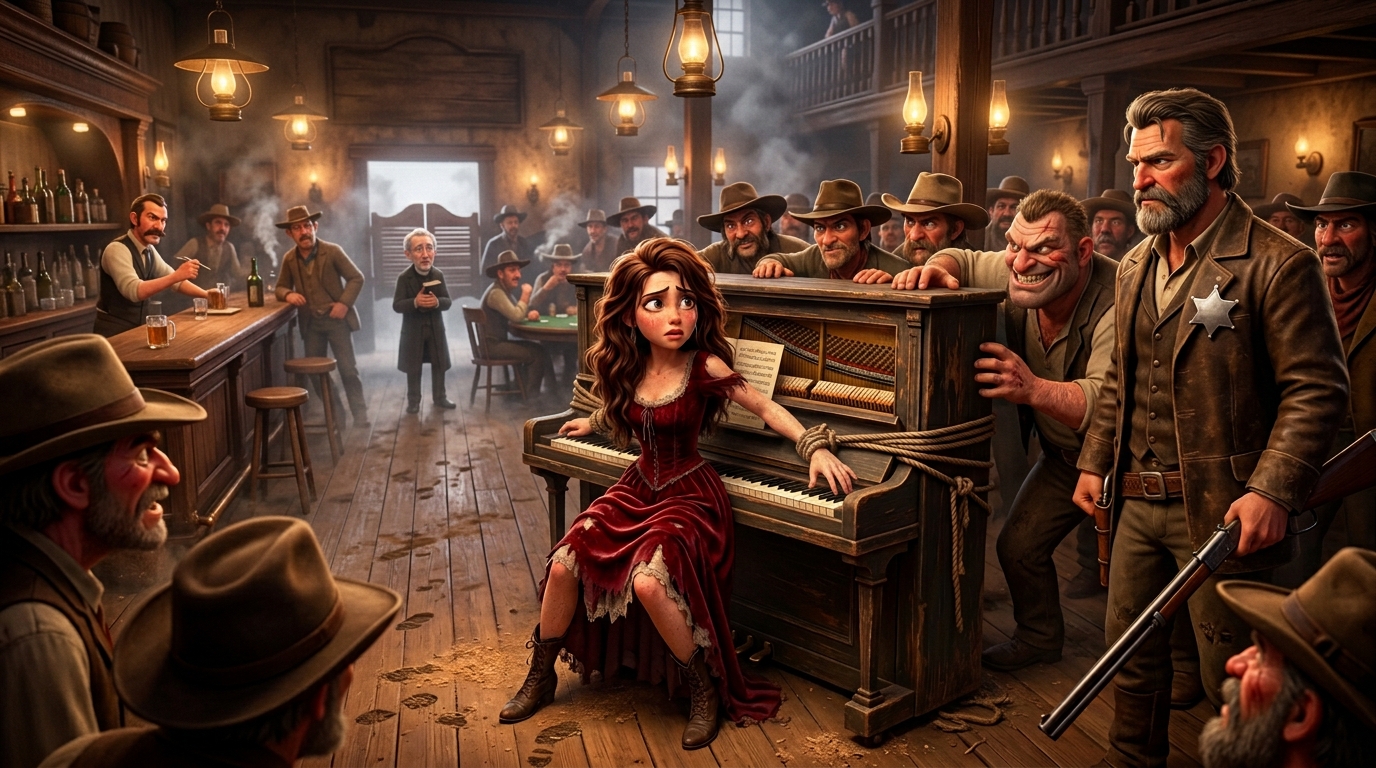
They Tied My Hands to the Piano and Begged Me to Cry
Some towns are built on dust, lies, and greed. Dry Creek was one of them. This is the story of Elira Voss, the saloon girl whose tears turned to gold—and how the whole West learned to fear the sound of her crying.
The Night They Wanted My Tears
The night they tied my hands to the piano and begged me to cry, the whole town smelled like whiskey, smoke, and fear.
Men who had once tipped their hats to me now stood in a circle with hungry eyes. The sheriff was there. Two ranchers were there. Even the preacher stood near the door, shaking like a weak candle in the wind.
They all wanted one thing.
My tears.
But none of them knew the truth yet. None of them knew that gold had already ruined more lives than it could ever save. And none of them knew what was riding toward our town in the dark.
My name is Elira Voss.
And this is how the West learned to fear a crying girl.
Three Weeks Earlier in Dry Creek
It began three weeks before that night, in the town of Dry Creek.
Dry Creek was not a kind place. It sat under a hard sky where dust never settled and mercy never stayed long. The streets were brown. The windows were cracked. The men were loud. The women were tired. And the saloon was the only place in town that still pretended life could feel warm.
That was where I worked.
The Rusted Belle Saloon.
Every evening, I walked down the stairs in a red dress that was not really mine and smiled at men who never asked if I was happy. I carried drinks. I sang soft songs when the piano was in tune. I laughed when I had to. I stepped away when hands got too bold. And I learned how to keep my face calm, even when my heart hurt.
I was nineteen years old.
Most people in Dry Creek thought they knew me. They thought I was just another saloon girl with pretty eyes and a tired smile. They thought I had come from nowhere. They thought I was weak because I spoke gently.
That was fine with me.
A secret lives longer when people think you are small.
“Move faster, Elira,” Madam Sable called one hot evening. “Table three has been waiting.”
Madam Sable owned the Rusted Belle. She wore black silk, smelled like roses and smoke, and spoke like every word cost money. Her face was beautiful in a sharp way. Nothing soft lived in her eyes.
I lifted the tray and crossed the room.
Cards slapped wood. Boots dragged across the floor. Men shouted over each other. The piano played a tune too cheerful for that hard room. Lamps glowed gold against the dark wood walls. Outside, the wind pushed dust against the windows like it wanted to come in.
At table three sat three men I did not trust.
One was Sheriff Talon Rusk. He was tall, broad, and always clean, which made him look strange in a town like ours. His badge shined brighter than his heart. His smile was slow and cold, like a wolf showing teeth. He liked control more than justice.
Next to him sat Brack Thorn, a rancher with a face like old leather and fingers heavy with rings. He owned half the land around Dry Creek and wanted the other half. He laughed too loud and stared too long.
The third man was new.
I had never seen him before.
He wore a dark coat, though the night was warm. Dust sat on his shoulders from a long ride. His hat was low, but I still saw his eyes when I set down the drinks.
Gray eyes.
Quiet eyes.
Dangerous eyes.
He looked at me once, and I felt something strange. Not safety. Not fear. Something sharper. Like the feeling before lightning.
Sheriff Rusk lifted his glass. “Elira, sing later.”
“If Madam Sable asks me to, I will,” I said.
Brack Thorn grinned. “You always talk sweet.”
“Sweet words earn better tips,” I replied.
The two men laughed.
But the stranger did not.
He kept looking at me as if he were trying to remember my face from somewhere else. I turned to leave, but then Brack Thorn caught my wrist. Not hard enough to cause a scene. Just hard enough to remind me what kind of man he was.
“You hear the rumor?” he asked.
My body went still. “Dry Creek has many rumors.”
“This one is my favorite.” His grin widened. “They say there is gold hidden in this town.”
Sheriff Rusk chuckled. “Men always smell gold, even when there is none.”
Brack kept watching me. “Maybe. But some gold ain’t buried under dirt.”
I pulled my wrist free. “Then maybe it is not yours to find.”
For one second, the table went quiet.
The stranger’s eyes shifted from Brack to me.
Then he spoke for the first time.
“Let the girl work.”
His voice was low and calm, but something in it made Brack Thorn’s smile crack a little.
Brack leaned back. “And who are you?”
The stranger picked up his drink. “A traveler.”
“That so?” Sheriff Rusk asked.
“That is enough for tonight.”
No one spoke for a breath. Then Brack laughed again, but it sounded forced this time.
“Fine,” he said. “Run along, songbird.”
I walked away.
But my hands were cold now.
Because Brack’s words had landed too close to the truth.
And in Dry Creek, truth was more dangerous than a loaded gun.
A Secret of Gold and Fire
That night, after the last drunk man stumbled out and the lamps burned low, I cleaned tables in silence while Madam Sable counted coins behind the bar.
I thought I had hidden my fear well.
I was wrong.
“Who was he to you?” Madam Sable asked without looking up.
“Who?”
“The gray-eyed rider.”
“No one.”
She tied off a money bag. “Men do not speak for women here unless they want something.”
“Then he wants peace and quiet.”
Madam Sable smiled faintly. “No man rides into Dry Creek for peace.”
I said nothing.
She looked up then, and her gaze settled on me like a knife resting on skin. “You look pale.”
“I am tired.”
“You are scared.”
Her words were too soft.
I kept wiping the table. “Of what?”
“That depends,” she said. “Of the rumor… or of the man who heard it?”
I dropped the rag.
Just for a second.
But Madam Sable saw.
She always saw.
“Elira,” she said almost kindly, “I took you in when you had nothing. I fed you. Dressed you. Kept men from breaking you. Do not lie to me in my own saloon.”
For one weak second, I wanted to tell her everything. I wanted to lay the whole heavy secret down and be done with it.
But secrets like mine never leave quietly.
So I forced my face calm again. “I know nothing about hidden gold.”
Madam Sable studied me. Then she reached up and moved a loose strand of hair from my cheek. The gesture was gentle.
Too gentle.
“That is good,” she whispered. “Because a town like this would rip open heaven itself for one bright stone.”
Then she stepped away.
But what happened next stayed with me. When she turned her back, her face changed. Only for a moment, but I saw it.
Fear.
Madam Sable was afraid.
And that scared me more than Brack Thorn ever could.
I slept in a little room above the saloon. One narrow bed. One cracked mirror. One wash bowl. One wooden chair by the window. From there, I could see the street, the stable, and the endless dark beyond town.
I locked the door, sat on the edge of the bed, and pulled out the small cloth pouch hidden under the mattress.
Inside were seven gold drops.
They were shaped like tears. Not smooth like coins. Not sharp like broken metal. Each one looked exactly like a tear caught in sunlight and turned solid.
I stared at them until my throat hurt.
I had promised myself I would never make more.
But promises made in pain are hard to keep in a cruel world.
A long time ago, when I was little, my mother had held my face in both hands and said, “You must never cry where greedy eyes can see. Never. Gold brings worship first. Then chains.”
Back then, I had not understood.
Later, I did.
My mother cried gold. So did her mother before her.
And now I did too.
I did not know why. I only knew the cost.
The first time it happened, I was ten years old and my father had just been buried. My mother cried beside me. One bright gold drop hit the dirt near her boot.
A man saw.
Three nights later, our house burned.
My mother got me out through the back.
She did not make it out herself.
That was the night I learned what greed smells like.
It smells like smoke.
It smells like sweat.
It smells like men telling you they are sorry while stealing your life.
I pressed the pouch shut and slid it back under the bed.
Then I heard footsteps outside my door.
Slow.
Careful.
I stood at once and reached for the little revolver hidden in the washstand drawer.
The footsteps stopped.
Then came three soft knocks.
A voice came through the wood. “It’s me,” the stranger said.
I froze.
“How did you find my room?” I asked.
“The saloon has one stairway.”
“That is not an answer.”
A pause.
Then: “You looked like you needed warning.”
I moved closer to the door but did not open it. “Warning about what?”
“Brack Thorn sent a man to follow you after closing.”
My heart kicked hard once. “Why?”
“You know why.”
The hall went silent again.
“I don’t know your name,” I said.
“Cairn Vale.”
It fit him. Hard and strange.
“What do you want, Cairn Vale?”
“To keep you alive.”
I almost laughed. “Men usually say that right before they ruin me.”
“I am not most men.”
“No,” I said quietly. “You are not.”
I do not know why I believed that part. Maybe because his voice held no hunger. Maybe because he had not smiled once. Maybe because lonely people can feel other lonely people, even through a closed door.
Still, I did not open it.
“You should leave town,” he said.
“Why would I trust you?”
“You shouldn’t,” he answered. “But you should still leave.”
“Because of a rumor?”
“Because Dry Creek is listening now.”
A chill slid down my back.
“Who told you about the rumor?” I asked.
“I hear many things.”
“That is not an answer either.”
“No,” he said. “It isn’t.”
I waited for more.
Instead, he gave me something worse.
A clue.
“I knew a woman once,” he said. “She cried in a mining camp. Men killed each other before sunrise.”
My breath caught.
Was he testing me? Did he know? Or was he speaking blind into the dark?
Before I could decide, another sound rose from below.
A crash.
Then a shout.
Then the crack of glass breaking.
Cairn’s voice sharpened at once. “Stay inside.”
Boots hit the stairs fast.
Not one man.
Several.
Madam Sable screamed below.
A man yelled, “Search every room!”
My blood turned to ice.
They were coming up.
“They found something,” Cairn said.
The hallway exploded with noise—heavy boots, harsh voices, doors being kicked open one by one.
Then Brack Thorn’s voice came through the wood.
“Open up, little songbird,” he called. “We just want to see your eyes.”
And I knew my life had changed forever.
The Betrayal and the Escape
Brack Thorn’s voice outside my door made my whole body go cold.
“Open up, little songbird,” he said again. “We just want to see your eyes.”
Behind my ribs, my heart beat so hard it almost hurt.
Cairn Vale moved closer to the door from the hallway. I could hear the shift of his boots on the wood.
“Step away from this room,” he said.
Brack gave a short laugh. “Well now. The traveler has picked a side.”
“I said step away.”
Another voice joined in. Sheriff Talon Rusk.
“Careful, Cairn,” he said. “You don’t want to point yourself against the law.”
“The law?” Cairn asked. “Sounds crowded tonight.”
One of the men laughed. Another spat on the floor.
I backed away from the door and looked around my room. The window. The bed. The washstand. The small pouch still hidden under the mattress. My mind moved fast, but fear kept trying to slow it.
Then I heard Madam Sable downstairs.
“Don’t wreck my whole place!” she shouted. “If you fools want the girl, take the girl and be done with it!”
Her words cut through me sharper than a blade.
So that was it.
She had sold me.
Or maybe she had only stopped protecting me.
In Dry Creek, those two things often looked the same.
Brack hit my door with the side of his boot.
The wood shook.
“Open,” he said, louder now.
I pulled the pouch from under my mattress and shoved it into the lining of my dress. My fingers shook so badly I almost dropped it.
Another kick.
The frame groaned.
Cairn’s voice came again, hard this time. “Last warning.”
A gun clicked.
Then another.
Then another.
Too many.
For one second, the hallway fell silent.
The kind of silence that comes right before blood.
Then everything broke at once.
A gunshot slammed through the hall. Men shouted. Wood cracked. Someone crashed into the wall outside my room. Another bullet tore through the door and buried itself in my washstand.
Outside, boots slammed, fists hit flesh, and guns roared so loud the whole second floor seemed to shake.
Then I heard Brack curse.
Then Sheriff Rusk barked, “Take him alive!”
That was all I needed to hear.
I ran to the window, pushed it open, and looked down.
Bad choice.
It was a long drop to the alley below. Two floors. Broken crates. Hard dirt. One mean-looking horse tied near the stable. If I jumped wrong, I would break a leg. If I stayed, I would lose more than that.
A hand hit my door.
Once.
Twice.
The lock split.
I turned just as the door flew inward.
But it was not Brack.
It was Cairn.
His dark coat was torn near the shoulder. Blood ran down one sleeve. His gray eyes found mine at once.
“Come,” he said.
I did not argue.
He crossed the room in two fast steps, grabbed the chair, smashed the rest of the window wide, then looked down once.
“Can you climb?” he asked.
“Yes.”
“You lie badly.”
Another shout rose from the hall. Sheriff Rusk again: “He’s in there!”
Cairn grabbed the bed blanket, twisted it hard, and tied one end around the bed frame. Then he threw the rest out the window.
“It won’t hold long,” he said. “Go.”
“You first,” I whispered.
“No. If they see you drop, they shoot.”
I stared at him.
He stared back.
No smile. No softness. Just that same hard calm.
“Go, Elira.”
I climbed onto the sill.
The night wind hit my face. The blanket rope swung against the wall. Below me, the alley looked black and deep.
Behind us, boots thundered closer.
Cairn lifted his revolver and pointed it at the broken doorway.
“Now,” he said.
So I went.
My hands burned at once. My shoes scraped the wall. Dust filled my nose. I slipped halfway down and bit my lip so hard I tasted blood. Then my foot found the top of a barrel. I dropped the last few feet and hit the ground hard enough to jar my teeth.
Pain shot through my ankle.
But it held.
Above me, men shouted from my room.
“There! Below!”
A gun fired.
The bullet hit wood near my head.
I ran.
Not well. Not fast. But fear is its own kind of horse.
I reached the stable just as Cairn dropped from the window behind me. He landed badly, one knee hitting dirt, but rose at once like pain meant nothing.
“Horse,” he said.
“The gray one?”
He nodded.
The horse kicked and snorted when I grabbed the reins. Cairn untied it, swung into the saddle, then reached down for me.
Another shot cracked through the alley.
“Move!” he barked.
I took his hand.
In one pull, he hauled me up behind him.
Then the horse exploded forward.
We burst out of the alley into the back road as shouting rose behind us. Men poured from the saloon. Someone pointed. Someone fired. The night split with noise.
Dry Creek flew past in pieces. The blacksmith shed. The water trough. The little church with the broken crossbeam. Lantern light flashed across faces in windows. The whole town seemed awake now.
Everyone knew.
Everyone would want a part.
The horse thundered past the last fence and into open land. Cold air slapped my face. I held onto Cairn’s coat with both hands as the town lights shrank behind us.
But what happened next made my stomach drop.
A second horse was coming from the east ridge.
Fast.
Its rider cut across the moonlight like a knife.
“Who is that?” I shouted.
Cairn looked once and cursed under his breath.
“Someone worse.”
The rider fired.
The bullet screamed past us.
Then came a voice I knew.
“Don’t let the girl leave!”
Sheriff Rusk.
I turned and saw him clearly now, hat low, badge flashing, horse foaming at the mouth. Behind him rode three more men.
We were being hunted.
And Dry Creek had just declared open season on me.
A Letter in the Dark
Cairn drove his heels into the horse. The animal surged harder across the scrubland. The ground was rough and mean. Brush scratched my skirt. The moon gave just enough light to fear every rock.
“You know these trails?” I asked.
“Yes.”
“How?”
“I’ve ridden worse.”
That told me nothing.
Another shot cracked.
Closer.
I ducked against his back.
“You carry a gun?” he asked.
“A small one.”
“Can you use it?”
“Yes.”
“Can you hit anything?”
“No.”
“That will do.”
I almost laughed, but fear killed it before it could grow.
We cut through a narrow wash, then up toward a line of dark stone hills. Sheriff Rusk and the others stayed behind us, but not far enough. Their horses were strong. Their greed was stronger.
At last Cairn pulled ours behind a cluster of rocks where the trail bent tight and steep.
He jumped down. “Off.”
“What?”
“Now.”
I slid down. My ankle nearly folded under me.
Cairn saw it. “Can you run?”
“I can try.”
“Try later.”
He led the horse between the rocks into a shallow cut hidden by brush. Then he pulled me down beside him.
The hoofbeats grew louder.
I held my breath so long my chest hurt.
Sheriff Rusk rode past first.
Then Brack Thorn.
Then the others.
Brack’s voice carried in the dark. “He can’t outride us forever!”
Sheriff Rusk answered, “Spread wide. Check the old mining road. If he reaches the pass, we lose them.”
Their hoofbeats faded.
I sagged against the stone.
Then Cairn turned to me.
“You hid it well,” he said.
I went still. “Hid what?”
“The truth.”
My throat tightened. “You still have not told me how much you know.”
“Enough.”
“That is not enough for me.”
His gaze stayed on mine. “I know your mother was named Sereth.”
My blood turned to ice.
No one in Dry Creek knew my mother’s name.
No one.
“How do you know that?” I asked.
He did not answer right away. That silence frightened me more than if he had drawn a gun.
At last he said, “Because I was there the night she died.”
The world seemed to tilt under me.
“No,” I whispered.
He gave one hard nod. “I was younger. Seventeen. I worked for a supply train outside Red Hollow. I saw the men who set the fire. I saw your mother push you through the back. I saw one gold tear in the dirt.”
I could not breathe.
“You did nothing?” I asked.
His jaw tightened. “I was a boy with no gun and too much fear.”
That answer was honest.
And I hated it.
“I carried that shame for years,” he said. “When I heard a rumor in Dry Creek, I came to see if it was you.”
I stared at him, trying to match this man with smoke and memory and loss.
“You remembered my face?”
“No,” he said. “I remembered your mother’s eyes.”
The words hit harder than I expected.
Then I asked the question burning inside me. “Who started the rumor?”
Cairn’s face darkened. “Maybe Brack. Maybe the sheriff. Maybe Madam Sable. Maybe all three.”
My stomach twisted.
Madam Sable.
I had slept under her roof. Worked under her hand. Believed her fear meant she might still protect me.
Instead, she had fed me to wolves.
Cairn reached into his coat and pulled out a folded paper.
“I took this from Sheriff Rusk during the fight.”
He handed it to me.
In moonlight, I opened it.
TO TALON RUSK
The girl has the gift. I saw gold with my own eyes. Bring her alive. Payment doubles if she cries before delivery.
— H. Vane
My hand shook.
“Who is H. Vane?”
Cairn looked toward the dark horizon. “Halrick Vane. Mine owner. Land buyer. Grave robber when the price is right.”
I knew the name. Everyone in the territory knew it.
Halrick Vane was not just rich. He was the kind of rich that could turn law into a servant and pain into business.
“He paid them for me?” I asked.
“Yes.”
“For how long?”
Cairn did not answer.
That was answer enough.
A cold sickness moved through me.
This was bigger than Dry Creek. Bigger than a rumor. Bigger than one greedy rancher or one rotten sheriff.
Someone had been looking for me.
Maybe for years.
Then my hand flew to my dress.
The hidden slit in the lining was open.
Empty.
The seven gold tears were gone.
Gone.
I looked back toward the black shape of Dry Creek far away under the stars. If someone found those tears, the rumor would become proof.
And proof would turn every greedy whisper into a stampede.
Then, from somewhere behind us in the hills, a lantern flared to life.
Then another.
Then another.
Not one rider.
Many.
Too many.
Cairn pulled his gun and shoved me behind a rock.
“They found the trail,” he said.
And in the cold dark, as lights began to circle us from three sides, I understood something terrible.
Dry Creek was no longer chasing a rumor.
Now it was chasing gold.
The Hunt Gets Bigger
The lanterns in the hills looked like evil stars.
Sheriff Talon Rusk’s voice rang out first. Then Brack Thorn’s. Then, worst of all, Madam Sable’s.
“Elira!” she shouted. “Come out, child! You know these men will tear this whole hill apart!”
Her voice struck deeper than the men’s threats.
Madam Sable had come herself.
Not because she cared.
Because she wanted to collect what she had sold.
Cairn leaned close. “The woman on the right ridge. Lantern low. That is your chance.”
“What chance?”
“She is the weakest point.”
I looked where he looked. One rider. Small. Nervous. Holding position too far from the others.
“You want us to break through there?”
“I want you to survive.”
Sheriff Rusk called again, “This ends one of two ways, girl. Either you walk down, or we drag you.”
Brack laughed. “Maybe she’ll cry on the way.”
A few of the men laughed with him.
That laugh did something to me.
Not fear.
Anger.
They wanted my tears. They wanted me broken enough to make them rich. They wanted my pain to shine in their hands.
I looked at Cairn. “If they catch me, they won’t stop.”
“No.”
“If I cry, more will come.”
“Yes.”
“Then I would rather die first.”
His gray eyes met mine.
“Not tonight,” he said.
Then he stood up and fired.
The first shot hit a lantern. The second tore a hat from someone’s head. The hills exploded with noise.
“Run!” Cairn shouted.
I ran.
We broke through the weak point—but not cleanly.
A rope flew from the dark and caught my waist. I screamed as it tightened and yanked me sideways. My feet left the ground. I slammed hard into the dirt and rocks tore through my sleeves.
“Elira!” Cairn shouted.
A rider dragged me across the ground for three brutal seconds before Cairn’s gun boomed again. The horse pulling me cried out and stumbled. The rope went slack.
I ripped it off and tried to stand, but pain shot through my ankle so hard I nearly blacked out.
Cairn was beside me at once. He pulled me up under one arm.
Then Madam Sable’s voice cut through the dark again.
“Don’t shoot her face!” she screamed. “Halrick pays double for beauty!”
That was the truth.
Not protection.
Not kindness.
Not fear.
Price.
I had only ever been price to her.
We reached a narrow cut between two rocks. Cairn shoved me through first, then followed. Bullets struck stone around us.
At last we stumbled into a small ravine hidden by brush and shadow.
I was tired of hiding.
Tired of being careful.
Tired of living like my tears were loaded guns.
But the night was not done with me yet.
Inside the ravine, Brack Thorn mocked my mother.
I fired.
And for the first time, I saw real pain in him.
Then all hell broke loose again.
We ran deeper through the ravine until the path opened into a hidden pocket of land, where the remains of an old miner’s shack leaned under the moonlight.
There we found brief shelter.
There I cleaned Cairn’s wound.
There he showed me the silver tear charm my mother once wore.
And there Tavian Quill—the quiet saloon piano player—found us.
He came trembling through the dark with terrible news.
Madam Sable had already handed my seven gold tears to Halrick Vane.
And Halrick Vane was riding toward Dry Creek himself.
He did not want me dead.
He wanted me heartbroken.
Because, Tavian whispered, sorrow made the purest gold.
Then a train whistle cried across the valley.
Halrick Vane had entered the night.
Red Hollow and the Truth My Mother Buried
By the time the train whistle died, even the wind sounded afraid.
Inside the shack, Tavian told us more. Halrick Vane had brought armed men, not ranch hands. Mine guards. Hard men. Men paid to protect ownership, not life.
He had locked down the roads.
He had already taken the gold tears.
And Madam Sable had been watching me for months.
Worse still, she had found a tiny old gold tear caught in torn cloth near my bed—proof I had not even known I left behind.
Cairn said there was one place Halrick would not expect.
Red Hollow.
The town where my mother died.
The town Halrick Vane had burned.
I said no.
But every other road was closing.
Then the truth turned darker still.
Tavian told us that Halrick did not simply want my tears. He wanted my hope removed first. Madam Sable had told him sorrow worked best.
Before we could think further, Halrick Vane himself came to the shack.
He spoke through the wall in a smooth, civilized voice that chilled me more than shouting could have.
He said he knew my mother.
I asked how.
And with terrible calm, he said, “I was the man she refused.”
That one sentence changed the shape of everything.
Red Hollow had not burned because of random greed alone.
It had burned because one man could not accept being told no.
When Cairn lunged for the door, it was a trap. Hidden men opened fire. Flames swallowed the shack. We escaped through the back and ran through brush and stone while Halrick’s promise followed us through the dark:
“She will cry before morning.”
Then Tavian was shot.
Not dead.
But bad enough.
With riders closing in, Cairn pressed a brass key into my hand.
“There is a locked iron box under the altar in Red Hollow chapel,” he said. “This key opens it.”
“What is in it?” I asked.
He looked at me once. “The truth your mother died protecting.”
Then he said the words that froze me to my bones.
“You were never just born with golden tears. You were chosen for them.”
Cairn turned and opened fire to hold the riders back while I dragged Tavian toward the dead trail that led to Red Hollow.
The moon gave us enough light to fear everything. Broken roofs rose in the distance like crooked teeth. Wind moved through empty buildings with a low, sad sound.
When we reached the old chapel, it stood at the edge of town like the last tired witness.
Half the bell tower had fallen. One wall leaned. The front doors were gone. But the stone altar still stood under a cracked wooden cross.
Tavian collapsed against a bench.
I knelt at the altar, pushed the brass key into the rusted lock beneath it, and opened the iron door hidden in the floor.
Inside was a metal box wrapped in old cloth.
Within that box were three things:
A letter.
A ledger.
And my mother’s scarf.
The letter was addressed simply:
For Elira
My mother’s handwriting broke the years open.
She told me the truth.
The gold tears were real—but they were not a prize from heaven. They were a burden carried by women in our line, and not every daughter received them.
They passed only by choice.
Love chose.
Not blood alone.
When I was a baby, fever nearly killed me. An old healer named Naeva told my mother there was one way to save me. She could pass the gift to me. It would cool my body and spare my life. But once given, it could never be called back.
My mother chose me.
She chose my life.
Not because she wanted gold.
Because she loved me.
Then the letter named Halrick Vane plainly.
He had courted her, threatened her, bought men, bought the law, and burned Red Hollow when she refused him.
The ledger listed the names of those he paid, the land he stole, and the sheriff who helped him.
And one final truth stayed with me more than any other:
The purest tear did not come from despair.
It came from love that refused to die.
The Chapel of Fire
Before I could finish breathing through the weight of it all, boots sounded outside.
Many of them.
Then Halrick Vane’s voice.
“So this is where the ghosts brought you.”
Lantern light spilled across the chapel doorway.
Halrick stepped in first. Tall. Clean. Silver at the temples. Black coat. Gloves. He looked like a banker who had learned how to smile over graves.
Behind him came Sheriff Talon Rusk. Brack Thorn. Madam Sable. Three armed mine guards.
And then two more men dragged someone in.
Cairn.
His face was bloodied. One eye swollen. His hands were tied behind his back.
My heart stopped so hard it hurt.
Halrick saw my face and smiled. “There,” he said softly. “That is the look of real sorrow.”
He wanted the box. He wanted my tears. He wanted everyone in the chapel to see what he believed he owned.
So I lifted the ledger high.
“This says you burned Red Hollow,” I said loudly. “It says you paid Sheriff Rusk. It says Brack Thorn took land from families after the fire. It says Madam Sable sold women’s names for money. It says all of you fed on ruin.”
The room shifted.
Sheriff Rusk changed first.
Brack Thorn swore.
Madam Sable went pale.
Only Halrick stayed calm.
Then I read my mother’s letter aloud.
I read the part where she named him.
I read the part where she wrote that Red Hollow burned because one man could not bear the word no.
I read the part where she called him a buyer of law and a maker of fire.
When I finished, silence filled the chapel.
Then Brack Thorn turned on Halrick. “You told us it was a business matter. You never said the whole town fire came from some woman turning you down.”
Sheriff Rusk looked sick.
Madam Sable looked afraid.
Because monsters turn on servants when servants know too much.
Halrick felt the room slipping from his grip and did what men like him always do when truth corners them.
He shot Brack Thorn in the chest.
The chapel exploded into chaos.
Sheriff Rusk raised his gun.
Cairn moved faster than an injured man should, drove into a guard, stole a revolver, and shot the lantern above the altar.
Fire burst across the dry wood.
Guards fired.
Sheriff fired.
Halrick fired back.
Madam Sable still lunged for the ledger.
Even with flames rising.
Even with death opening around her.
She still wanted the paper that might buy her one last bargain.
Then Halrick lunged for me and gripped my arm.
“There you are,” he whispered. “Cry for me.”
I looked at him.
At the man who burned my mother’s town.
At the man who hunted me like an animal.
At the man who believed pain belonged to him.
And then I felt it—not despair, not helplessness, but love.
For my mother.
For the life she chose for me.
For Cairn, bleeding and still fighting.
For Tavian, trembling and still warning me.
For myself.
For the girl who had survived long enough to stand there.
A tear filled my eye.
Halrick smiled.
Then it fell.
A real gold tear struck the chapel floor between us.
Every eye in the room snapped toward it.
That one second saved me.
Halrick bent for it.
So did Madam Sable.
Sheriff Rusk turned too.
Even dying, Brack reached with bloody fingers.
Greed pulled them all lower than bullets ever could.
Then the burning beam above the altar cracked loose.
It fell hard across Halrick, Sheriff Rusk, and Madam Sable together.
The floor beneath the altar gave way.
Old mine rot.
Old fire damage.
Old sins finally opening their mouth.
The boards collapsed.
All three dropped screaming into the black shaft below.
The gold tear went with them.
Then the chapel itself began to die around us.
Cairn grabbed my hand.
“Tavian!”
We pulled him up between us and ran as the front of the chapel began to fall in. Smoke slammed into our backs. Fire roared behind us. We stumbled into the open dirt just as the bell tower groaned and crashed through the roof.
Red Hollow burned again.
But this time, it was swallowing the right people.
Sheriff Rusk never climbed out.
Madam Sable never climbed out.
And Halrick Vane—the man who wanted my sorrow to make him rich—vanished into the dark he had dug for others.
By sunrise, the mine guards had fled.
Brack Thorn died by the chapel door.
And the ledger, blackened at the edges but still readable, remained in Cairn’s hand.
That was enough.
Enough for nearby towns.
Enough for the territorial court.
Enough for every stolen widow, burned family, and cheated ranch hand who had waited years for a reason to speak.
Truth, once lit, moves faster than fire.
What Remained After the Fire
Three days later, we buried my mother’s letter beside the chapel ruins under a stone cairn Cairn built with his own hands.
Tavian lived.
Barely, but he lived.
He said he would never play piano in another saloon again, and I told him that was the first smart thing he had done in months.
He laughed.
Weakly.
But he laughed.
Then it was just me and Cairn by the ruins.
Morning light lay soft over the broken land.
I held the silver tear charm in one hand. In the other, I held the last gold tear I would ever keep.
Not for selling.
Not for fear.
For memory.
Cairn stood beside me, hat in hand, wind moving through his dark hair.
“You can still ride away from me,” he said.
I looked at him. “Is that what you want?”
“No.”
The answer came fast.
Honest.
Warm.
I stepped closer.
“All my life,” I said, “men wanted me crying.”
His eyes stayed on mine. “I know.”
“But you did not.”
“No,” he said quietly. “I wanted you free.”
That did it.
Not like thunder.
Not like gunfire.
Just one clean truth reaching the place inside me that had been hurt for too long.
I rose onto my toes and kissed him.
Soft.
Slow.
Real.
When I pulled back, his forehead touched mine.
And for the first time in years, I did not feel hunted.
I felt chosen.
By my mother’s love.
By my own survival.
By the future still waiting for me.
I looked down at the last gold tear in my palm.
Then I buried it in the dirt beside the stone cairn.
The West could keep its greed.
My sorrow was no longer for sale.
And after that, no one ever again begged Elira Voss to cry.
Moral of the Story
Greed can turn pain into a marketplace, but love has the power to break that chain. The people who try to own your sorrow do not deserve your tears—and the strongest freedom comes when you stop letting others decide what your pain is worth.
Reader Question
If you were Elira, would you have hidden your gift forever, or would you have used the truth much earlier to fight back?
Leave a Reply