
Free reader powered by your browser. Available voices may vary by device.
The Day the Herd Took Tom
“ELEANOR! MOVE!”
You hear the shout, but it’s too late.
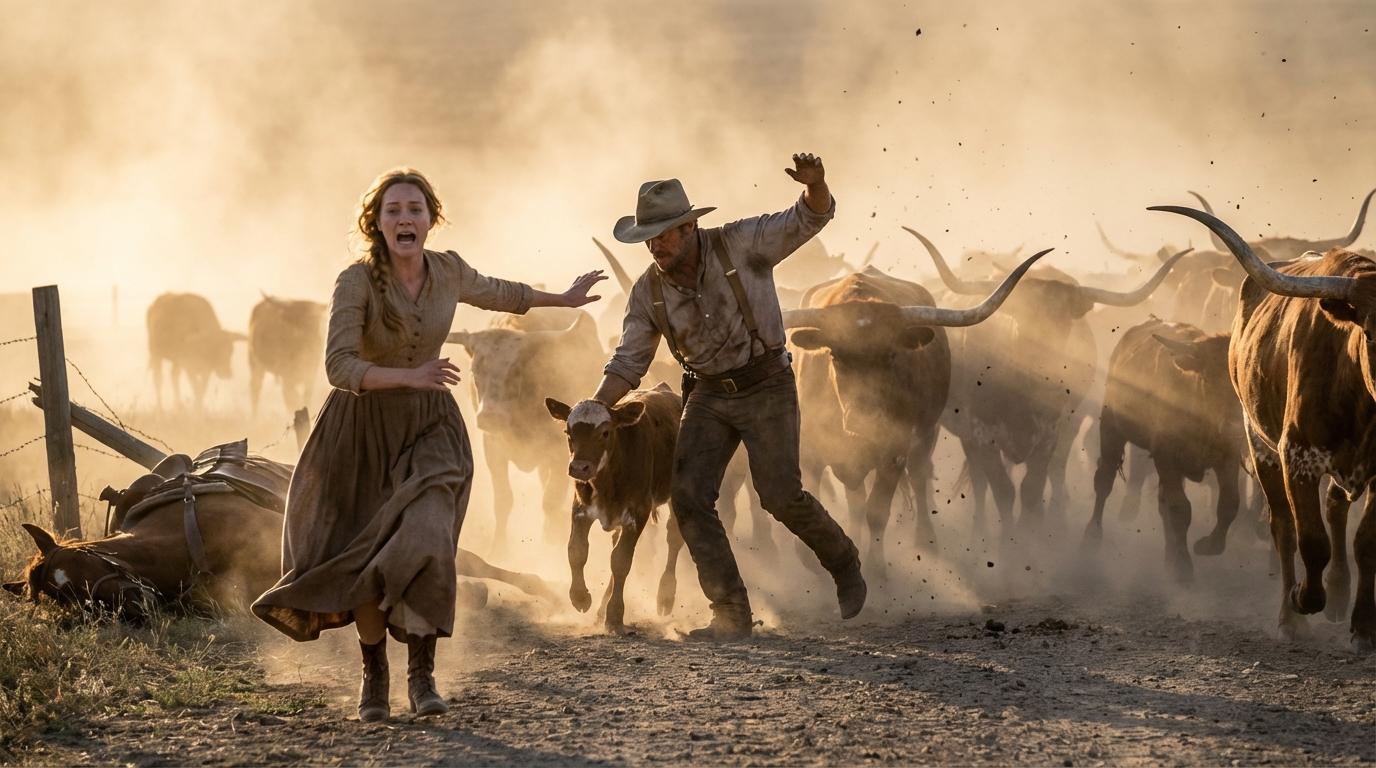
The ground shakes under your boots like thunder is trapped under the dirt. Cattle. Too many cattle. Their eyes are wild. Their horns look like knives. They are not running past you.
They are running through you.
Your husband, Tom Reed, is in the middle of it.
Tom is on foot. That is the first wrong thing. Tom is never on foot when the herd breaks. He should be on his horse. But his horse is down. You see it for one terrible second—legs twisted, dust covering its eyes.
“Tom!” you scream.
Tom turns his head. He looks straight at you. His face is tight. Not fear. Not panic.
It is worse.
It is a hard decision.
Because Tom points at you and shouts, “GET TO THE FENCE!”
Why is he not running to you? Why is he waving you away like you are a stranger?
Then you see it.
A calf is stuck in the open. A small thing. A foolish thing. But it is trapped, and its cries are sharp and high, like it is calling the whole herd back to it.
Tom runs toward the calf.
“Tom, NO!” you yell, your throat burning.
He does not listen.
Of course he does not.
Tom reaches the calf and tries to pull it free. He gets his arms around its chest. The calf kicks. Dust explodes around them. The herd comes like a moving wall.
Tom looks up.
And in that split second, you understand.
Tom is not trying to save the calf.
Tom is trying to keep the herd from turning toward you.
Because if they hit the house side of the road… if they rush the fence line… you will be trapped.
Tom shoves the calf away. He raises his arms and waves, trying to pull the stampede to him, away from you.
“Tom!” you cry again.
Then the wall hits him.
It is not one cow. It is dozens. The sound is sick. Like wood snapping. Like bones breaking. Like the world ending in dust.
You run anyway.
You do not remember choosing to run. Your legs choose for you. You trip. You fall. You taste dirt. You get up. You run harder.
“Tom! TOM!”
But there is only dust.
And there is silence inside the noise, like your heart has stopped and forgotten to start again.
Minutes later, the stampede passes. The herd thins. The road shows again. The fence is broken. The air smells like sweat and dry grass and something coppery you do not want to name.
You find Tom.
You find his hat first. Then his hand. Then the rest of him.
You drop to your knees so fast they sting. You grab his shirt, like you can pull him back into the world by force.
“Tom,” you whisper. “Please. Please.”
His eyes are open, but they are not seeing you.
And the only thought in your head is a simple, awful one:
I am alone now.
The Days After
The days after that feel like someone erased the sun.
Neighbors come. Men from down the road. Women with soft eyes. They bring stew. They bring boards for the fence. They bring words like I’m sorry and Let us help.
You do not want any of it.
Not because you do not need help. You do.
But because if you accept it, it makes Tom’s death feel real. Like you are admitting you cannot hold the ranch the way you and Tom did.
So you stand in the doorway and say, “No. I’m fine.”
Even when your hands shake.
Even when your throat closes every time you see Tom’s empty chair.
Even when you wake in the night reaching for a man who is not there.
You fix the fence yourself. You drag wood by yourself. You carry water by yourself. You cry quietly into the sink so no one hears.
And then, one night, you notice something that makes your skin turn cold.
A cowboy.
Across the road.
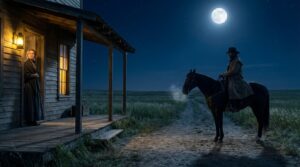
Sitting on his horse.
Not near your house. Not close enough to talk. Just far enough to watch.
The moon is thin. The wind is sharp. The cowboy does not move.
You blink and tell yourself it is nothing. Maybe he is lost. Maybe he is waiting for someone. Maybe he will ride away.
But he does not.
The next night, he is there again.
Same place. Same stillness.
You hold your lantern up higher. The light reaches him only a little. You cannot see his face. You cannot even tell his age. But you see the shape of him and the calm of his horse.
He does not wave.
He does not call out.
He just sits there, like a shadow that decided to become a man.
On the third night, you grab your shotgun.
Not because you want trouble.
Because you already have trouble, and you refuse to get more.
You step onto the porch. The boards creak under your feet. You lift the shotgun enough for him to see it clearly.
“Who are you?” you shout.
Your voice is strong, but your stomach is not.
The cowboy does not answer.
Not a word.
He does not even shift in the saddle.
He just turns his horse slightly—like he is making sure he can see your door.
Like he is making sure you can get back inside safely.
That is when your anger gets confused.
Because if he is a threat, why is he staying so far?
If he is watching you, why does it feel like he is watching the road?
You stand there a long time, waiting for him to speak.
He never does.
Then, just when you are about to go back inside, you see something in the dim light.
Something hanging from his saddle.
A small metal thing that catches the moon.
It swings once in the wind.
And your breath stops.
Because you know that shape.
You have seen it a thousand times.
It looks like Tom’s old pocket watch—the one Tom carried every day, the one you buried with him.
Your hands tighten around the shotgun.
Your voice comes out like a crack.
“That watch… where did you get that?”
The cowboy finally moves.
He reaches down, slow and careful, and closes his fist around the shining thing, hiding it from the moon.
Then he turns his horse away from you.
And rides into the dark.
Leaving you on the porch with one terrifying question burning in your chest:
How does a stranger have something that should be in your husband’s grave?
The Watch in the Morning Light
You do not sleep that night.
Every time you close your eyes, you see the watch swinging in the moonlight.
Tom’s watch.
You remember the weight of it in your palm. The small scratch near the hinge. Tom got that scratch the year before he met you. He laughed about it. Said a horse stepped on it but the watch survived, so it must be tougher than him.
You buried it with him yourself.
You saw it go into the ground.
So how could that cowboy have it?
At sunrise, you are already outside. You do not even drink coffee. You do not feed the chickens first. You just stand on the road staring down the direction he rode.
Dust. Empty land. Nothing.
For a moment, you almost convince yourself you imagined it.
Then you see hoofprints.
Fresh ones.
Your chest tightens. You go inside and grab your hat. Not the shotgun this time. Something inside you knows this is not a robbery, not a thief, not a drifter looking for food.
This is an answer.
And you need it.
You follow the tracks slowly. The road curves past the dry creek bed, then toward the old cottonwoods. The wind pushes your skirt against your legs and the sky feels too big, like you are small inside it.
After almost an hour, you see him.
The cowboy.
He is not watching your house now. He is standing beside the creek, watering his horse. His back is to you.
You stop walking.
You suddenly feel nervous. Not scared. Just heavy.
You call out anyway.
“You.”
Your voice comes out smaller than you wanted.
He turns.
For the first time, you see his face.
He is not old. Maybe early thirties. Sun-browned skin. Tired eyes. A scar across his jaw. Not a mean face. Not a friendly one either. Just careful.
He does not reach for a gun.
He does not step closer.
He just nods once, like he expected you.
“You’ve been following me,” you say.
“Yes, ma’am,” he answers quietly.
It is the first time you hear his voice.
Low. Gentle. Not nervous.
You swallow. “The watch.”
His jaw tightens.
“Where did you get it?”
He looks at the ground for a moment, like he is choosing which truth hurts least.
“Tom gave it to me,” he says.
Your heart pounds so hard you feel dizzy.
“That’s not possible,” you whisper. “I buried it with him.”
“No,” he says softly. “You buried a different one.”
Your stomach drops.
“What?”
He reaches slowly into his saddlebag. Careful. Like he is afraid you will run. Or break.
He holds out the watch.
You do not want to take it.
But you do.
Your fingers shake as you open it.
The scratch is there.
Inside the lid is a carving you know by heart.
E + T
You almost fall.
“Tom…” you breathe.
You look up at the cowboy. “Why would he give you this?”
The cowboy looks straight at you now. No more hiding.
“Because I would’ve died without him.”
You say nothing. You just wait.
“Last winter,” he continues, “blizzard hit north of the ridge. I got lost. Horse collapsed. I was freezing to death. Your husband found me half buried in snow.”
Your throat tightens.
“He carried me onto his horse. Rode through the night. Kept talking so I wouldn’t sleep. I kept telling him to leave me. He didn’t.”
The cowboy pauses.
“He brought me to your house.”
Your breath catches.
“What?”
“You were away visiting your sister,” he says. “Tom stayed up three days keeping me alive. Fed me. Sat beside the fire. Every time I passed out, he shook me awake.”
Your eyes burn.
“Why didn’t he ever tell me?”
The cowboy looks sad now.
“He made me promise not to.”
Your chest hurts.
“Why?”
“He said you already worried too much. Said you’d be angry he risked himself for a stranger.”
That sounds exactly like Tom.
Your grip tightens around the watch.
“So you’re here because you owe him?”
“Yes.”
You nod slowly. That makes sense. A debt. A promise. You almost feel relief.
Then you ask the question you did not plan to ask.
“For how long?”
The cowboy looks at your house far away across the plains.
“As long as needed.”
Your stomach twists.
“That was over a year ago.”
“I know.”
“So the debt is paid,” you say.
He does not answer.
You step closer. “Then why are you still here?”
The cowboy finally looks at you again. Not away. Not past you.
At you.
And for the first time, his calm breaks.
“Because,” he says quietly, “I wasn’t just watching the ranch.”
Your heart skips.
You whisper, “Then what were you watching?”
He takes a slow breath.
“You.”
The Truth He Carried
You freeze.
The wind moves through the grass. Neither of you speaks for a long moment.
Then he says one sentence that makes your entire world shift again:
“The night Tom died… I was there.”
Your fingers go numb around the watch.
“You… what?”
His eyes fill with something heavy.
“I tried to stop him.”
Your ears ring.
“I tried to stop him,” the cowboy repeats.
You stare at him like you do not understand the language he is speaking.
“You were there?” you say slowly. “You were there the day my husband died… and you never came to my door?”
His shoulders sink a little.
“No.”
Your chest tightens. Anger rises fast, hot, sharp.
“You watched him die?”
“No!” His voice breaks for the first time. “I rode as hard as I could. I saw the herd break from the north pasture. I knew it would cross your road. Tom knew too.”
Your breathing becomes shallow.
“Then why didn’t you help him?”
“I tried.”
He steps closer but still keeps distance, like he knows you might push him away.
“I shouted for him to leave the calf. I told him the herd was turning. I was seconds away.”
Your throat burns. “But you weren’t fast enough.”
His eyes drop.
“No.”
Silence falls between you. The wind moves the tall grass around your boots. The world feels too quiet for something this heavy.
“I got there right after the herd passed,” he continues softly. “You had run back toward the house. You didn’t see me. You were with him already.”
You remember that moment. You barely saw anything except Tom.
“I checked his pulse,” the cowboy says. “I knew…”
He cannot finish the sentence.
You close your eyes. A tear slips down your cheek before you can stop it.
“Why didn’t you come to me?” you whisper.
His answer is immediate.
“Because you already lost everything in one minute. I didn’t want to be another stranger standing there with pity in his eyes.”
Your anger weakens.
“I buried him the next day,” you say.
“I watched from the ridge,” he admits.
You look at him sharply.
“You watched my husband’s funeral?”
“Yes.”
Your hands shake again, but not the same way as before.
“Why?”
His voice becomes quiet, almost rough.
“Because I made him a promise before he died.”
You stare.
“What promise?”
The cowboy reaches into his coat and pulls out a folded cloth. Inside is the watch chain, old and worn.
“After I got better from the blizzard,” he says, “I tried to give the watch back. Tom wouldn’t take it.”
You swallow.
“He said, ‘If anything ever happens to me, make sure she’s never alone.’”
Your knees weaken.
You sit on a rock beside the creek without realizing you moved.
The cowboy continues, gentle, careful.
“He knew ranch life was dangerous. He laughed about it, but he meant it. He said you were strong… but you carried everything yourself. He worried what would happen if no one watched over you.”
Your voice shakes.
“So you stayed because of a promise.”
“Yes.”
You look down at the watch in your hands.
Every night. Every cold wind. Every lonely sunset.
He had been there.
Not knocking. Not asking. Not forcing.
Just there.
“You never spoke to me,” you say.
“I wasn’t supposed to take his place,” he answers. “Just guard the edges.”
You feel something crack inside your chest. Not pain, not exactly. Something softer.
“Then why didn’t you leave after months?” you ask quietly.
He does not answer right away.
This time, he struggles.
His eyes search the horizon like he is trying to escape the words.
Finally he says it.
“Because after a while… I wasn’t staying for Tom anymore.”
Your breath stops.
“I stayed because I saw you rebuild fences alone. Carry feed sacks heavier than you. Sit on that porch every night pretending you weren’t waiting for footsteps that would never come.”
Tears blur your sight.
“I saw your strength,” he says. “And your loneliness.”
The world feels still.
“And somewhere along the way… guarding you stopped being duty.”
He looks straight at you now. No hiding left.
“I stayed because I couldn’t ride away from you.”
Your heart pounds.
“I never meant to,” he adds. “I never expected it. But I fell in love with the woman who refused to fall apart.”
You cannot speak.
For a long moment, there is only wind and the slow sound of water in the creek.
You finally manage one question.
“What is your name?”
A small, almost relieved smile touches his face.
“Samuel Carter.”
You nod slowly.
“Eleanor Reed,” you say softly, even though he already knows.
The Porch at Sunset
You look at Tom’s watch one last time.
Then you stand and walk to Samuel.
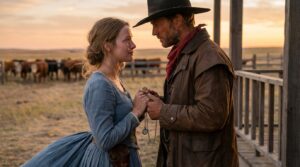
You gently take his hand.
Not replacing Tom.
Not forgetting Tom.
But stepping forward.
“Samuel,” you say quietly, “you don’t have to sit across the road tonight.”
His eyes widen slightly.
“You can come to the porch.”
For the first time in a year, you are not afraid of the empty chair anymore.
And that night, as the sun sets over the plains, two people sit side by side in silence.
Not lonely silence.
Peaceful silence.
The kind Tom would have wanted.
Moral of the Story
Grief does not always end with forgetting. Sometimes healing begins when love, loyalty, and kindness make room for life to grow again. Moving forward is not betrayal—it can be the gentlest way to honor what was lost.
Reader Question
If you were Eleanor, would you have trusted Samuel after learning he had been watching from a distance all that time, or would that truth have been too hard to forgive?
Leave a Reply