
Free reader powered by your browser. Available voices may vary by device.
She Came West to Marry One Brother… and Fell in Love With the Other
Clara Bennett crossed the country expecting to marry a man whose letters promised safety, love, and a fresh start. Instead, she stepped into grief, hard truth, and a future she never imagined—one that would test her heart more deeply than any dream ever could.
The telegram in Clara Bennett’s trembling hand read like a death sentence.
Thomas McKenna deceased. Stop. Fever took him Tuesday last. Stop. Brother will meet stage.
She stood on the platform in Redemption Creek, Montana Territory, dust devils spinning across the empty street like restless ghosts. The September wind bit through her traveling dress—the good wool one she’d saved for meeting her husband-to-be. The smell of horse manure and sun-baked wood mixed with something else, something metallic that might’ve been blood from the butcher’s shop across the way.
Her husband was dead. The man whose letters had promised her safety, a home, a future far from the Boston boarding house where she’d scrubbed floors until her hands cracked and bled. Dead before she’d even seen his face.
“Miss Bennett.”
The voice came from behind her, low and rough as gravel under wagon wheels. Clara turned, and her breath caught in her throat.
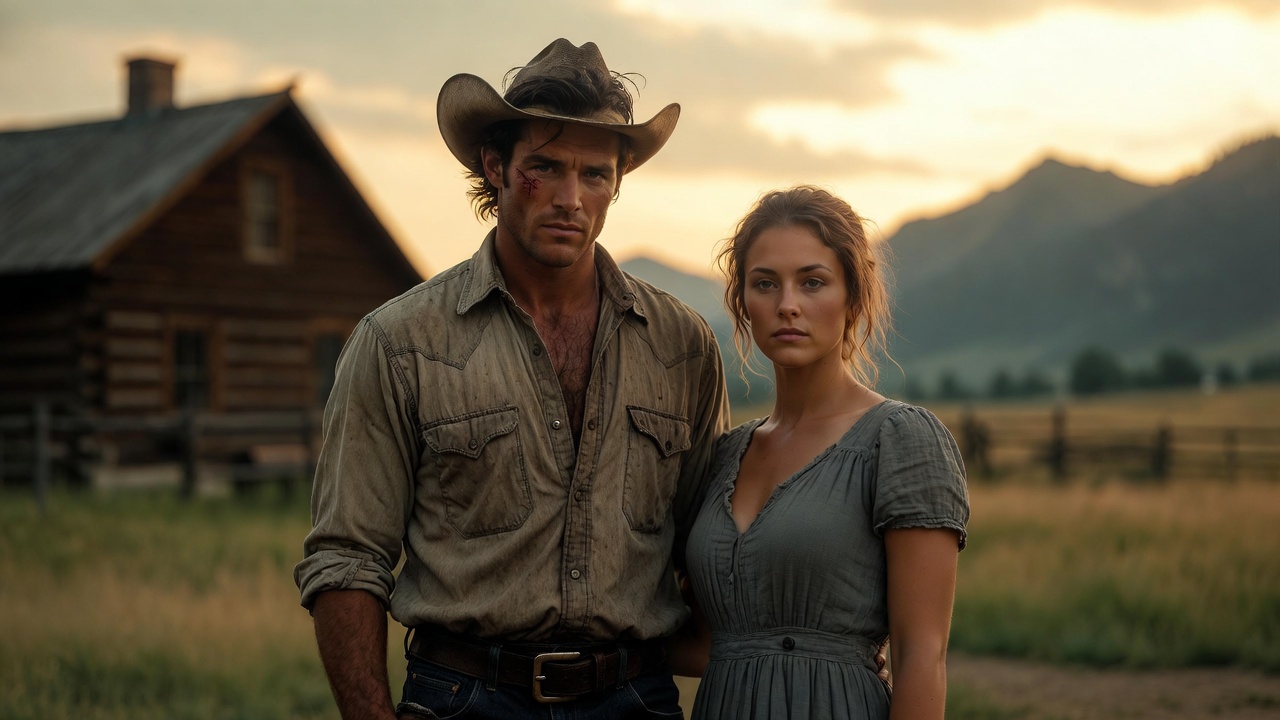
The man standing there looked like he’d been carved from the same unforgiving stone as the mountains looming beyond town. Tall, broad-shouldered, with dark hair that brushed his collar and eyes the color of a winter sky before a storm. But it was the scar that held her attention—a vicious thing that ran from his left temple down to his jaw, pulling the corner of his mouth into a permanent half-sneer.
“James McKenna,” he said, not offering his hand. “Thomas’s brother.”
His gaze traveled over her with all the warmth of a man inspecting livestock at auction. Clara lifted her chin, refusing to wilt under that cold assessment. She’d survived worse than a hard stare.
“I’m sorry for your loss, Mr. McKenna.”
“Are you.” It wasn’t a question. He picked up her trunk like it weighed nothing, muscles flexing beneath his worn shirt. “Wagon’s this way.”
She had to half-run to keep up with his long strides, her boots kicking up puffs of that cursed dust that seemed to coat everything in this godforsaken place. “Mr. McKenna, I—perhaps we should discuss arrangements. I have some money saved, enough for passage back East, or perhaps—”
“Get in.”
He’d stopped beside a weathered buckboard, throwing her trunk into the back with a thud that made her wince. When she didn’t move, he turned those glacier eyes on her again.
“Look, Miss Bennett. I don’t know what pretty words Thomas wrote you, and I don’t much care. He’s dead, buried three days now up on the ridge beside our ma and pa. You came all this way, and I reckon that wasn’t cheap. The McKenna ranch is two hours north. You’ll stay the night, get your bearings, and tomorrow I’ll take you back to town. Fair enough?”
Fair? Nothing about this was fair. Clara had sold everything she owned, said goodbye to the only friend she had in the world, traveled two thousand miles based on letters full of promises about mountain meadows and fresh starts. And now she stood in ankle-deep dust, being spoken to like an inconvenience by a man who looked like he’d sooner shoot her than offer her a cup of coffee.
“Fine,” she said, gathering her skirts and climbing onto the wagon seat. “One night.”
He made a sound that might’ve been agreement or might’ve been derision—hard to tell—and swung up beside her. The wagon lurched forward, and Clara gripped the seat to keep from sliding into him. His thigh was solid as oak where it nearly touched hers, and she shifted away, pressing herself against the far edge of the bench.
They rode in silence through town—past the saloon where piano music jangled, past the general store with its painted sign peeling in the relentless sun, past a church so small and plain it looked like a strong wind might blow it over. People stared. Women in faded calico whispered behind their hands. A man in a sheriff’s badge watched them pass with narrowed eyes.
“They know,” Clara said quietly. “About Thomas. About me.”
“Small town. Everyone knows everything.” James kept his eyes on the rutted road ahead. “By sundown, they’ll have decided you’re either an angel of mercy or a gold-digging harlot who killed him with her very presence.”
Heat flooded Clara’s cheeks. “That’s—”
“The truth. Facts don’t matter much out here, Miss Bennett. Only what folks decide to believe.”
The town fell away behind them, replaced by endless rolling grassland that shifted from gold to amber in the afternoon light. Mountains rose in the distance, their peaks already dusted with early snow. The land was beautiful in a harsh, unforgiving way—like James McKenna himself.
“Thomas never mentioned he had a brother,” Clara ventured after a long silence.
James’s jaw tightened. “I reckon there’s a lot Thomas didn’t mention.”
“Were you close?”
“Once.” The single word held a lifetime of complicated history. Then, after a pause: “He was younger than me by three years. Always was the charming one, the one folks took to. Could talk a snake out of its skin, that boy.”
“And you?”
His laugh was bitter as alkali water. “I’m the one who keeps the ranch running while pretty boys write poetry to mail-order brides.”
The cruelty in his words stung, but Clara heard something else beneath it—grief, raw and unprocessed. This hard man had loved his brother, whatever their differences. She knew about loving difficult people, about the complicated tangle of duty and resentment and fierce loyalty that family could be.
“The fever,” she said. “Was it quick?”
“Quick enough. He was sick Friday, dead by Monday.” James’s hands tightened on the reins, knuckles going white. “Nothing the doc could do.”
“I’m sorry.”
“Stop saying that.” His voice cracked like a whip. “You didn’t know him. You don’t get to mourn him.”
They rode the rest of the way in tense silence, the only sounds the creak of the wagon, the jingle of harness, and the endless whisper of wind through the grass. The sun was sinking toward the mountains when they finally topped a rise and Clara saw the ranch spread out in the valley below.
It was bigger than she’d expected—a sturdy log house with a covered porch, a barn that looked newly built, corrals holding a dozen horses, and outbuildings she couldn’t identify. Smoke rose from the chimney, and as they drew closer, she saw someone moving around outside.
James pulled the wagon to a stop in front of the house. Before Clara could climb down, the door banged open and an older woman emerged, wiping her hands on her apron. She had steel-gray hair pulled back in a severe bun and sharp dark eyes that missed nothing.
“So this is her,” the woman said, looking Clara up and down. “The bride who came too late.”
“Mrs. Kowalski,” James said, climbing down and reaching for Clara’s trunk. “This is Miss Bennett. She’ll be staying the night.”
“Just the night?” Mrs. Kowalski raised an eyebrow. “That hardly seems—”
“Just the night,” James repeated, his tone brooking no argument.
Clara climbed down on shaking legs, smoothing her travel-worn skirts. Mrs. Kowalski’s expression softened fractionally, and she gestured toward the door.
“Come on then, girl. You look like you’re about to fall over. There’s stew on the stove and a room already made up. James, bring her things inside.”
The house was warm and smelled of woodsmoke and cooking meat—such a contrast to the harsh wind outside that Clara nearly wept with relief. Mrs. Kowalski ushered her into a kitchen with a large table and a stove that radiated blessed heat.
“Sit,” the older woman commanded, ladling stew into a bowl. “Eat. We’ll talk after.”
Clara sat, too exhausted to argue, and picked up her spoon. The stew was rich and savory, and she realized she hadn’t eaten since early that morning. She was on her second bowl when James came in, his boots heavy on the wooden floor.
“I’ll be in the barn if you need me,” he said to Mrs. Kowalski, not looking at Clara.
“You’ll eat first,” Mrs. Kowalski said firmly. “Sit down, James McKenna. The horses can wait five minutes.”
Something flickered across his scarred face—surprise, maybe, or reluctant amusement—and he pulled out a chair across from Clara, putting as much distance between them as the table allowed.
They ate in uncomfortable silence, punctuated only by the scrape of spoons and the pop of wood in the stove. Clara kept her eyes on her bowl, acutely aware of James’s presence, the way he filled the room with barely contained energy, like a wolf that might bolt at any moment.
“Thomas’s room is ready,” Mrs. Kowalski said finally, breaking the tension. “I changed the linens this morning.”
Clara’s spoon clattered against her bowl. “Thomas’s room? I couldn’t possibly—”
“It’s the only spare room,” James said flatly. “I’ll sleep in the barn.”
“You’ll do no such thing,” Mrs. Kowalski snapped. “Your back can’t take another night on hay bales, and you know it. Miss Bennett will have Thomas’s room, you’ll keep your own, and that’s the end of it.”
The look James shot the housekeeper could’ve frozen hellfire, but he didn’t argue. He stood abruptly, his chair scraping against the floor.
“I’ve got work to do.”
He was gone before either woman could respond, the door slamming behind him hard enough to rattle the windows. Clara flinched at the sound.
“Don’t mind him,” Mrs. Kowalski said, gathering up the empty bowls. “He’s taking Thomas’s death hard. They weren’t always on the best terms, and that makes the grieving harder, I reckon.”
“What happened between them?”
Mrs. Kowalski’s mouth thinned into a hard line. “That’s not my story to tell, girl. Come on, I’ll show you to your room. You look dead on your feet.”
She was right. Now that Clara had eaten, the exhaustion crashed over her like a wave. She followed Mrs. Kowalski up a narrow staircase to a small room with whitewashed walls and a window overlooking the valley. A double bed dominated the space, covered in a quilt that looked handmade. On the dresser sat a daguerreotype in a simple frame—a young man with laughing eyes and an easy smile.
Thomas McKenna. The man she’d traveled two thousand miles to marry.
He looked nothing like his brother.
“I’ll leave you to settle in,” Mrs. Kowalski said from the doorway. “Privy’s out back, water pump’s in the kitchen. If you need anything in the night, my room’s at the end of the hall.”
“Thank you,” Clara managed. “For your kindness.”
The older woman’s expression softened. “You’ve had a hell of a day, pardon my language. Get some rest. Tomorrow will bring its own troubles.”
She closed the door gently, and Clara was alone.
She sat on the edge of the bed—Thomas’s bed—and finally let herself cry. Silent tears that tracked through the dust on her cheeks, tears for the life she’d left behind and the life that would never be, tears for a man she’d never met and the future that had died with him.
Through the window, she could see the barn, and in the square of lamplight spilling from its open door, the silhouette of a tall man working late into the night.
James McKenna.
Tomorrow she would leave this place, return to town, figure out what came next. But tonight, in this room that still smelled faintly of the man who should have been her husband, Clara admitted a terrible truth to herself:
The wrong brother had survived.
And God help her, she couldn’t stop wondering what that meant.
Clara woke to the smell of smoke and the sound of shouting.
For a disoriented moment, she thought she was back in Boston, back in the boarding house during the fire two years ago that had taken Mrs. Henley’s life and left Clara with nothing but the clothes on her back. But then she opened her eyes to unfamiliar whitewashed walls and remembered—Montana, Thomas, the scarred brother who looked at her like she was a problem to be solved.
The shouting came again, closer now, and she recognized James’s voice, sharp with command. She stumbled to the window and looked out into the pre-dawn gray.
The barn was on fire.
Not the whole structure—just one corner where flames licked up the wooden siding, sending sparks spiraling into the sky. James and two other men she hadn’t seen yesterday were hauling buckets from the pump, throwing water against the blaze while horses screamed in terror from inside.
Clara didn’t think. She grabbed her shawl, ran down the stairs in her nightdress, and burst out into the cold morning air. The acrid smell of burning wood filled her lungs, and she could feel the heat from twenty yards away.
“The horses!” she shouted, running toward the barn. “Someone needs to get the horses out!”
“Get back in the house!” James roared, not looking at her, his face streaked with soot and sweat despite the cold. “Now!”
But Clara had already reached the barn door. Through the smoke, she could see the animals in their stalls—a dozen terrified horses rearing and kicking, whites of their eyes showing. The fire was still small, contained to the far corner, but growing. Another few minutes and it would spread.
She yanked open the nearest stall door.
“Miss Bennett, don’t—” One of the ranch hands started toward her, but a crash from above stopped him. Part of the loft was coming down, burning hay raining like hellfire.
The horse in the first stall—a pretty paint mare—bolted past Clara and out into the yard. She moved to the next stall, then the next, fingers fumbling with latches while smoke burned her throat and made her eyes stream. Behind her, she heard James cursing, heard the splash of more water against hungry flames.
She was on the sixth stall when strong hands grabbed her shoulders and spun her around. James’s face was inches from hers, fury and fear warring in those storm-cloud eyes.
“What the hell do you think you’re doing?” he shouted over the roar of the fire.
“Saving your horses!” she shouted back, shoving at his chest. It was like pushing against granite. “Let me go!”
“The men can handle it—”
“They’re fighting the fire! The animals will burn!”
Something shifted in his expression. He released her shoulders, then grabbed her hand instead, his palm rough and warm against hers. “Then we do it together. Stay behind me.”
They worked in tandem after that, James kicking open stall doors while Clara urged the panicked animals toward the exit. Smoke filled the barn now, thick and choking. Clara’s lungs burned with every breath, and she could barely see three feet in front of her. But she kept moving, kept counting—seven horses out, eight, nine.
The tenth horse, a big bay gelding, refused to leave his stall. He reared and struck out with his front hooves, eyes rolling in terror.
“Stubborn bastard,” James muttered, then did something that made Clara’s heart stop. He walked right into the stall with that thrashing, terrified animal, speaking low and steady in a language she didn’t understand—not words so much as sounds, a rumbling calm that somehow cut through the chaos.
The horse’s ears flicked forward. James reached up, slow and careful, and grabbed the halter. “Come on now, Thunder. Come on, boy. That’s it.”
He led the gelding out just as a support beam cracked overhead. Clara heard it, saw James look up, saw the horror flash across his scarred face as he realized he wouldn’t make it clear in time.
She moved without thinking, throwing herself against his back and shoving with all her strength. They tumbled through the barn door in a tangle of limbs, hitting the dirt hard just as the beam crashed down exactly where they’d been standing seconds before.
Clara couldn’t breathe. Whether from the smoke or from the solid weight of James McKenna sprawled half on top of her, she wasn’t sure. She was aware of several things at once—the pounding of her heart, the smell of wood smoke and male sweat, the way his chest heaved against hers, the strange intimacy of being pressed together on the cold ground while chaos raged around them.
“You damn fool woman,” he rasped, but his voice lacked heat. His eyes, when they met hers, held something she couldn’t quite name. “You could’ve been killed.”
“So could you.”
They stared at each other for a heartbeat longer, and Clara felt something dangerous spark between them, hot as the flames consuming the barn. Then James was up and moving, hauling her to her feet with hands that weren’t quite steady.
“Get inside,” he said gruffly. “You’re half-naked and it’s freezing.”
Clara looked down and realized her nightdress was nearly transparent where the water from the buckets had splashed her. Heat flooded her cheeks, but she lifted her chin. “Not until the fire’s out and all the horses are accounted for.”
“They’re all out. We got them all.” He shrugged out of his coat—his arms were bare beneath, just a thin undershirt—and wrapped it around her shoulders. It smelled of smoke and leather and something uniquely him. “Now get inside before you freeze to death. I’ve got enough on my conscience without adding that.”
This time Clara didn’t argue. She retreated to the porch where Mrs. Kowalski waited with blankets, watching as the men finally got the fire under control. It took another hour, but eventually the flames died to smoldering embers, leaving one corner of the barn a blackened ruin.
James stood in the middle of the wreckage, hands on his hips, staring at the damage. Even from the porch, Clara could see the rigid set of his shoulders, the way his jaw clenched and unclenched.
“It was the lantern,” one of the ranch hands said, approaching cautiously. “Must’ve got knocked over somehow.”
“Knocked over.” James’s voice was flat, dangerous. “Or kicked over. Where’s Garrett?”
“Haven’t seen him since last night, boss. His bedroll’s gone from the bunkhouse.”
James spat a curse that would’ve made a sailor blush. “He set this fire. That son of a bitch set my barn on fire and ran.”
“Why would he do that?” Clara asked, stepping off the porch despite Mrs. Kowalski’s restraining hand on her arm.
All three men turned to look at her like they’d forgotten she was there. James’s expression was unreadable, but the other two ranch hands—one grizzled and old, one barely out of boyhood—exchanged uncomfortable glances.
“Go on back to the bunkhouse,” James told them. “See to the horses, make sure none of them are injured. We’ll rebuild the corner once we know what we’re dealing with.”
They left quickly, and James turned his full attention to Clara. In the growing daylight, she could see how exhausted he looked—lines of weariness etched deep around his eyes and mouth, soot streaking his face, his shirt torn at the shoulder.
“You should’ve stayed in the house,” he said.
“You should thank me for saving your life.”
“I should—” He stopped, ran a hand through his dark hair, leaving it standing on end. Then, so quietly she almost missed it: “Thank you.”
“Why did that man burn your barn?”
James was quiet for a long moment, his gaze drifting to the mountains where the sun was just starting to peek over the peaks, painting the snow-capped ridges gold and pink. When he finally spoke, his voice was rough with something that might’ve been shame.
“Because I fired him two days ago for stealing. And because small men with wounded pride do stupid, dangerous things.” He looked at her then, really looked at her, and Clara saw something raw and unguarded in his face. “You could’ve died in there. Do you understand that? You could’ve died trying to save horses that can be replaced.”
“But they weren’t replaced, were they? They’re living, breathing creatures who deserved a chance.”
“They’re animals.”
“So are we, Mr. McKenna. Just animals trying to survive in a hard world.”
Something flickered across his face—surprise, maybe, or recognition. He opened his mouth like he wanted to say something, then closed it again and shook his head.
“You’re still leaving today,” he said, but it sounded like he was trying to convince himself. “Soon as you’re ready, I’ll take you back to town.”
“Of course.” Clara pulled his coat tighter around her shoulders. “That was the plan.”
But neither of them moved.
Mrs. Kowalski appeared in the doorway, practical as always. “Both of you inside. You need food and rest, and Miss Bennett needs proper clothes before she catches her death. James, there’s hot water for washing. The smoke’s in your hair and all over your skin.”
James nodded but didn’t look away from Clara. “Thank you,” he said again. “For what you did. That was… brave. Stupid, but brave.”
“I’ve been called worse things,” Clara said lightly, though her heart was hammering in her chest.
She went inside, but paused at the door to look back. James stood in the yard, surrounded by smoke and ash, staring at the damaged barn like it held answers to questions he didn’t know how to ask. In the golden light of dawn, with his shoulders slumped and his guard finally down, he looked lost.
Clara’s chest tightened with an emotion she had no business feeling.
Upstairs, she washed the soot from her skin and changed into her only other dress—a practical gray cotton that had seen better days. Her hands shook as she buttoned it, and she couldn’t tell if it was from the cold or the delayed shock of what they’d just survived.
Through the window, she watched the ranch hands leading the horses one by one into the corral, checking them for injuries. All accounted for. All safe because she and James had acted, because they’d worked together like they’d been doing it for years instead of hours.
A knock at the door startled her.
“Breakfast is ready,” Mrs. Kowalski called. “And we need to talk, you and I.”
Clara found the older woman in the kitchen, stirring a pot of porridge with more force than necessary. Two bowls sat on the table, steam rising from them.
“Sit,” Mrs. Kowalski commanded.
Clara sat.
“I’ve been with this family for fifteen years,” Mrs. Kowalski began without preamble. “Came on when the boys’ mother died, stayed because someone needed to keep them from killing each other or themselves. I loved Thomas like he was my own, God rest him. But that boy had a gift for seeing only what he wanted to see.”
Clara’s spoon paused halfway to her mouth. “I don’t understand.”
“Thomas painted you a pretty picture in his letters, didn’t he? Told you about the ranch, the mountains, the life you’d have here. But he left things out. Important things.”
“Like what?”
Mrs. Kowalski sat down heavily, her lined face grave. “Like the fact that this ranch is barely breaking even. Like the debts their father left when he died five years back. Like the drought that killed half the herd last summer, or the wolves that took the other half in the spring. Thomas was a dreamer, and dreams don’t pay bills or fix barns or keep food on the table.”
“But the ranch looks—”
“It looks good because James works himself to death keeping it that way. He’s the one who rebuilt the barn after the storm two years ago. He’s the one who breaks the horses and drives them to Fort Benton to sell. He’s the one who sits up nights figuring numbers, trying to make the money stretch.” Mrs. Kowalski’s voice softened. “Thomas was charm and words. James is the one who keeps this place alive.”
Clara set down her spoon, appetite gone. “Why are you telling me this?”
“Because you’ve got a decision to make, girl. You can go back to town like James plans, buy a ticket East, and forget this place ever existed. Or—”
“Or?”
Mrs. Kowalski met her eyes squarely. “Or you can stay. This ranch needs a woman’s touch. It needs someone who isn’t afraid of hard work, someone with sense and spine. I’m getting old, and I can’t do it all anymore. James needs help, whether he’s too proud to admit it or not.”
“He doesn’t want me here.”
“He doesn’t want anyone here. That man’s been alone so long he’s forgotten there’s any other way to be. But I saw how you two worked together this morning. I saw how you didn’t hesitate, didn’t shrink back. And I saw how he looked at you after.”
Heat crept up Clara’s neck. “You’re mistaken. He looks at me like I’m a burden.”
“He looks at you like you scare him. There’s a difference.” Mrs. Kowalski stood, picking up her bowl. “Think on it. You’ve got until he hitches up the wagon. But remember—sometimes the life we planned isn’t half as good as the life waiting for us if we’re brave enough to take it.”
She left Clara alone with her thoughts and cooling porridge.
Through the window, Clara could see James at the water pump, stripped to the waist, washing away the smoke and ash. Water sluiced over his scarred back—and there were more scars there, she realized, faint white lines that spoke of old pain, old violence. He was lean and hard, all muscle and sinew with no softness anywhere, a body built by labor and survival.
He turned, as if sensing her gaze, and their eyes met across the distance. Clara should’ve looked away, should’ve had the decency to be embarrassed at being caught staring. But she didn’t.
And neither did he.
The moment stretched between them like a rope pulled taut, humming with tension. Then Mrs. Kowalski bustled back into the kitchen, breaking the spell, and James turned away to pull his shirt back on.
Clara pressed her hand to her chest, feeling her heart race beneath her palm.
She’d come here to marry a charming man who wrote pretty letters. Instead, she’d found his brother—difficult, damaged, and completely wrong for her in every possible way.
So why couldn’t she stop thinking about the way his hand had felt wrapped around hers in the burning barn? The weight of him when they’d fallen together, the fierce protectiveness in his voice when he’d called her a fool, the vulnerability in his eyes when he’d thanked her?
A wagon rattled into the yard, and Clara looked out to see a man in a sheriff’s badge climbing down. James met him by the porch, and even from inside, Clara could see the tension in every line of his body.
She shouldn’t eavesdrop. It wasn’t proper.
She moved closer to the window anyway.
“—looks like arson to me,” the sheriff was saying. “You got any enemies, McKenna?”
“Besides half the town?” James’s laugh was bitter. “Take your pick, Sheriff.”
“I heard you fired Pete Garrett.”
“Two days ago. Man’s a thief.”
“Man’s also got a big mouth and a mean streak. He was at the saloon last night, telling anyone who’d listen how you wronged him, how the ranch should’ve been his brother’s and not yours.” The sheriff spat tobacco juice into the dust. “How Thomas’s bride arrived to find she’d married into a family of bastards.”
Clara’s breath caught. Is that what people were saying?
James’s voice went cold as January ice. “My brother’s been dead less than a week, and folks are already spreading poison. Sounds about right for Redemption Creek.”
“I’m just telling you what I heard. There’s talk, McKenna. About the fire, about the woman, about—” The sheriff hesitated. “About how convenient it was, Thomas dying right before his bride arrived.”
The silence that followed was so complete Clara could hear her own heartbeat.
“What exactly are you suggesting, Sheriff?” James’s words were quiet, dangerous.
“I’m not suggesting anything. But you know how it looks. Thomas was healthy as a horse until—”
James moved so fast Clara barely saw it. One moment he was standing still, the next he had the sheriff by the shirtfront, slamming him back against the wagon.
“My brother died of fever,” he snarled. “Doc Pierce confirmed it. If you’re implying I had anything to do with his death, say it plain so I know whether to punch you or shoot you.”
“James!” Mrs. Kowalski rushed out onto the porch. “Let him go!”
For a terrible moment, Clara thought he wouldn’t. Then James released the sheriff with a shove and stepped back, hands clenched into fists.
The sheriff straightened his shirt, his face red. “You just assaulted a lawman, McKenna.”
“You just accused me of murdering my brother. I’d say we’re even.”
“This isn’t over.”
“It is as far as I’m concerned. You want to investigate the fire? Fine. Start with Pete Garrett. Otherwise, get off my land.”
The sheriff climbed back into his wagon, but he paused before driving away. “That woman staying here isn’t going to help the rumors any. People are talking. Might be best if she moved to town, stayed at the boarding house until you can sort out what to do with her.”
“What to do with her?” James’s laugh was sharp enough to draw blood. “She’s not a stray dog, Sheriff. She’s a woman who traveled two thousand miles based on promises my brother made. And she’ll stay or go as she damn well pleases.”
He stalked toward the house without waiting for a response, taking the porch steps two at a time. Clara barely had time to step back from the window before he burst through the door.
He stopped short when he saw her standing there. She knew he could tell she’d heard everything—the accusations, the rumors, the barely contained violence in his response.
“I’ll hitch up the wagon,” he said roughly. “Give you ten minutes to gather your things.”
“Mr. McKenna—”
“Don’t.” He held up a hand. “Just… don’t. You heard what he said. You know what people are thinking. The longer you stay here, the worse it’ll get. For both of us.”
He was right. Clara knew he was right. The smart thing, the safe thing, would be to leave. To put distance between herself and this hard man with his scarred face and his damaged barn and his grief that he wore like armor.
But when had Clara Bennett ever done the smart thing?
“What if I don’t want to go?” she heard herself say.
James froze. “What?”
“What if I want to stay? At least for a while longer. Mrs. Kowalski could use the help, and I—” She faltered, searching for the right words. “I have nowhere else to go. No money for a ticket East. No job waiting for me. Thomas promised me a home, and I know that’s not your responsibility, but—”
“You can’t stay here.” James’s voice was strained. “It wouldn’t be proper. People already think—”
“I don’t care what people think.” And as she said it, Clara realized it was true. “I’ve been judged my whole life, Mr. McKenna. For being an orphan, for being poor, for accepting a proposal from a man I’d never met. One more scandal won’t kill me.”
“It might kill me.”
The words were so quiet she almost missed them. She looked up and found him staring at her with something like desperation in his storm-cloud eyes.
“Why?” she whispered.
He closed the distance between them in two strides, and suddenly he was too close, close enough that she could see the flecks of silver in his eyes, could smell the soap he’d used to wash away the smoke.
“Because you’re trouble,” he said hoarsely. “Because you ran into a burning barn without thinking twice. Because you look at me like I’m not a monster. Because—” He stopped, jaw clenching. “Because I can’t be what Thomas was. I can’t write pretty words or make promises about a future I’m not sure I can deliver. All I’ve got is work and debt and a ranch that’s barely holding together. That’s not enough for anyone.”
“Maybe I don’t need pretty words,” Clara said, her voice steadier than she felt. “Maybe I just need the truth.”
James laughed, but there was no humor in it. “The truth? The truth is my brother was the good one, the one people loved. And I’m the bastard who survived. That’s the truth, Miss Bennett.”
“No,” Clara said fiercely. “The truth is your brother wrote beautiful letters while you kept this ranch alive. The truth is you risked your life to save a stubborn horse while he was—” She caught herself, but too late.
“While he was what?” James’s eyes narrowed. “What did Thomas tell you in those letters?”
Clara bit her lip. She shouldn’t say it. It would only make things worse.
But she was tired of lies and pretty words and half-truths.
“He told me he ran the ranch alone. That he built it from nothing. That he was the one who—” She stopped, seeing the pain flash across James’s scarred face. “I’m sorry. I shouldn’t have—”
“No.” James’s voice was hollow. “You should know what kind of man you almost married. Thomas was good at taking credit for other people’s work. Always was.”
He turned away, and Clara saw his shoulders rise and fall with a deep breath.
“I’ll hitch up the wagon,” he said again. “You should go. Before—”
Thunder cracked overhead, so loud and sudden that Clara jumped. Through the window, she saw dark clouds rolling over the mountains, moving fast.
“Storm’s coming,” Mrs. Kowalski announced, appearing in the doorway. “Big one, by the looks of it. Nobody’s going anywhere today.”
James’s jaw clenched. “I can drive in rain.”
“Not in this, you can’t. Look at that sky, boy. That’s a Montana storm, the kind that drops a foot of snow in an afternoon. You try to drive through that, you’ll both end up dead in a ditch.”
As if to prove her point, the first fat drops of rain began to fall, quickly turning to sleet that clattered against the windows like thrown pebbles.
James stood rigid, staring out at the storm as it rolled toward them with inexorable force.
“Looks like you’re stuck with me a while longer, Mr. McKenna,” Clara said softly.
He didn’t answer. But when he finally turned to look at her, Clara saw something in his eyes that made her breath catch—something dangerous and desperate and entirely too complicated for a man who’d just lost his brother and a woman who’d arrived too late to become a bride.
The storm hit like a hammer, and Clara couldn’t shake the feeling that it was only the beginning of what was coming.
The snow fell for three days.
Clara had never seen anything like it—great white curtains of it that turned the world beyond the windows into a featureless void. The wind howled around the house like a living thing, rattling the shutters and finding every crack in the walls to send icy fingers through. Inside, they huddled close to the stove, conserving firewood and lamp oil, existing in a strange suspended reality where time seemed to have stopped altogether.
James barely spoke. He worked with grim determination—feeding the animals in the barn, splitting wood, checking the roof for damage, doing anything that kept him moving and kept him away from Clara. At meals, he sat as far from her as the table allowed, his scarred face closed off, his eyes carefully averted.
It was driving her mad.
On the third morning, Clara found him in Thomas’s room.
She’d been looking for extra blankets when she heard the sound—a low, ragged noise that might’ve been pain or might’ve been grief. The door was cracked open, and through it she saw James sitting on the edge of the bed, Thomas’s letters spread out around him like fallen leaves.
“I didn’t know he kept copies,” James said without looking up. His voice was rough, like he’d been crying, though his face was dry. “Found them in his desk drawer when I was going through his things.”
Clara should’ve left. Should’ve given him privacy. Instead, she stepped into the room and closed the door softly behind her.
“Mr. McKenna—”
“James.” He looked up then, and the raw pain in his eyes stole her breath. “If you’re going to stand there and watch me fall apart, the least you can do is call me by my name.”
“James,” she whispered, moving closer. “I’m sorry. I didn’t mean to intrude.”
“You want to know the funny part?” He picked up one of the letters, his hand shaking slightly. “He wrote beautiful things. Talked about the mountains at sunset, about building a future together, about love and hope and all the pretty dreams a woman wants to hear. And you know what? I believed him. I actually thought maybe Thomas had finally grown up, finally found something real.”
“Maybe he had.”
James’s laugh was bitter. “He wrote to you about the ranch he’d built from nothing. Want to know the truth? Our father built this ranch. Broke his back and his spirit doing it, trying to make something out of this hard land. He died owing more than the place was worth, and I’ve spent five years clawing my way out of that debt.” He crushed the letter in his fist. “Thomas helped when it suited him. When there was glory in it or when it made him look good. But the day-to-day grind? The brutal, endless work of keeping this place alive? That was beneath him.”
Clara sat down beside him on the bed, close enough that their shoulders almost touched. “Why didn’t you tell him no? When he wanted to send for a bride?”
“Because I’m a fool.” James dropped the crumpled letter, scrubbing his hands over his face. “Because he was my little brother and I wanted him to be happy. Because I thought maybe having a wife, having you, would finally make him settle down, take responsibility.” His voice cracked. “Because I loved him, even when I hated him.”
“That’s not foolish,” Clara said softly. “That’s family.”
“Family.” James turned to look at her, and she saw something dangerous kindle in his storm-cloud eyes. “You want to know about family, Clara? I’ll tell you. Thomas and I fought the night before he got sick. Screamed at each other for hours about money, about the ranch, about responsibilities he kept dodging. I told him he was selfish. Told him he had no business bringing a wife here when he couldn’t even take care of himself. Told him—”
He stopped, his jaw clenching so hard she could see the muscle jump beneath his skin.
“Told him what?” Clara prompted gently.
“Told him I wished he’d never written those letters. That I wished—” James’s voice dropped to barely a whisper. “That I wished you’d never come.”
The confession hung between them like smoke. Clara felt her chest tighten, felt the sharp sting of tears she refused to let fall.
“And now?” she asked. “Do you still wish that?”
James looked at her for a long moment, and Clara saw the war happening behind his eyes—duty against desire, grief against something that looked dangerously like hope.
“No,” he said finally, the word rough as gravel. “God help me, no.”
The air between them felt charged, electric, like the moment before lightning strikes. Clara was acutely aware of how close they were, of the way his leg pressed against hers through layers of fabric, of the heat radiating from his body in the cold room.
“The things Thomas wrote to you,” James said, his voice low and strained. “The promises he made—I can’t give you those things. I can’t be charming or romantic or easy. I’m rough and I’m difficult and I’ve got a temper that scares most people. I’ve got scars inside and out, and this ranch takes everything I have just to keep it running. That’s all I can offer.”
“What if that’s enough?” Clara heard herself say. “What if I don’t need easy? What if I need—”
She stopped, the words catching in her throat. But James was looking at her with such intensity that she couldn’t look away, couldn’t retreat into safe silence.
“What if I need real?” she finished in a whisper.
James made a sound that might’ve been pain or might’ve been surrender. His hand came up to cup her face, his palm rough against her cheek, his thumb brushing across her lips with a gentleness that contradicted everything else about him.
“You don’t know what you’re saying,” he said hoarsely. “You don’t know me. Not really.”
“Then let me know you.” Clara turned her face into his palm, her eyes never leaving his. “Let me see the man my husband’s brother really is.”
“Clara—”
Whatever he was going to say died as she leaned forward and pressed her lips to his.
For a heartbeat, he froze. Then he was kissing her back, his hand sliding into her hair, his other arm wrapping around her waist and pulling her closer. It wasn’t gentle or practiced or anything like the romantic kisses described in novels. It was desperate and hungry and raw—two people who’d been alone too long, two people who’d found something unexpected in each other, two people who were probably making the biggest mistake of their lives and didn’t care.
When they finally broke apart, both breathing hard, James rested his forehead against hers.
“This is wrong,” he said, but his arms didn’t release her. “You came here to marry my brother.”
“Your brother is dead.” Clara’s voice was steady despite the way her heart hammered. “And I’m alive, and so are you, and I’m tired of pretending I don’t feel this.”
“People will talk. They already are.”
“Let them talk.”
“The ranch is barely surviving—”
“Then we’ll make it survive together.”
James pulled back to look at her, his scarred face a mixture of hope and fear. “You don’t know what you’re signing up for. Winters here are brutal. The work never ends. There are no guarantees, Clara. I could lose this place tomorrow. I could—”
She kissed him again, softer this time, silencing his protests. When she pulled away, she saw something shift in his expression—the last of his defenses crumbling.
“I didn’t come here for guarantees,” she said. “I came here for a new life. Maybe it’s not the life I planned, but—” She smiled, a real smile that felt like sunshine after days of storm. “Maybe it’s better.”
“Better?” James’s laugh was shaky. “Woman, you’re either the bravest person I’ve ever met or the craziest.”
“Can’t I be both?”
He kissed her then, long and thorough, pouring all the words he couldn’t say into the touch of his lips, the press of his hands. When they finally broke apart, his eyes were bright with something that might’ve been tears.
“If we do this,” he said, “if you stay—we do it right. Proper. I’ll marry you, Clara Bennett, if you’ll have me. Not because you need a home or because you traveled all this way. But because—” He stopped, swallowing hard. “Because in three days, you’ve made me feel less alone than I’ve felt in five years.”
Clara’s breath caught. “Is that a proposal, James McKenna?”
“It’s a terrible one, I know. No pretty words, no poetry, just—”
“Yes.”
He blinked. “Yes?”
“Yes, I’ll marry you. Yes, I’ll stay. Yes to all of it.” She cupped his scarred face in both her hands. “On one condition.”
Wariness crept into his expression. “What condition?”
“No more secrets. No more carrying everything alone. We’re partners, James. In everything. The work, the worry, the hope—all of it. Can you do that?”
For a long moment, he just looked at her. Then, slowly, he nodded. “I can try.”
“That’s all I’m asking.”
A commotion from downstairs interrupted them—Mrs. Kowalski’s voice raised in surprise, then the sound of boots stomping snow from the floor. James was on his feet instantly, his hand going to the pistol he always wore at his hip.
“Stay here,” he ordered, but Clara was already following him down the stairs.
In the kitchen, three men stood dripping melted snow onto the floor. One of them was the sheriff. The other two were ranch hands Clara recognized from the neighboring spread.
“McKenna,” the sheriff said grimly. “We need to talk.”
James’s body went rigid. “Talk about what?”
“Found Pete Garrett this morning. Frozen to death about two miles from here, looks like he got caught in the storm trying to make it to town.” The sheriff’s gaze flicked to Clara, then back to James. “He had a bag full of your tools, some silver candlesticks that Mrs. Kowalski here reported missing last month, and a letter.”
“What kind of letter?”
The sheriff pulled a folded paper from his coat. “One he wrote but never sent. A confession of sorts. Says he set the fire because you fired him for stealing. Says he was planning to rob the house while you were fighting the flames, but the woman—” He nodded at Clara. “—spooked his plans when she ran into the barn.”
James’s hand fell away from his pistol. “So you came to tell me I was right?”
“I came to apologize.” The words clearly cost the sheriff. “I said things the other day, implied things, that were out of line. You’ve had enough grief without me adding to it.”
James nodded stiffly. “Apology accepted.”
“There’s more.” The sheriff glanced at Mrs. Kowalski, who’d gone very still. “Garrett’s letter also talks about Thomas. Says Thomas knew about the stealing, was in on it even. Says they had a deal—Garrett would take things piece by piece, sell them in Fort Benton, and split the profits with Thomas.”
The silence that followed was absolute.
Clara saw the pain flash across James’s face, raw and immediate, before he locked it down behind his usual stoic mask. But she knew. She understood what this revelation cost him—the final destruction of whatever illusions he’d held about his brother.
“I see,” James said flatly. “Anything else?”
“Just—” The sheriff cleared his throat. “Just that I’m sorry. For your loss, for the accusations, for all of it. You’re a good man, McKenna, even if the town doesn’t always see it.”
After the sheriff and his men left, James stood at the window, staring out at the endless white. Clara came up beside him, slipping her hand into his. He gripped it like a lifeline.
“He was stealing from us,” James said quietly. “From his own family. To pay for what? More whiskey? More nights at the saloon?”
“You don’t know that. The letter could’ve been—”
“It’s true.” Mrs. Kowalski spoke from the doorway, her voice heavy with old secrets. “I knew about the missing things. I confronted Thomas about it a month ago. He swore he’d stop, swore it was just because he needed money to bring you here properly, to make everything perfect for his bride.”
James laughed, a sound like breaking glass. “Of course. Even his thieving was romantic.”
“He loved you,” Mrs. Kowalski said. “In his way. He just—he couldn’t be what you needed him to be.”
“No.” James’s voice was hollow. “He couldn’t.”
Clara squeezed his hand. “But you’re what I need. Right now, that’s all that matters.”
He turned to look at her, and she saw the moment he made a choice—to let the past be past, to let his brother’s flaws and failures rest with him in the frozen ground. To choose forward instead of backward.
“Marry me tomorrow,” he said suddenly. “The storm’s breaking. We’ll ride into town, find the preacher, do it right and proper before anyone can say otherwise.”
“Tomorrow?” Clara’s heart leapt. “That’s—”
“Too fast? Too soon?” His scarred face was vulnerable, open. “Tell me if it is. Tell me if you need time.”
She thought about the life she’d left behind in Boston—the grinding poverty, the loneliness, the feeling of being trapped in a future that held nothing but more of the same. She thought about Thomas’s pretty letters full of beautiful lies. And she thought about James—difficult, damaged, brutally honest James who worked until his hands bled to keep this ranch alive, who’d run into a burning barn to save a stubborn horse, who kissed like a man drowning and she was air.
“It’s perfect,” she said.
The next day dawned clear and cold, the kind of crystalline morning that makes the whole world look new. They rode to town in the wagon, bundled in furs and blankets, with Mrs. Kowalski sitting between them like a chaperone and grinning like she’d personally arranged the whole thing.
The preacher married them in his small parlor, with Mrs. Kowalski and the preacher’s wife as witnesses. Clara wore her gray cotton dress because it was all she had, and James wore his cleanest shirt and a collar that looked like it was strangling him. His hands shook when he slipped the simple gold band onto her finger—his mother’s ring, Mrs. Kowalski whispered, kept all these years.
“I, James McKenna, take you, Clara Bennett, to be my lawfully wedded wife,” he said, his voice rough with emotion. “To have and to hold from this day forward, for better or worse, for richer or poorer, in sickness and in health, to love and to cherish, till death do us part.”
When it was Clara’s turn, she looked into his storm-cloud eyes and spoke the words that bound her life to his. And when the preacher told James he could kiss his bride, he did—gentle and reverent and full of promise.
They emerged from the preacher’s house to find half the town staring. Clara saw the whispers start, saw the sidelong looks and raised eyebrows. But James just wrapped his arm around her waist and helped her into the wagon like she was something precious.
“Let them talk,” he murmured against her ear. “You’re mine now, and I’m yours, and the rest of the world can go to hell.”
Clara laughed, giddy with joy and terror and the sheer improbability of it all. “That’s not very romantic, husband.”
“Good thing you didn’t marry me for romance.”
“No,” she agreed, leaning into his warmth as he drove them home through the snow. “I married you for something better.”
“What’s that?”
She looked at him—this hard, scarred man who’d become hers through the strangest twist of fate—and smiled. “The truth.”
The ranch looked different when they returned, though nothing about it had changed. Maybe it was Clara who’d changed, who could now see past the weathered wood and the patched roof and the damaged barn to the home it could become. Would become, with time and work and the kind of stubborn determination she’d learned from Boston’s harsh streets.
That night, after Mrs. Kowalski had tactfully retired to her room, James built up the fire in his bedroom—their bedroom now—until it blazed warm and bright. He stood by the window, looking out at the mountains silvered by moonlight, and Clara saw the tension in his shoulders, the uncertainty.
She crossed to him, wrapped her arms around his waist from behind, and felt him relax into her touch.
“Scared?” she asked softly.
“Terrified,” he admitted. “I don’t know how to do this, Clara. How to be a husband, how to—”
She turned him around to face her. “Neither do I. We’ll figure it out together.”
He cupped her face in both hands, his callused palms gentle against her skin. “I can’t promise it’ll be easy. I can’t promise we won’t struggle or fight or have days where we wonder what the hell we were thinking.”
“Good.” Clara smiled up at him. “Easy is overrated.”
“You’re remarkable, you know that?”
“I’m practical. There’s a difference.”
“No,” James said, his voice thick with emotion. “You’re remarkable. You’re brave and strong and you ran into a burning barn without thinking twice and you married a man you barely know because—”
“Because he’s real,” Clara finished. “Because he tells the truth even when it hurts. Because he works until his hands bleed for the things he loves. Because—” She rose up on her toes to kiss him. “Because I love him.”
The words hung in the air between them, impossible and true.
“Clara—”
“You don’t have to say it back. Not yet. Not until you mean it.” She smiled against his lips. “I’ve got time.”
But James was shaking his head. “I’ve been trying not to say it since you shoved me out of that barn. I love you, Clara McKenna. God help me, I do.”
He kissed her then, and it was different from before—not desperate or hungry but something deeper, something that felt like coming home. They came together in the firelight, two damaged people finding wholeness in each other, two souls who’d taken the long way round to where they were always meant to be.
Later, lying in the darkness with James’s arm wrapped around her waist and his breath warm against her neck, Clara thought about the journey that had brought her here. The pretty letters from a charming man. The long train ride full of dreams and hope. The telegram that had shattered everything.
If Thomas had lived, she would’ve married him. Would’ve spent her life with a man who wrote beautiful words but couldn’t back them up with action, who charmed everyone but loved no one quite enough.
Instead, she’d found James. Difficult, honest, broken James who’d lost his brother and gained a wife in the span of a week. Who worked like a man possessed and loved like it might kill him. Who’d given her the truth when pretty lies would’ve been easier.
“What are you thinking?” James murmured sleepily.
Clara snuggled closer to his warmth. “That I married the wrong brother.”
She felt him tense, then relax when she continued.
“And found exactly the right man.”
His arm tightened around her. “You sure about that?”
“I’ve never been more sure of anything.”
Outside, the wind whispered through the pines, and snow began to fall again—soft and gentle this time, blanketing the world in white. Inside, two people who’d been alone too long held each other close and dreamed of the future they’d build together.
It wouldn’t be easy. Clara knew that. There would be hard winters and lean years, gossip and judgment, setbacks and struggles. But they’d face it all together—she and this scarred, beautiful man who’d taught her that sometimes the wrong choice leads you exactly where you need to be.
In the morning, they’d start the work of rebuilding the damaged barn. They’d plan the spring planting, talk about the horses James wanted to break and sell, dream about the life they’d carve out of this harsh and unforgiving land.
But tonight, Clara was exactly where she belonged—in the arms of the right brother, in the home she’d choose again and again, in a love born from ashes and truth and the kind of courage it takes to embrace the unexpected.
She’d come to Montana to marry a charming stranger and build a safe, predictable life.
Instead, she’d married his difficult brother and found something far more precious—a love worth fighting for, a partnership built on honesty, and a future that was wholly, beautifully theirs.
And in the end, that was worth more than all the pretty letters in the world.
Moral of the Story
Beautiful promises can be tempting, but the strongest love is built on truth, sacrifice, and steady action. Sometimes the life that falls apart is only making room for the one that truly belongs to you.
Reader Question
If you were Clara, would you have stayed and built a life with James so quickly, or would you have left Redemption Creek and started over somewhere else?
Leave a Reply