He Married the Ranch Cook to Save Her — But Fell in Love for Real.
The first time I understood that a woman could die without a bullet, I was standing in the snow with my wedding ring still warm on my finger, while another woman held my husband’s face like it belonged to her.
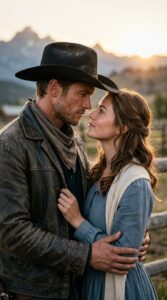
The wind was cruel that day.
It pushed my shawl back. It froze my tears before they could fall. The whole town of Cinder Ridge stood outside the church and watched me like I was some foolish girl in a traveling show.
Then Rowan Vey said words that cracked something inside me.
“Calista,” he whispered, with pain in his voice, “why did you come back now?”
Not why are you here.
Not leave us alone.
Why did you come back now.
That one word told me more than any long speech could.
Now.
As if she still had a place in his heart.
As if I had only been filling space.
As if our marriage had never been a real choice.
I remember holding my breath so hard my chest hurt. I remember the church bell still ringing. I remember the town waiting for me to cry.
But I did not cry.
Not then.
What I did next changed everything.
But to understand why that day broke me, you first need to know how a quiet ranch cook like me ended up marrying the coldest, kindest cowboy in the whole valley.
And you need to know what promise he made to my dying father.
Because none of us knew yet how expensive that promise would become.
My name is Lark Ashdown.
And this is how my life was saved, ruined, and changed forever.
It started on the morning my father died.
The sky over Cinder Ridge looked white and empty, like God had forgotten to paint it. The air smelled like dust and smoke and old coffee. I was in the cookhouse behind the Vey ranch bunkhouse, stirring a pot of beans and salt pork while the men outside shouted at each other over horses and rope.
That was my life then.
I cooked before sunrise.
I kneaded bread while it was still dark.
I packed tin plates with bacon grease and biscuits.
I smiled when the cowhands joked too loud.
I kept my head low.
I went home with sore feet and flour on my arms.
It was not a grand life. But it was honest. And my father was still alive then, which made even hard days feel safe.
He was a blacksmith once. Then his lungs got weak. Then his hands started to shake. By the end, he could barely sit up without coughing. Still, every evening, I hurried home with leftover stew or bread so I could feed him while it was warm.
That morning, I kept looking at the window.
Something in my chest felt wrong.
Like a horse before a storm.
Old Miv, one of the ranch hands, leaned into the kitchen door and grinned. “Lark, you trying to poison us today or save us?”
I gave him a tired smile. “You still breathing, so I must be doing something right.”
The men laughed.
Then another voice came from the doorway.
Low. Calm. Heavy.
“She always does.”
I turned.
Rowan Vey stood there with snow on his coat collar and leather gloves in one hand.
He was a hard man to look at for too long.
Not because he was cruel. Because he was not.
Cruel men are easy to understand.
They shout. They take. They hurt.
But Rowan was quiet.
He was the kind of man who carried pain like a locked box inside his chest. Tall. Broad in the shoulders. Dark hair. Eyes like winter river water. He did not smile often, but when he did, it felt rare, like sunlight in a bad season.
He owned the biggest ranch near Cinder Ridge.
Men listened when he spoke.
Women watched when he rode by.
And I had spent two years cooking for his workers without ever fully understanding him.
He set a sack of flour by the wall. “Store was short on sugar. I brought what I could.”
“Thank you,” I said.
His eyes stayed on me one moment too long. “You look tired.”
“I slept fine.”
It was a lie.
He knew it.
But Rowan never pushed people when they were trying to hold themselves together. That was one of the things that made him dangerous to my heart. A loud man can be avoided. A gentle one can ruin you.
He gave a small nod and turned to leave.
Then little Finnick, the stable boy, came running so fast he almost slipped.
“Miss Lark!” he shouted. “Miss Lark!”
My spoon fell from my hand.
The whole cookhouse went still.
Finnick stopped in front of me, breathing hard, his face pale under the dirt. “It’s your pa.”
Everything inside me dropped.
I do not remember taking off my apron.
I do not remember running out the door.
I only remember the sound of my own boots hitting frozen ground while the world went thin and strange around me.
And behind me, I heard Rowan call my name.
But I did not stop.
By the time I reached our little house at the edge of town, Mrs. Hester from next door was standing outside with her hands twisted in her shawl.
One look at her face, and I knew.
Still, I shook my head.
“No,” I said, though my voice sounded far away. “No. No, he was breathing when I left. He was warm. I covered him good.”
Mrs. Hester stepped toward me. “Lark—”
I went past her.
The door was open.
The room was quiet.
Too quiet.
My father lay on the bed by the wall. His blanket was pulled up to his chest. His eyes were closed. His face looked calm in a way that frightened me more than pain ever had.
For one foolish second, I thought maybe he was sleeping.
Then I saw his hand.
Still.
Too still.
I crossed the room on weak legs and touched his cheek.
Cold.
That was when the world split.
I dropped to my knees beside the bed and made a sound I had never heard from myself before. It was ugly. Deep. Like something tearing loose. I held his hand and pressed my forehead against the blanket and begged him to wake up.
He did not.
I begged again.
He did not.
I do not know how long I stayed like that.
At some point, Mrs. Hester came in and tried to lift me.
At some point, someone else stood in the doorway.
At some point, I heard boots I knew.
Rowan.
But grief is a strange thing. It turns the room into water. Voices come from far away. Time breaks.
Then Rowan crouched beside me, and his hand hovered near my back, not touching yet, as if he feared I might shatter.
“Lark,” he said softly.
That voice did what kindness always does to the hurting.
It made me fall apart harder.
I turned and clutched his coat like a drowning woman. “He promised he would stay till spring,” I sobbed. “He promised.”
Rowan’s jaw tightened. I saw pain move across his face, quick and hidden. “I know.”
“No, you don’t.” I could barely breathe. “I have no one now.”
The moment those words left my mouth, I wished I could pull them back. Not because they were false. Because they were too true.
He looked at me in a way I could not read.
And that unreadable look would come back to haunt me later.
But I did not know that yet.
The burial happened two days later.
Cinder Ridge was not the sort of town that gave long mourning to poor people. Rich men got flowers. Important men got speeches. My father got a plain box, cold ground, and three men whispering about unpaid debts before the last prayer even ended.
I wanted to scream at them.
Instead, I stood beside the grave with my hands locked tight and my face dry.
I had already used up all my tears.
The preacher left first.
Then the town folk drifted away.
Mrs. Hester kissed my cheek and told me to come by if I needed coffee.
Then I was alone.
Almost.
Rowan stood a little distance away, hat in his hands.
He had come without being asked.
He had stayed until the end.
That should have comforted me.
Instead, it made my chest ache.
Because some kindness comes too late to feel simple.
“You don’t have to stay,” I told him.
He looked at the grave. “I know.”
“But you did.”
“Yes.”
The wind moved between us.
I turned back to the dirt. “He always liked you.”
Rowan let out a slow breath. “Your father and I understood each other.”
I almost laughed at that. My father talked too much when he felt strong. Rowan only spoke when words were needed. They were nothing alike. But somehow I knew Rowan was telling the truth.
My father had trusted him.
Again, that should have comforted me.
Instead, it left me with a strange fear I could not name.
Then Sheriff Talver climbed the hill with a folded paper in his hand, and I knew the day was not done with hurting me.
He cleared his throat. “Miss Ashdown.”
I turned slowly. “Yes?”
His eyes slid away from mine. That was never a good sign. “There’s been a matter brought before the town office. Your father owed money on the house lot. Three months now.”
My mouth went dry. “He was sick.”
Talver nodded once, like he pitied me but would not help. “I know.”
“Then you know he meant to pay.”
“The lender wants the property cleared.”
I stared at him. “Cleared?”
“He wants possession by the end of the week.”
The ground seemed to tip under me.
“What are you saying?”
He shifted awkwardly. “I’m saying, Miss Ashdown… you’ll need to leave.”
Rowan’s head snapped up.
I could feel his anger before I saw it.
“He just buried her father,” Rowan said, voice low.
Talver swallowed. “It’s not from me. It’s from Silas Creed.”
At that name, my stomach clenched.
Silas Creed owned the mercantile, two saloons, half the debts in town, and most of the fear. He smiled like a church man and squeezed people like a snake.
I had seen the way he looked at me before. Not with love. Not even with hunger. With ownership. Like he was measuring how easily I could be cornered.
And now my father was gone.
I understood the danger at once.
“When?” I asked.
Talver looked ashamed. “Four days.”
Mrs. Hester, who had not gone far after all, gasped behind us.
“Four days?” she cried. “That girl has nowhere to go.”
Talver rubbed the back of his neck. “I’m sorry.”
Sorry. That word is cheap in towns like ours.
I felt my legs shake, but I forced my spine straight. “I will manage.”
It was a foolish thing to say.
I had no savings worth speaking of.
No land.
No brothers.
No husband.
And in the West, a woman alone with nothing was not seen as a person for long. She became a target. A rumor. A bargain.
Rowan stepped closer. “You will not manage under Silas Creed.”
I hated that he was right.
I hated even more that my eyes burned when he said it.
“I still have work at the ranch,” I whispered.
“For now,” Talver muttered.
I looked at him sharply. “What does that mean?”
His silence answered first.
Then Mrs. Hester did.
“Lark,” she said carefully, “folk are talking.”
My whole body went cold. “Talking about what?”
No one spoke.
That silence was worse than any insult.
Then Talver finally said it.
“They say a young unmarried woman has no business working among so many men at the bunkhouse. They say it invites trouble.”
I actually laughed then.
A broken, bitter laugh.
“They ate my food for two years,” I said. “Now suddenly I am the trouble?”
No one answered.
Because they knew I was right.
But right does not protect poor women. It never has.
I looked at Rowan. “Do you believe that too?”
His answer came at once. “No.”
One word.
Firm. Certain.
It hit me harder than if he had touched me.
But even that small mercy carried a shadow. Because he looked not only angry.
He looked like a man making a choice.
And I did not know what kind.
Talver left soon after.
Mrs. Hester followed, though not before squeezing my hand so hard it hurt.
Then only Rowan and I remained beside the fresh grave.
The sky had gone gray. Snow threatened again.
I wrapped my shawl tighter and tried to think, but grief and fear were wrestling inside me. My house would be gone in four days. My work might disappear next. Silas Creed was circling. The town was already sharpening its tongue.
I had never felt so small.
Rowan stood still for a long moment.
Then he said, “Your father came to see me last week.”
I looked up.
The wind seemed to stop.
“What?”
He kept his eyes on the grave. “He was weak. Could barely stand. But he came anyway.”
I stared at him. “Why?”
Rowan’s jaw moved once before he answered.
“He asked something of me.”
A strange fear rose in my chest.
“What did he ask?”
Rowan looked at me then.
And in his eyes I saw pity, resolve, and something else I was not ready to name.
When he spoke, my whole life changed.
“He asked me to protect you,” Rowan said. Then he took one slow step closer. “And I believe I know how.”
I should have stepped back.
I should have run.
Instead, I stood frozen beside my father’s grave as Rowan Vey removed his gloves, looked me straight in the face, and prepared to say words no woman forgets.
And when he did, I felt the last of my old life slip away.
“Marry me.”
That was what Rowan Vey said beside my father’s grave.
No soft lead-in.
No careful circle around the words.
Just that.
The wind moved between us. The snow above us thickened. Somewhere far below the hill, I heard a wagon wheel hit a stone. But up there, near the fresh dirt that covered my father, the whole world seemed to go still.
I stared at Rowan as if he had spoken another language.
“What?”
His face did not change. “Marry me.”
I took one step back.
My boots sank into cold mud.
“Do not mock me,” I whispered.
Something sharp passed through his eyes. “I would never do that.”
“Then why would you say such a thing?”
“Because by tomorrow, half this town will smell blood.” His voice stayed low, but it was harder now. “Silas Creed will press harder. The women will whisper. The men will look at you like you are alone because you can be taken. If you become my wife, it ends.”
I shook my head fast. “No. No. You cannot just say those words like they mean nothing.”
“They do not mean nothing.”
“Then what do they mean?”
He looked away for one second, toward the grave. “They mean protection. A name no one can stain. A roof. Food. Safety.”
Safety.
It was a holy word to a woman with nowhere to go.
That was why I hated hearing it.
Because part of me wanted to grab it with both hands.
“You are offering me pity,” I said.
“No.”
“It sounds like pity.”
“It is not.”
I laughed a little, but it broke in the middle. “Then what is it, Rowan? Duty?”
His silence lasted too long.
That silence answered me.
I turned away before he could see how deeply it struck.
My father had died.
My home was being taken.
And now the one good man in town wanted to save me like a starving dog from the side of the road.
It was kindness.
But it still burned.
Behind me, Rowan spoke again. “Your father knew what kind of town this is.”
I froze.
“He came to me because he was afraid,” Rowan said. “Not of dying. Of what would happen to you after.”
I closed my eyes.
That sounded like my father.
He was the sort of man who would face death with a straight back, then worry himself sick over whether I had enough flour for bread.
“What exactly did he say?” I asked.
Rowan took a breath. “He said, ‘I cannot leave my girl to wolves.’”
My chest caved in.
I heard my father’s voice in those words. I could almost see his rough hands, blackened from old forge work, gripping Rowan’s sleeve.
I wanted to be angry.
Instead, I wanted to cry.
But I had already cried all I could for one day.
“And you promised him?” I asked.
“Yes.”
“Without asking me.”
“He was dying.”
That was true.
Cruel, simple, true.
I turned back to Rowan. “What kind of marriage are you offering?”
His expression changed a little then. Not softer. Sadder.
“A real one in the eyes of the law,” he said. “But not one I will force on you in any other way.”
My cheeks warmed even in the cold.
“I would move you into the ranch house. You would have your own room if you wanted it. No one would trouble you. No one would throw you out. Your father’s debts would be paid. Silas Creed would lose his hold.”
“And what would you get from it?”
“Peace.”
That answer came too fast.
Too prepared.
I looked at him more closely.
“You already thought this through.”
His jaw tightened. “I started thinking the moment Talver read that paper.”
That shook me.
While I was still trying to breathe through grief, Rowan had already been planning a way to save me.
It should have made me grateful.
Instead, it scared me.
Because men do not make life-changing plans that fast unless something inside them has been moving for a long time.
But I was too broken then to understand what.
“What if I say no?” I asked.
His eyes met mine, steady and unreadable. “Then I will still make sure Creed does not touch you. But it will be harder. And this town will not stop talking.”
I believed him.
That was the worst part.
I looked down at my father’s grave. The dirt was still dark and loose. A few dead winter weeds stuck through it like thin fingers.
I had nowhere to go.
No family to run to.
No money hidden away.
No miracle coming.
Only a quiet cowboy with sadness in his eyes was standing in front of me, offering me a way not to be swallowed alive.
And still I could not say yes.
Not yet.
“I need until morning,” I whispered.
Rowan nodded once. “You have until morning.”
He turned to go, then stopped.
“If you agree,” he said without facing me, “I will not let you regret it.”
Then he walked away.
I watched him until the snow hid him.
That night, I sat beside the little stove in my father’s house until the fire turned low and red.
Everything looked smaller already.
His cup on the shelf.
His boots by the door.
The blanket on the bed.
A person dies, and suddenly every object in the room becomes louder than words.
I held one of his old shirts in my hands and tried to think.
Mrs. Hester had begged me to sleep at her place, but I could not leave yet. Not on the last night I would ever spend in the home where I had grown up.
So I sat alone.
And I argued with ghosts.
“What would you have me do, Pa?” I whispered.
The room did not answer.
I laughed bitterly. “No, that is not fair. You already answered, didn’t you? You went to Rowan.”
I pressed the shirt to my face.
It still smelled faintly of smoke and iron.
I remembered being eight years old, sitting on the floor while my father fixed a broken pot handle. He had looked at me over the firelight and said, “A good man is not the one who talks sweet. It is the one who stands still when trouble comes.”
Rowan Vey stood still when trouble came.
That truth had been living in my chest for two years.
I had simply never let myself name it.
Because naming it would have been dangerous.
And now danger had come anyway.
Before dawn, I made my choice.
I met Rowan at the edge of the ranch just as the sun pushed weak light across the frozen fields.
The bunkhouse smoke was rising. Horses shifted in the pens. Somewhere a gate creaked.
He was waiting by the fence as if he had been there a long time.
His coat was dark. His hat was pulled low. His face looked tired, but when he saw me, something in him sharpened with attention.
“Well?” he asked.
I hated how small my voice sounded.
“Yes.”
He did not smile.
He only closed his eyes for the shortest moment, like a man who had been bracing for a blow and had just been spared it.
Then he nodded. “All right.”
That was all.
No joy.
No triumph.
No romance.
Just all right.
A strange hurt moved through me.
This was what I had agreed to, after all. Not love. Not courtship. A shelter made of his name.
Still, part of me had hoped his face would warm.
It did not.
He looked at me carefully. “We will go to the preacher at noon.”
“So soon?”
“Yes.”
I almost asked if he feared I would run.
Maybe he did.
Maybe he feared the town would move first.
Then he added, “If you want to back out before then, say it. I will not shame you.”
I lifted my chin. “I said yes.”
His eyes held mine a second longer than needed. “So you did.”
But what happened next was the first thing that made this strange agreement feel real.
He stepped closer, took off one leather glove, and held out his hand to me.
Not like a lover.
Like a partner making a vow.
After one second of fear, I placed my hand in his.
His palm was warm. Rough. Steady.
“Then from this moment,” he said, “you do not stand alone.”
That was when I almost cried again.
But the day did not leave room for softness.
By noon, the news had already raced through Cinder Ridge.
People came out just to stare.
Women leaned out from shop doors.
Men stood on porches with folded arms.
I heard my name in low voices every few steps.
Poor thing.
Lucky girl.
He must feel sorry for her.
Maybe she trapped him.
Maybe he’s settling.
That one cut deepest.
Settling.
As if Rowan was giving up something better by taking me.
As if I was a burden he had lifted onto his own back.
The church was cold and nearly empty. Rowan had kept it small on purpose. Only the preacher. Mrs. Hester. Old Miv from the ranch. Sheriff Talver, who looked like he wanted to disappear through the floorboards.
I wore my best plain dress, though black was still on my sleeves from mourning. My hands would not stop shaking.
Mrs. Hester squeezed them. “Breathe, child.”
“I am breathing.”
“No,” she said gently. “You are surviving. It is not the same thing.”
Before I could answer, the church door opened.
Silas Creed stepped in.
The whole room changed.
He was dressed in rich dark cloth with silver on his vest and clean boots that had never seen honest mud. His hair was slicked back. His smile was smooth and empty.
“Am I too late?” he asked.
Rowan turned before I did.
“Yes,” he said.
Silas looked at me, and I felt cold all over. “Miss Ashdown. I was so sorry to hear about your father.”
I said nothing.
He kept smiling. “I had hoped we might discuss your future.”
“It is being discussed now,” Rowan said.
Silas’s eyes moved to him. “Is that so?”
“Yes.”
The preacher cleared his throat nervously. “Mr. Creed, unless you are here as witness—”
“I am here as a citizen of this town,” Silas said. “Concerned that grief may be pushing people into foolish choices.”
He meant me.
But he was looking at Rowan.
Then he said, “Marrying beneath your station is generous, Mr. Vey. But generosity often grows heavy after the first winter.”
Mrs. Hester gasped.
My face burned.
Rowan did not move.
He only said, “Leave.”
Silas chuckled. “You are calm now. That will change.”
Rowan took one step forward.
That was enough.
Something in his eyes told Silas he had gone as far as he could go without losing teeth.
Silas tipped his hat toward me.
“I wish you joy, Miss Ashdown,” he said. “Though I doubt joy was part of this arrangement.”
Then he walked out.
The door closed.
And though no one said it aloud, his words stayed in the church like smoke.
This arrangement.
That was what our marriage was.
Even if we did not say it.
Even if I wanted to forget it for one selfish second.
The ceremony itself was short.
The preacher’s voice echoed off the bare walls.
I barely heard the words.
I heard only pieces.
Honor.
Home.
Forsake.
Faithful.
When Rowan said “I do,” his voice was deep and steady.
When I said “I do,” my voice nearly broke.
Then the preacher said, “You may seal the union.”
My whole body went still.
Rowan looked at me, and for the first time that day, real uncertainty crossed his face.
He was asking without words.
I gave the smallest nod I could manage.
He bent down and kissed my forehead.
Only my forehead.
The room let out a quiet breath.
And I felt something inside me twist.
It was a gentle act.
Respectful.
Kind.
So why did it hurt?
Because somewhere deep down, I had wanted him to forget the agreement for one second.
To choose me with his mouth, not just his promise.
But that did not happen.
And maybe it was better that way.
Because hope is often the first cruel thing in a hard marriage.
By sunset, I was in the Vey ranch house.
It was larger than any place I had ever lived, but it did not feel grand. It felt lonely. The rooms were neat. The furniture was strong and plain. The walls carried no laughter.
This was not the home of a man who lived richly.
It was the home of a man who worked, ate, slept, and remembered too much.
Rowan carried in my trunk himself.
“I had Mae put fresh blankets in the east room,” he said.
“Thank you.”
“You do not need to thank me for things that are yours now.”
Yours now.
The words should have comforted me.
Instead they frightened me with how much they offered.
He set the trunk down and stepped back. “Supper is at seven. If you would rather eat alone tonight, say so.”
I looked at him. “Will you?”
He seemed surprised by the question. “Will I what?”
“Eat alone?”
His eyes softened just a little. “Not if you ask me not to.”
So at seven, we sat across from each other at a long wooden table in a house too quiet for two newly married people.
The storm outside scraped at the windows.
The lamp between us burned low and gold.
I served stew with my own hands, though I was no longer the bunkhouse cook. Old habits do not die in a single day.
Rowan took his bowl. “You should sit.”
“I am sitting.”
“No,” he said, watching me. “You are ready to rise again the moment someone needs something.”
I froze.
Then, slowly, I sat fully.
He looked down at his food. “You are not a servant here, Lark.”
That simple sentence almost undid me more than any wedding vow had.
We ate in silence for a while.
Then I asked the question that had been pressing on my ribs all day.
“Why did you never marry?”
His spoon paused.
A long second passed.
“Work,” he said.
It was too quick.
Too clean.
Not the truth.
I knew it, and he knew I knew it.
But I let the lie live between us.
Because I had secrets too now.
One of them was this:
I was already afraid I could love him.
And fear like that makes a woman careful.
After supper, I carried the bowls to the kitchen, and that was when I saw it.
A letter.
Folded once.
Resting on the side table near the back door.
It must have come with the evening delivery. I almost passed it by. Then I saw the handwriting.
Not a man’s hand.
A woman’s.
Long, careful strokes.
And across the front was written only this:
For Rowan Vey — I am coming home.
My fingers went cold.
I should have left it there.
Instead, I stood staring at those words while the fire cracked behind me and my husband’s boots sounded slowly from the other room.
And in that moment, though I did not know the woman’s name yet, I felt trouble step into my marriage before the first night had even begun.
I did not sleep that first night as Rowan Vey’s wife.
I lay in a bed too soft for grief, staring at the ceiling while the storm beat the house like a warning.
On the table beside me sat the lamp, the Bible, and the new name I had not yet learned how to carry.
Lark Vey.
It looked strange in my mind.
Heavy.
Borrowed.
Dangerous.
And beneath all of that was the letter.
For Rowan Vey — I am coming home.
I had put it back exactly where I found it. I had not opened it. I had no right.
But the words had opened something inside me anyway.
A door.
A fear.
A humiliation I had not even known how to name until then.
Because a man does not receive a letter like that from a woman unless there was once a story between them.
And now I was in the middle of that story.
Or worse.
Maybe I was only the pause between one chapter and the next.
But what happened the next morning changed everything.
I found Rowan in the kitchen before sunrise, already dressed, pouring coffee into two cups.
He looked as if he had slept even less than I had.
When he saw me, he slid one cup across the table. “You should eat.”
“I am not hungry.”
“You should anyway.”
That was Rowan’s way. Never loud. Never forceful. Just steady, like a fence post driven deep into the ground.
I sat.
For a while, neither of us spoke.
The stove hissed softly. Dawn had not yet reached the windows. The house still felt like it was holding its breath.
Then I said it.
“There was a letter.”
His hand stopped on the coffee cup.
I watched something close inside his face.
“I know,” he said.
“You know.”
“Yes.”
From that one word, I understood he had already read it.
And he had not told me.
A small hurt moved through me.
I looked down at my hands. “Who is she?”
He did not answer at once.
That silence made everything worse.
So I asked again, very quietly, “Who is she, Rowan?”
At last he said, “Her name is Calista Wren.”
The name sounded exactly like the handwriting had looked. Beautiful. Fine. Dangerous.
My throat tightened. “And what was she to you?”
His eyes met mine then, and I wished they had not.
“Before,” he said, “I believed she would be my wife.”
The room went cold.
Not because I had not guessed it.
Because hearing it spoken made it real.
I gave a small nod. “I see.”
“No,” he said. “You do not.”
That was the first time real heat entered his voice.
But I did not want heat. I wanted truth.
“Then explain it.”
He looked away toward the dark window. “Years ago, before your father fell sick, before I took over the whole ranch, Calista and I planned a life. Then a mine investor came through town with talk of cities and rail money and better things. She left with him.”
I could hear the rest even before he said it.
“She chose something else.”
“Yes.”
“Over you.”
His mouth hardened. “Yes.”
That should have comforted me.
It did not.
Because she had once been chosen by his heart, even if she later threw it away.
And I… I had been chosen by his mercy.
He leaned forward. “Lark, listen to me. That ended a long time ago.”
“Then why did she write to you?”
“I do not know.”
That answer was honest.
And still it gave me no peace.
He stood. “I will tell her to leave if she comes.”
I looked up sharply.
Something in me wanted that.
Something in me hated that I wanted it.
“You would do that?”
“Yes.”
“Because of me?”
“Because of us.”
Those words should have healed me.
Instead, they frightened me with how badly I wanted to believe them.
So I said the foolish thing.
“There is no us, Rowan. There is an agreement.”
The moment the words left my mouth, I saw them hit him.
He stepped back like I had slapped him.
Then his face went still.
Too still.
“If that is how you need to see it,” he said, “I will not argue before breakfast.”
He picked up his hat and walked out.
The door shut behind him.
And I sat there with untouched bread, aching from a pain I had caused myself.
That was the trouble between us then.
He spoke kindly.
I heard duty.
He offered steadiness.
I saw pity.
And every time he moved one step closer, fear made me take two back.
Three days passed like that.
Cold mornings. Quiet suppers. Long looks. Short words.
He was never cruel.
That almost made it harder.
Cruelty can be fought.
Kindness mixed with distance leaves a woman arguing with shadows.
Still, the ranch gave me work for my hands if not peace for my heart.
I no longer cooked in the bunkhouse. Rowan had hired old Mae to help there. But I kept the main house, mended shirts, checked stores, and sometimes brought hot coffee to the men in the lower field when the wind cut too hard.
The workers treated me differently now.
Not badly.
But carefully.
No more easy jokes.
No more loud teasing at the kitchen door.
Now I was the rancher’s wife.
That title protected me.
It also placed a wall around me.
And none of us knew yet how high that wall would grow.
On the fourth day, Calista came.
It happened after Sunday service.
That was the day from the beginning of my story.
The day the bell rang over the church.
The day the town gathered like crows.
The day I learned how fast a woman can feel invisible inside her own marriage.
I had worn my plain blue dress. Rowan had stood beside me through the sermon, his shoulder close enough to warm mine through the wool of my shawl. Once, during prayer, his hand brushed mine, and for one weak second I let myself imagine something sweet.
Then the church doors opened.
And the past walked in.
Calista Wren was not the sort of woman a town forgets.
Tall. Fine-boned. Dark red hair pinned under a velvet hat. Gloves soft as cream. Eyes full of sorrow arranged just carefully enough to be seen.
She looked like the kind of woman who had lived where rooms were lit by chandeliers instead of lamps.
And when she saw Rowan, her face changed like she had found the one thing she had been mourning.
“Rowan.”
That one word passed through the crowd like fire through dry grass.
My fingers went numb.
He turned.
And I watched his face as he looked at the woman he had once planned to marry.
Pain moved through him first.
Then surprise.
Then anger.
“Calista,” he whispered, with pain in his voice, “why did you come back now?”
There it was.
The moment that had split me open from the future.
Now.
As if some part of him had kept a door unlatched.
As if the timing mattered.
As if I had only been standing in a place that belonged to someone else.
Calista stepped closer and touched his face with her gloved hand.
And Rowan did not catch her wrist.
He did not step back fast enough.
He only froze.
That was all the town needed.
Whispers broke out around us like insects in dry grass.
I heard my own blood rushing in my ears.
Calista’s voice trembled. “I had nowhere else to go.”
That line was meant for all of us to hear.
Poor abandoned Calista.
Poor returned sweetheart.
Poor wounded romance.
I suddenly understood how stories get stolen from women like me.
All it takes is one beautiful stranger and a room ready to pity her.
Then Rowan stepped back.
Too late for my heart.
But he did it.
“What happened?” he asked.
“My husband is dead,” she said. “He lost everything before he died. I came home because…” Her eyes filled with tears. “Because I thought maybe what we had once might still be alive.”
The whole crowd drew breath.
I could not stay another second.
The church bell was still ringing when I turned and walked into the cold.
No tears.
Not yet.
I would not give them that.
I heard Rowan call my name behind me.
I did not stop.
He caught up outside near the hitching rail.
“Lark.”
I faced him then.
The snow struck both of us.
The town watched from the church steps.
And that was when I said the words that had been growing inside me since the graveyard.
“You do not have to explain,” I told him, though my voice shook. “I understand now.”
His brow tightened. “Understand what?”
“That I was needed.”
Pain flashed through his face. “No.”
“Yes,” I said, stronger now because hurt was holding me up. “I was your promise. Your duty. Your rescue work. A good thing done by a good man. But she—”
“Stop.”
“But she was the woman you chose when your heart was free.”
He stared at me like I had said something unbearable.
I laughed once, broken and ugly. “Do you know what hurts most? You have never lied to me. Not really. The truth was there from the start. I was just foolish enough to hope it might change.”
“Lark—”
“I am grateful,” I said, because if I did not keep speaking, I would collapse. “For the house. For the name. For the kindness. But I will not stand in front of this whole town and pretend I do not see what is plain.”
His jaw tightened hard. “What is plain?”
“That if she had come back one week earlier, there would have been no marriage at all.”
Silence.
A terrible, final silence.
Not because I was right.
Because he was too stunned to answer before I turned away.
And what happened next almost destroyed everything.
I went home alone.
I packed before my courage failed.
Two dresses. My father’s shirt. My Bible. The little tin hair comb my mother had once owned.
I had nowhere clear to go. Mrs. Hester for a night, maybe. Then some other town. Some other kitchen. Some other struggle.
But better hunger than being loved out of duty in a house full of ghosts.
I was tying the trunk shut when Mae burst in, breathless.
“Lark!” she cried. “Do not leave yet.”
I wiped my face angrily. “Please, Mae.”
She shut the door behind her. “You need to hear what happened at the mercantile.”
I went still.
“What happened?”
Mae came closer. “Silas Creed has been telling folk Calista did not come home by chance. He paid for her ticket.”
I stared at her.
The room seemed to tilt.
“What?”
“He has been spreading poison for days,” Mae said. “Saying he would put Rowan’s pride to the test. He promised Calista money if she came back and stirred old feelings. He wanted to break this marriage and make you desperate enough to come asking him for help.”
A cold rage rose through me.
I thought of the church steps. Calista’s hand on Rowan’s face. The well-placed tears. The timing. The words.
Not grief.
Performance.
And suddenly Curiosity Gap 2 in my own life snapped shut.
This was never only about an old sweetheart.
It was a trap.
But the truth was worse still.
Mae grabbed my wrist. “There is more. Rowan went straight to Creed after church.”
Fear shot through me. “Why?”
“To kill him, I think.”
I did not think.
I ran.
The whole town was already outside the mercantile when I got there.
Men circled the wooden porch. Women pressed hands to their mouths. Sheriff Talver shouted, but nobody listened.
And in the center of it stood Rowan Vey, coat open in the wind, his fist bloody, Silas Creed against a post, half his fine collar torn.
Calista stood to one side, pale and shaking.
I pushed through the crowd just in time to hear Rowan say, “You used her father’s debt. You used my name. And then you used your money to drag back a woman who left this town years ago, all to corner my wife.”
My wife.
Not the cook.
Not the girl he rescued.
My wife.
Silas spat blood and laughed. “You married her out of guilt.”
Rowan hit him so hard the whole porch shook.
Then he said words I will hear until I die.
“I married her because I could not stand one more day pretending she had become nothing to me.”
The crowd went silent.
Even the wind seemed to stop.
Rowan’s chest rose and fell hard. He was not looking at the town anymore.
He was looking at me.
“I asked too late,” he said, voice rough, eyes locked on mine. “I should have asked as a man in love, not as a coward hiding behind duty. I thought giving you safety was the cleanest thing I had to offer. I thought wanting more would shame you when you had already lost so much. So I called it protection and buried the truth inside it.”
My whole body shook.
He took one step toward me.
“I loved you before the graveyard,” he said. “Before the letter. Before the ring. I loved you in the cookhouse when you laughed with flour on your cheek. I loved you when you carried soup home for your father. I loved you every time you looked at the world like it had wounded you but would not break you. And I have made a mess of it because I am better with storms than words.”
I could not breathe.
Around us, the whole town stood frozen.
Calista lowered her head. In that moment, I almost pitied her. Almost.
Silas tried to speak, but Talver finally found his courage and clapped irons on him. “Silas Creed, you are under arrest for fraud, coercion, and debt tampering.”
The crowd burst into noise.
Justice had arrived late.
But it had arrived.
Still, none of that mattered as much as Rowan standing in front of me, waiting like a condemned man.
I stepped closer.
My eyes burned.
“You should have told me sooner,” I whispered.
“I know.”
“You let me think I was only duty.”
“I know.”
“You let me bleed over that.”
Pain crossed his face. “I know.”
Then I said the hardest thing of all.
“I love you too, you foolish man.”
He closed his eyes like the words struck deeper than any bullet.
When he opened them again, they were wet.
I had never seen that before.
He reached for me slowly, giving me every chance to turn away.
I did not.
This time, when he kissed me, it was not my forehead.
And it was not duty.
The town saw it.
The wind saw it.
Even the church bell, ringing faint in the distance, seemed to know the difference.
Later, people would tell the story wrong.
They would say Rowan Vey saved the ranch cook and fell in love after.
But that was never the truth.
The truth was sadder and better than that.
He loved me first.
He just did not know how to speak it before the world forced his mouth open.
And me?
I had thought being chosen late was the same as being chosen little.
I was wrong.
Sometimes love comes quietly.
Sometimes it comes wearing work boots and silence.
Sometimes it builds you a home before it dares to call itself love.
By spring, Silas Creed was gone from Cinder Ridge.
Calista left too, with no money and no applause. I do not know where she went, only that she did not touch our story again.
As for Rowan and me, we learned each other slowly.
Not like fire catching.
Like winter ending.
Softly.
Certainly.
For the first time in a long time, the house felt full.
And when I sat across from my husband at supper, with stormlight on the windows and warmth on his face, I no longer felt like a promise he was keeping.
I felt like the woman he had chosen.
At last.
The End..