
Free reader powered by your browser. Available voices may vary by device.
My Name Is Amara, and My Hand Was Shaking
(Sound of an expensive car engine humming, then soft, classy music playing)
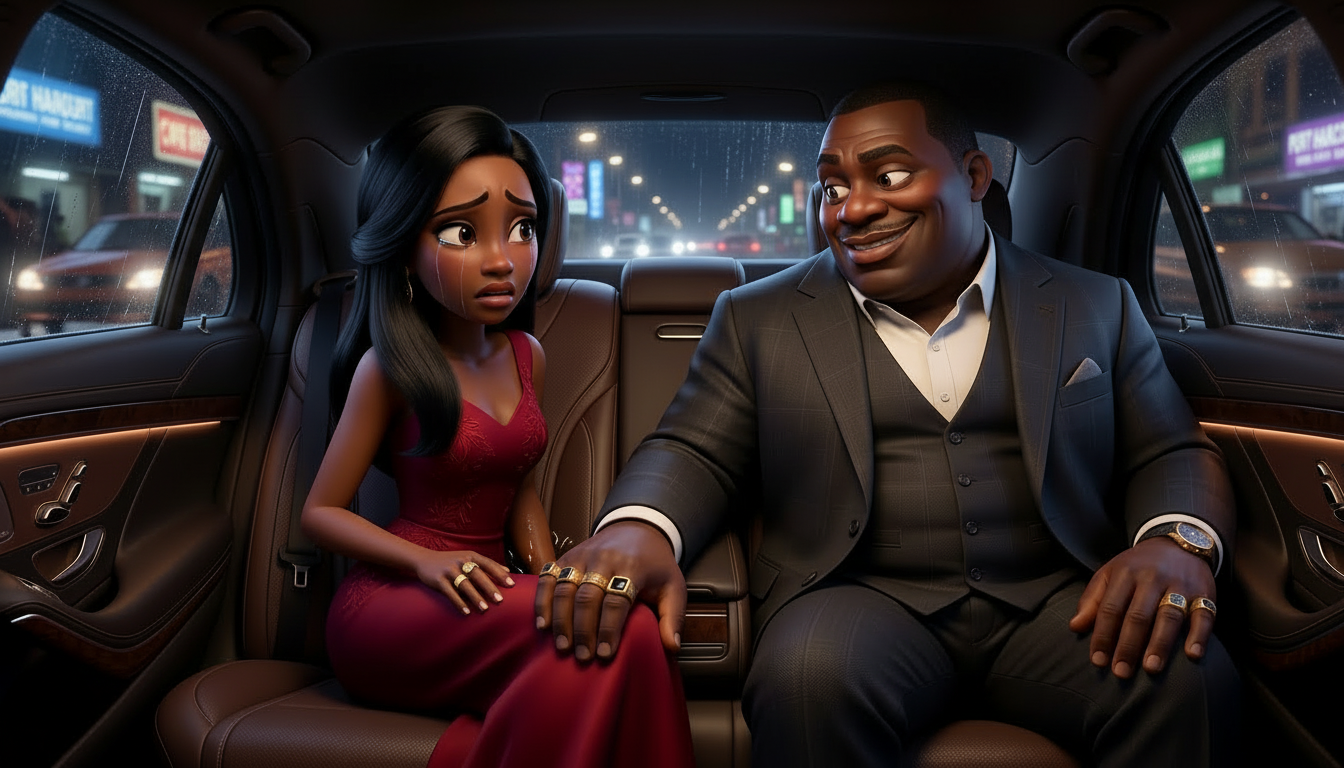
My name is Amara, and my hand was shaking. I tried to stop it, hiding it under my thigh on the cold leather seat. The car was so new, so clean. It smelled like money. It smelled like everything I ever wanted. Outside, the dusty streets of Port Harcourt flew by, but inside, it was a different world. A perfect world.
And next to me sat Chief Obinna, the man who owned this world.
“You are quiet this evening, my dear Amara,” he said. His voice was deep, like the slow rumble of thunder far away. He smelled of expensive cologne that was so strong it almost made my head hurt.
I forced a smile. “I am just enjoying the ride, Chief. I have never been in a car this fine.” It was the truth. It was a lie. My mind was a battlefield. One thought was of the sparkling diamond necklace he said was waiting for me at the restaurant. The other thought was of Emeka. Poor, kind, wonderful Emeka.
Before you hear the rest of my story, please take a second to like this audio, and comment where you are listening from. It helps me know you’re with me. Now, let’s get back to the car.
“Just fine?” Chief Obinna laughed, a loud, booming sound that filled the car. “Amara, this is one of my cheapest cars. A small gift to myself for a deal that went well.” He put his heavy hand on my knee, the one that wasn’t shaking. His fingers were thick, covered in gold rings that looked heavy enough to be weapons. “For you, my dear, I would buy the company that makes the cars.”
This was it. This was the moment I had worked for. The moment I had planned for. I had spent years learning how to talk, how to walk, how to dress to attract a man like Chief Obinna. A man with power, with connections. A man whose bank account could solve every problem my family ever had. My mother was sick and needed medicine that cost more than our house. My father worked until his bones ached and still, we were always hungry. This wasn’t just for me. It was for them. I had to remember that. This was my sacrifice.
So why did my heart feel like a stone in my chest?
The memory of that morning crashed into my mind. Emeka had been waiting for me at the corner, just like he did every day. He wasn’t handsome like the men in movies, but his smile was the warmest thing I had ever known. He was a mechanic, and his hands were always stained with black grease, but they were gentle. He held out a small, crumpled paper bag.
“For you, Amara,” he said, his eyes shining. “I passed by the bakery. I know you like their meat pie.”
I looked at the small bag, then I looked at my new shoes, the ones I had saved for months to buy. The ones I was wearing now for Chief Obinna. I couldn’t be seen holding a cheap meat pie from a poor mechanic. What if someone important saw me? What if Chief Obinna’s driver passed by right now?
“I’m not hungry, Emeka,” I said, and my own voice sounded cold and strange. I took a step back.
His smile fell. It was like watching the sun go behind a cloud. “Oh. Okay. Maybe later, then.” He looked down at the ground, hurt. He was always so easy to read.
“Emeka, you can’t keep doing this,” I said, the words feeling sharp and ugly in my mouth. “I have told you. We are not on the same path. You need to find a girl who is happy with your… life.”
“My life?” he asked, looking up. There was a fire in his eyes I had never seen before. “Because I work with my hands? Because I don’t have a big car?”
“Yes!” The word exploded out of me. I was angry. Angry at him for making me feel guilty. Angry at myself for the lie I was living. “I want more, Emeka! I want a big house, and nice things, and I want to stop worrying about money every second of every day! Is that so wrong?”
He just stared at me. He didn’t say anything. He just looked at me, his face a mask of disappointment. That look hurt more than any insult. I turned and walked away, my heart pounding with a mix of shame and determination. I would not feel bad. I was making the right choice. I was choosing a better life.
“Amara?”
Chief Obinna’s voice snapped me back to the present. The car had stopped. We were in front of the most expensive restaurant in the city, a place with lights that sparkled like diamonds. A man in a clean white uniform rushed to open my door.
“We are here, my dear,” Chief said, smiling. “A night for my beautiful queen.”
I took a deep breath, pushing the image of Emeka’s hurt face out of my mind. I was Amara, the girl who was going to marry a rich man. This was my dream. I stepped out of the car, my head held high, and took Chief Obinna’s arm.
The restaurant was even more beautiful on the inside. Everything was gold and red and shining. The people here were different. Their clothes were perfect, their laughter was quiet and confident. They looked like they had never been hungry a day in their lives. This is where I belong, I told myself. This is my new home.
We sat at a special table in a quiet corner. Chief Obinna was very charming. He told jokes and stories about his travels to London and Dubai. He talked about business deals worth millions of Naira. He made me feel like the only person in the world. He ordered food I couldn’t even pronounce, and wine that was older than I was.
Then he reached into his pocket and pulled out a small black box. My breath caught in my throat.
“For you, Amara,” he said, his eyes watching me carefully. “A small sign of my… affection.”
He opened the box. Inside, resting on a bed of black velvet, was the necklace. It was a string of diamonds, so bright they looked like captured stars. It was the most beautiful, most expensive thing I had ever seen. I imagined showing it to my mother. I imagined the look on the faces of the neighbors who always whispered about our family’s poverty. We wouldn’t be poor anymore.
“It’s… beautiful,” I whispered. I was speechless.
“Let me,” he said. He stood up and walked behind me. His fingers, those thick, heavy fingers, fumbled with the clasp at the back of my neck. I felt the cold weight of the diamonds settle on my skin. It was heavy. So heavy. I looked at my reflection in the dark window next to our table. I saw a girl with wide, frightened eyes, wearing a necklace that was worth more than her life. This was success, so why did it feel like a cage?
Just as he was fastening the clasp, his phone buzzed on the table. He ignored it. It buzzed again. And again. A third time.
With a sigh of frustration, he pulled away from me and picked up the phone. “What is it? I told you not to call me!” he whispered, his voice low and angry. The charming man from a moment ago was gone. This new man was cold and dangerous.
He listened for a moment, his face growing dark. “What do you mean, they are asking questions? Which one? The boy?” He turned his back to me, trying to hide his conversation, but I could still hear him. His voice was a venomous hiss.
“Listen to me,” Chief Obinna whispered fiercely into the phone. “You find that mechanic. Emeka, yes, that’s his name. You find him. He saw the car. He saw me. He knows too much. I don’t care what you have to do. Shut him up. Permanently. Do you understand me?”
My blood turned to ice. Emeka. He was talking about Emeka. My Emeka.
The beautiful restaurant, the fine food, the diamond necklace—it all disappeared. The only thing in the world was Chief Obinna’s voice and the horrible, final word he had just spoken. Permanently.
Chief Obinna ended the call and turned back to me. The charming smile was back on his face as if nothing had happened.
“Now,” he said smoothly, sitting back down. “Where were we, my dear?”
I stared at him. At the monster sitting across from me. He had just ordered a man’s death as easily as he had ordered dinner. And the man he wanted to silence, the man he wanted to remove forever, was the only man I had ever truly loved.
My hand, which I had tried so hard to keep still, was now shaking so violently that the whole table vibrated.
The Escape
My mind went completely blank, and then it exploded. It was like a thousand alarms were screaming inside my head, but on the outside, I was frozen. I stared at the man who was smiling at me, the man who wanted to kill Emeka. The taste of the expensive wine in my mouth turned to poison. The diamond necklace felt like a chain, pulling me down, choking me.
“My dear? Are you alright? You look pale,” Chief Obinna said, his smile fading a little. Concern crept into his eyes, but it wasn’t real. It was the same fake kindness he had shown me all night.
I had to get out. I had to get to Emeka.
The words came out before I even thought about them. My body took over. I pressed my hand to my stomach, letting out a small gasp. “I… I don’t feel well, Chief. I think… I think it was the wine. My stomach is hurting very badly.” I hunched over in my chair, making my face twist in pain. I am a good actor. I have been acting my whole life, pretending to be happy when I was hungry, pretending to be confident when I was scared. I had to make this my best performance.
“What?” Chief Obinna looked annoyed for a second before his mask of concern slipped back on. “The wine? This is a very expensive vintage. It can’t be.” He looked around, as if he was afraid someone would hear me complaining about his perfect evening. “Here, drink some water.”
“No,” I said, shaking my head and pushing the glass away. The water sloshed onto the white tablecloth. “I need to go home. Please. I feel like I am going to be sick.” I stood up, my legs feeling like jelly. I swayed on my feet, holding onto the table to keep from falling. I had to make him believe I was weak, that I was just a silly girl who couldn’t handle her drink.
“Nonsense, I will take you home,” he said, standing up and reaching for my arm. His grip was like iron.
Panic shot through me. If I got in that car with him, I would never get away. He would control where I went. He would ask questions. “No!” I said, a little too loudly. I softened my voice, trying to sound pathetic and desperate. “Please, Chief. I don’t want to trouble you. Your evening is so important. And I… I am embarrassed. I just want to go home by myself. I will take a taxi. Please, I just want to be alone.”
I looked up at him, my eyes wide and pleading. I let a tear roll down my cheek. I was not just acting anymore. The tear was real. It was a tear for Emeka. A tear for my own stupidity.
He stared at me for a long moment. I could see him thinking, weighing his options. He did not want a scene. Not here. Not in his world of perfect, quiet people. Finally, he let go of my arm. “Fine,” he snapped. The charm was completely gone. His face was a cold, hard mask. “Do as you wish.” He pulled a thick stack of Naira notes from his wallet and threw them on the table. “For the taxi. Don’t be a fool, Amara.”
He didn’t even look at me as I turned and almost ran from the table. I could feel the eyes of everyone in the restaurant on my back. I clutched the heavy diamond necklace. It felt wrong, like stolen property. I wanted to rip it off, but I couldn’t. Not yet. That would be too suspicious.
I burst out of the restaurant doors and into the humid night air. I didn’t look for a taxi. I started running. I ran past the uniformed men, past the line of expensive cars. I ran until my lungs burned and my new shoes, the shoes I had been so proud of, were pinching my feet. I kicked them off, leaving them on the side of the road, and kept running on the hard, dusty pavement. The rich part of town gave way to the familiar, crowded streets of my neighborhood. The air no longer smelled of cologne and money; it smelled of cooking fires and generator fumes and life.
My mind was racing faster than my feet. Emeka saw the car. What car? Why was that so important? Chief Obinna wasn’t just a rich businessman. He was a criminal. A dangerous one. All the stories he told, the trips, the deals… they were all built on something dark. Something that required silencing people. I felt so stupid. I had been so blind. I thought these men were strong and powerful. I saw their money and thought it meant they were smart, that they were better. But it was all a lie. A dirty, ugly lie.
Emeka was the real one. He worked with his hands, yes. He came home tired and covered in grease. But his money was honest. His smile was real. His love was real. And I had thrown it away for a man who ordered death like it was a side dish. The guilt was a physical pain, worse than the ache in my stomach I was faking.
I had to get to him. Chief’s men were probably already on their way. I knew where Emeka’s workshop was. It was a small, rented space behind a block of old apartments. He often worked there late at night, tinkering with engines or working on his own strange little inventions. He always said he did his best thinking when the world was quiet.
Please be there, Emeka. Please be safe.
I rounded the last corner, my heart pounding in my ears. I could see the faint glow of a single lightbulb coming from his workshop. He was there. A wave of relief washed over me, but it was followed by a new wave of terror. I was running out of time.
I slammed the rickety metal door open. “Emeka!”
He was bent over a complicated-looking machine on his workbench, a mess of wires and metal parts I didn’t recognize. He jumped, startled, and spun around. He was holding a soldering iron, and his face was smeared with grease. When he saw me—breathless, shoeless, crying, wearing a ridiculously expensive dress and a diamond necklace—his jaw dropped.
“Amara? What on earth…?”
There was no time for explanations. The words just poured out of me in a desperate rush. “You have to get out of here. Now. He’s coming for you. His men, they’re coming to hurt you. To kill you.”
He just stared at me, his eyes full of confusion. “What are you talking about? Who is coming for me?”
“Chief Obinna!” I cried, grabbing the front of his work shirt. “I was with him. At dinner. He got a phone call. Someone saw his car. He said it was you. He said your name, Emeka. He told his men to find you and… and to shut you up. Permanently.”
The confusion on Emeka’s face slowly turned into dawning horror, but not for the reason I expected. He looked past me, towards the door, and then back at the machine on his workbench. “The car,” he whispered. “It wasn’t just a car, Amara. I wasn’t just looking. I was testing my new long-range scanner. It’s for a security system I’m designing. It picks up heat signatures and energy outputs from a distance.”
My mind struggled to keep up. “Scanner? What are you talking about?”
“I pointed it at the warehouse down by the docks,” he said, his voice low and urgent. “Just a test. But it picked up something strange. A convoy of trucks, but they were cold. Refrigerated. Except what was inside wasn’t cold. The scanner showed they were full of weapons. Illegal arms. Chief Obinna and his men were overseeing the whole thing. One of his men saw me, Amara. He saw me with the scanner.”
So that was it. Emeka hadn’t just seen a car. He had seen everything. He had proof. He wasn’t just a witness; he was a danger to Chief Obinna’s entire criminal empire.
“We have to go,” I said, pulling his arm. “We have to run. Now, Emeka!”
He nodded, his face grim. He grabbed a small, hard drive from his workbench and shoved it into his pocket. “Everything is on here. All the scanner data.”
But just as we turned to run, the bright, blinding glare of headlights flooded the workshop, casting our long, terrified shadows against the back wall. We heard the sound of two cars screeching to a halt right outside. Heavy doors slammed shut.
We were trapped.
The silhouette of three large men appeared in the doorway, blocking our only exit. One of them chuckled, a low, cruel sound that sent a shiver down my spine.
“Well, well,” the man said, his voice dripping with menace. “Look what we have here. The Chief told us to find the mechanic. He didn’t say anything about a party.”
My heart stopped. Three men. They were huge, built like concrete walls with faces that had never known a smile. The man in the middle, the one who had spoken, took a slow step into the workshop. His eyes weren’t just on Emeka; they were on the strange machine on the workbench.
“The Chief wants the little toy you were playing with, mechanic,” the man said, pointing a thick finger at the scanner. “And the little metal box in your pocket. Hand them over, and maybe we just break your legs. If you make us work for it, you won’t have any legs left to break.”
The Workshop
Instinct took over. I moved, placing myself between Emeka and the three men. My body was trembling, but my voice was steady. “You will not touch him.”
The man laughed, a short, ugly sound. “Look at this. The pretty girlfriend wants to play hero.” He took another step. “Get out of the way, little girl, before you get hurt.”
“Amara, get back,” Emeka said quietly from behind me. His voice was calm, too calm. It was the voice he used when he was concentrating on a difficult engine problem. It was the voice of a man with a plan.
“I said get back!” Emeka’s voice was sharp now.
I trusted him. I had to. I took a stumbling step backward, my eyes never leaving the three thugs. Emeka moved into my place. He stood in front of his workbench, his small frame looking tiny compared to the mountains of muscle in the doorway. He looked completely calm.
“You want the scanner?” Emeka asked. “And the hard drive? Fine. You can have them.”
The lead thug smiled, a greedy, triumphant grin. “Now you’re being smart. Just bring them here. Nice and slow.”
Emeka didn’t move towards them. Instead, he reached behind him, his fingers dancing over the controls of the other machine on his bench, the one he was working on when I arrived. The mess of wires and metal parts.
“I don’t think so,” Emeka said, his eyes glinting in the dim light. “You see, I’ve been working on a new kind of security system. Not just for watching. For stopping. It’s based on high-frequency sonic waves. Inaudible to the human ear, but at close range, the vibrations are… very unpleasant.”
The thugs looked at each other, confused. “What is this nonsense? Are you a madman?” the leader growled.
“I call it ‘The Disruptor’,” Emeka said, and I could hear the pride in his voice. “And you are standing right in the middle of its effective range. Amara,” he said, his voice dropping low. “Cover your ears. Now.”
I didn’t hesitate. I slammed my hands over my ears.
Emeka flipped a large red switch on the machine.
There was no sound. Not a bang, not a pop. Just a sudden, deep hum that I felt in the bones of my feet. The single lightbulb above us flickered, buzzed loudly, and then exploded, plunging the workshop into near-darkness, lit only by the car headlights outside.
The three men screamed. It was not a sound of anger; it was a sound of pure agony. They grabbed their heads, their knees buckled, and they all fell to the ground, writhing and groaning as if they were being torn apart from the inside.
“The vibrations,” Emeka shouted over their screams, grabbing my hand. “It feels like a thousand needles in your brain. It will only last a few minutes, but it’s enough. Run!”
He pulled me toward the back of the workshop, where a small, grimy window was set high in the wall. It was a window I never thought a person could fit through. Emeka kicked over an old oil drum, jumped on top of it, and smashed the window open with his elbow. “Go!” he yelled. “Go now!”
I scrambled onto the drum, and he practically shoved me through the opening. I fell onto the soft dirt of the alleyway behind the building. My dress ripped, my arms were scratched, but I didn’t care. A second later, Emeka jumped through behind me, landing lightly on his feet. He still had the hard drive clutched in his hand.
We didn’t look back. We just ran. We ran through dark alleyways and deserted backstreets. My mind was a blur of fear and adrenaline, but one thought was crystal clear: Emeka was brilliant. He wasn’t just a mechanic. He was an inventor. A genius. He had saved us with his mind.
We didn’t stop running until we saw the blue and red flashing lights of a police station in the distance. We stumbled through the doors, breathless and dirty, and told the officer at the desk everything.
The next few hours were a whirlwind. I told them about Chief Obinna, about his phone call, about the threat. I handed them the diamond necklace, placing it on the counter like it was a venomous snake. The cold weight was finally off my skin. Emeka gave them the hard drive. He explained the scanner data, showing them the images of the illegal weapons, the refrigerated trucks, the location of the warehouse.
The police acted fast. They understood the danger immediately. They believed us.
We sat in the station for the rest of the night, giving statements, answering questions. As the sun began to rise, a high-ranking police officer came to talk to us.
“We got him,” the officer said, a tired but satisfied smile on his face. “We raided the warehouse. It was everything you said. We arrested Chief Obinna at his house this morning. He was trying to flee the country. Your information also led us to a dozen of his associates. This is the biggest crime bust this city has seen in years.” He looked at Emeka. “And your technology… it’s incredible. The national security division will want to speak with you.”
Relief washed over me so powerfully that I almost fainted. It was over. It was truly over.
Three Months Later
Three months later, I sat on the small porch of our new home. It wasn’t a mansion, but it was clean and bright, with a small garden where my mother, who was now getting the medicine she needed, loved to sit.
I was reading the newspaper. On the front page was a picture of Chief Obinna, his face angry and defeated, being led into a courthouse. The headline read: “Crime Lord ‘Chief’ Obinna Sentenced to Life in Prison.”
“Good riddance,” I whispered.
The screen door creaked open, and Emeka walked out. He was wearing clean trousers and a simple shirt. He wiped his hands on a rag, but I could still see a small smudge of grease on his cheek. He was smiling that smile, the one that felt like sunshine.
“You’re reading about him again?” he asked, sitting next to me and wrapping his arm around my shoulders.
“Last time,” I promised, leaning my head against his shoulder. “I just wanted to see it for myself.”
Emeka’s life had changed completely. The government had been so impressed with his “Disruptor” and the scanner technology that they had given him a major contract to develop security systems for the country. His small workshop was now a growing company with ten employees. He was successful. Not flashy, not loud, but truly successful. He had earned it all with his brilliant mind and his honest, hardworking hands.
“I still can’t believe I was so foolish,” I said quietly, looking out at our little garden. “I was chasing shiny things, and I almost lost the only thing that was real.”
Emeka kissed the top of my head. “You were scared, Amara. You wanted a better life for your family. Your heart was in the right place, even if your compass was a little broken.”
I looked at him. At his kind eyes, at the grease smudge on his cheek that I now found so endearing. I reached up and gently wiped it away with my thumb. He was right. I had wanted security, but I had looked for it in all the wrong places. I thought money was the goal, but it wasn’t. The goal was peace. The goal was love. The goal was waking up every morning without a feeling of dread in your stomach.
I was no longer the girl who chased only rich men. I was the woman who had found a man richer than any of them; rich in kindness, rich in intelligence, and rich in love. And that was a treasure no amount of money could ever buy.
Thank you for listening to my story. If you enjoyed it, please share it with someone you think might like it too. Goodbye for now.
Reader question: At what exact moment did you feel Amara truly saw the difference between a rich life and a safe, honest one?**
Leave a Reply