
Free reader powered by your browser. Available voices may vary by device.
My Name Is Amara Bello, and the Night My Father Started Hitting the Locked Study Door, I Knew Our Life Was Breaking
My name is Amara Bello, and the night my father started hitting the locked study door, I knew our life was breaking.
“Open this door!” Daddy shouted.
His voice shook the whole house.
I stood at the top of the stairs, barefoot, my heart beating fast. It was almost midnight. The power had just come back. The lights in our mansion in Lekki blinked hard, then held. My mother was crying downstairs. One flower vase had already broken. I could hear the glass under somebody’s shoe.
“Kunle!” my mother screamed from below. “Please! Stop shouting and tell me what is happening!”
But Daddy did not answer her. He kept banging the door with his fist like there was somebody inside who had stolen his life.
I gripped the stair rail so hard my palm hurt. Something was wrong. Not small wrong. Big wrong. The kind of wrong that can throw a whole family into the street.
Before I tell you what happened next, tap like on this story, tell me where you are listening from, and share this with someone who loves deep family drama. Because what happened to me in Lagos changed everything.
Daddy finally stepped back from the study door. His shirt was wet with sweat. His face looked older than it had that morning. My father was the kind of man who always looked strong. Clean beard. Gold watch. Calm voice. The kind of man people stood up for when he entered a room. But that night, he looked like fear itself had worn his face.
“Mummy,” I said as I ran down the stairs, “what happened?”
My mother, Gloria Bello, turned to me with red eyes. “Go upstairs, Amara.”
“No.”
“Go upstairs!”
“I said no!” I shouted back.
That was not like me. In our house, nobody raised their voice like that. Not even me. But fear was already making all of us different.
Daddy turned slowly and looked at me. For one second, I saw something in his eyes I had never seen before.
Defeat.
“The accounts are empty,” he said.
I frowned. “What accounts?”
He laughed, but it was not a happy laugh. It sounded like a man choking.
“All of them.”
My mother covered her mouth. “No…”
I moved closer. “What do you mean all of them? Daddy, stop talking in riddles.”
He looked straight at me. “I mean the company accounts. My personal accounts. The fixed savings. The dollar account. Everything.”
The room went still.
I heard the generator outside. I heard the wall clock. I heard my own breathing. But my brain did not accept his words.
“That’s impossible,” I said.
“That is what I thought too,” Daddy replied.
My mother sat down slowly on the sofa like her legs had forgotten how to stand. “Who did this?”
Daddy swallowed. “I don’t know yet.”
That answer scared me more than anything.
Because my father always knew everything.
I wish I could tell you that this was where my trouble started. It was not. My trouble started three days earlier, under hot Lagos sun, on a traffic-filled road, when I opened my mouth and insulted a man everybody else had learned to ignore.
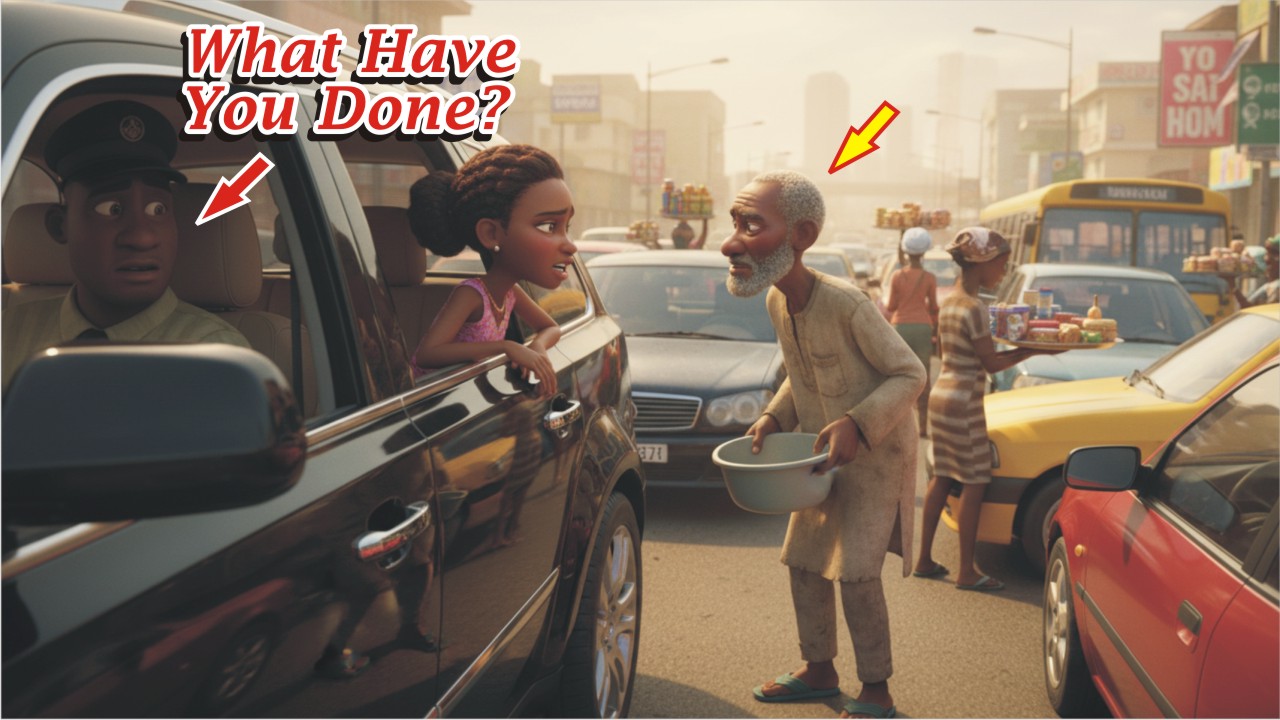
That afternoon, I was sitting in the back seat of our black SUV, wearing dark sunglasses and scrolling through my phone. My friend Teni had just posted photos from a boat party, and I was angry she went without me. We were stuck in traffic near Falomo. Horns were shouting everywhere. Hawkers moved between cars. The AC in our car was cold. Outside, the heat looked cruel.
Then somebody tapped lightly on my window.
I turned.
It was an old man.
His clothes were faded and dusty. His slippers did not match. His beard was rough and white. He held a plastic bowl in one hand and leaned a little like one of his legs hurt him.
He did not even knock hard. Just one soft tap.
My driver, Musa, glanced back. “Madam, should I move?”
But the traffic was tight. We could not move anywhere.
The old man bent a little and looked through the glass. His eyes were strange. Not empty. Not begging exactly. Just… watching.
I rolled my window down halfway.
“Please,” Musa said quickly, “don’t.”
But I was already annoyed. Annoyed at traffic. Annoyed at heat. Annoyed at my friend. Annoyed that this old man was now looking at me like I was part of his day.
“What?” I snapped.
“God bless you, my daughter,” he said quietly. “Anything for food.”
I looked at him from head to toe and felt disgust rise inside me. It shames me now, but that day I felt powerful.
“There are many jobs in Lagos,” I said. “Why are you begging? Old age is not work.”
Musa shifted in his seat. “Madam…”
The man stayed quiet.
And because he stayed quiet, I went further.
“You people like easy money,” I said. “Everywhere you stand with dirty bowls. Beggar in the morning. Beggar in the afternoon. Beggar in the night. Is this your career?”
The old man’s face did not change much. But his eyes changed.
Not anger.
Pain.
Still, I did not stop.
“If you stand near this car again, I will call the police,” I said. “Go and work. Don’t stand here smelling like the gutter and disturbing decent people.”
The words came out sharp. Too sharp.
Musa whispered, “Madam, please.”
The old man stepped back.
For a second, I thought he would curse me. Instead, he nodded slowly.
Then he said something I did not understand at the time.
“Pride is loud when the ground is still under the feet.”
I frowned. “What?”
But the traffic moved. Musa drove forward. The old man grew smaller in the side mirror.
I forgot him.
Or I thought I did.
Back in the living room, with my father standing like a broken king, that old man’s face flashed into my mind for no reason. I pushed it away. This was different. This was money. This was family. This was not some roadside stranger.
“Call the bank manager again,” my mother said.
“I have called him ten times,” Daddy replied.
“And?”
“And his number is off.”
That made me cold.
Daddy walked to the bar, poured water with shaking hands, and drank half the glass. “Two directors are not answering me. One investor sent me a message saying the EFCC came to his office this evening. A story is spreading that I moved funds. They are saying I stole from my own company.”
I stared at him. “Did you?”
The question came out before I could stop it.
My mother turned to me sharply. “Amara!”
But Daddy only looked tired. “No.”
Just that one word.
No.
I wanted to believe him. I really did. But rich people in Lagos said no all the time before the truth came out. I had seen enough gossip online to know that.
Daddy rubbed his forehead. “Somebody set me up.”
“Who?” I asked again.
He looked at the locked study door.
That was when I noticed something else.
The door was not only locked.
The bottom edge had fresh scratch marks, like somebody had dragged something heavy from inside.
A strange fear touched my spine.
“Who is in there?” I asked.
Nobody answered.
“Daddy,” I said again, slower this time. “Who is inside your study?”
My mother stood up at once. “There is nobody inside.”
But she said it too fast.
I turned to her. “Then why were you crying?”
“Because your father lost money!”
“No,” I said. “That’s not all.”
Daddy closed his eyes like he was tired of lies. “Go to your room, Amara.”
“I’m not a child.”
“Tonight you are.”
I stared at both of them. My family had secrets. Big ones. And I was hearing the sound of them even if nobody would speak.
Then my phone rang.
It was Teni.
For a moment I almost cut the call. Then I answered.
“What?”
“Amara!” she whispered loudly. “What is happening at your house?”
I froze. “What do you mean?”
“Your father is online!”
My heart dropped. “What?”
“Twitter. Instagram blogs. Even WhatsApp. They’re posting him. They’re saying he ran away with people’s money. They’re saying police are looking for him.”
I looked at Daddy. He was already looking at me. He knew.
“Who posted it first?” I asked.
“I don’t know,” Teni said. “But it’s spreading fast. Amara, people are insulting your family badly. Somebody posted your picture too.”
“What picture?”
“The one from your birthday dinner at Eko Hotel.”
My hand shook.
That was the picture where I wore a silver dress and stood between my parents smiling like life could never touch us.
Now people were using it to mock us.
“Delete my number from any group you’re in,” I said.
“What?”
“You heard me.”
I ended the call.
For one second I could not breathe.
Reputation.
That was the first thing I felt slipping away. Before the cars. Before the clothes. Before the house. Reputation. In Lagos, people forgive many things, but they do not forget shame.
Musa rushed in from the front door without knocking properly. His eyes were wide.
“Sir,” he said, breathing hard, “two men are at the gate.”
Daddy straightened. “Who?”
“They say they are police.”
My mother made a choking sound.
I felt my knees weaken.
“Did you open the gate?” Daddy asked.
“No, sir.”
“Good.”
The intercom rang.
Nobody moved.
It rang again.
Then again.
Daddy walked to it slowly and pressed the button. “Yes?”
A male voice answered. Hard. Flat. “Mr. Kunle Bello, open the gate. We need to ask you some questions.”
My mother grabbed Daddy’s arm. “Don’t.”
Daddy removed her hand gently. “If I don’t open, it becomes worse.”
I could hear the blood in my ears.
The voice at the gate spoke again. “Mr. Bello, open now.”
Then, before Daddy could answer, the lights went out.
Everything went black.
My mother screamed.
The generator sound died at the same time.
Total silence.
Then from upstairs, from inside the locked study, something heavy fell.
Boom.
I jumped.
Daddy turned toward the stairs.
My mouth went dry.
Because in the darkness, with police at our gate and our family name burning online, one truth became impossible to avoid.
There was definitely someone inside that study.
And then, from the darkness above us, an old man’s voice said quietly,
“Kunle… it is time to tell her.”
The Study
The whole house went silent.
Even my mother stopped breathing for one second.
I stood frozen at the bottom of the stairs, staring into the darkness above us. My skin turned cold. My heart was beating so hard I could hear it in my ears.
I knew that voice.
Not fully. Not from memory like a song. But from somewhere close.
From somewhere recent.
Then it hit me.
The roadside.
The traffic.
The old man with the bowl.
My mouth opened, but no words came out.
Daddy looked like somebody had poured ice water inside his body. “No,” he said into the dark. “Not now.”
The voice answered, calm and firm. “You waited too long already.”
My mother grabbed my wrist so tightly it hurt. “Amara,” she whispered, “go to the kitchen. Stay there.”
I pulled my hand away. “No.”
At the gate, the intercom started buzzing again.
Then pounding.
Hard. Loud. Serious.
“Mr. Bello!” the man outside shouted. “Open the gate now!”
Musa ran back into the living room, using his phone torch to light the way. The small white light shook in his hand. “Sir, they are not leaving. Neighbors are coming outside. People are watching.”
That made everything worse.
In Lagos, once neighbors came outside, the story was no longer private.
It became public shame.
Daddy took a slow breath. “Musa, open the small gate. Let them in.”
“No!” Mummy cried. “Kunle, no!”
“If I run now, I look guilty,” Daddy said.
“You already look guilty!” she shouted back, and when she heard her own words, she burst into tears.
That hurt me more than the darkness. My mother never spoke to my father like that. Never.
From upstairs, the old man spoke again. “Let the girl hear the truth.”
I turned sharply toward the stairs. “Who are you?”
No answer.
Only the sound of my father breathing.
I looked at him. “Daddy… why does that voice sound familiar to me?”
He did not speak.
“Why is the old beggar in your study?”
Still nothing.
The pounding at the gate came again.
Musa swallowed hard. “Sir?”
Daddy rubbed his face, then pointed at Musa. “Open it.”
Musa ran out.
My father looked at me with tired eyes. “Amara, whatever you hear tonight, keep quiet until I finish talking.”
I felt anger rise through my fear. “No. I have been quiet enough. Police are at our gate. Your money is gone. A strange old man is inside your study. People are posting us online. And you still want me to keep quiet?”
“Amara—” Mummy began.
“No, Mummy!” I snapped. “Not this time!”
My voice shook, but I kept talking.
“I want to know what is happening in this house.”
From outside, I heard the gate open.
Metal scraped.
Footsteps entered the compound.
My stomach tightened.
This was real now.
Not online gossip. Not family tension. Real men. Real trouble.
The old man upstairs gave a soft cough. “Then let her know.”
Daddy closed his eyes. When he opened them, he looked like a man stepping into fire because he had no road left.
“He is not just a beggar,” Daddy said.
I stared at him.
Then the study door opened upstairs.
Slowly.
The old man stepped out.
Musa’s torch, left on the side table, threw weak light up the stairs. It touched the old man’s face. It was him. The same white beard. The same tired clothes. The same eyes.
But now he was standing inside our home.
Inside my father’s study.
Not on a roadside.
Not outside our world.
Inside it.
My legs almost gave way.
“You,” I whispered.
The old man looked down at me. There was no smile on his face. No victory. Just sadness.
“Yes,” he said quietly. “Me.”
I felt hot shame burn through my chest. The words I had thrown at him near Falomo came rushing back into my head one by one. Dirty bowl. Beggar. Smelling like gutter. Disturbing decent people.
And now he was here.
In my house.
In our family’s night of disgrace.
I wanted to disappear.
“How did he enter this house?” I asked.
Nobody answered at first.
Then Daddy said, “I brought him.”
That made no sense.
“When?” I asked.
“This evening.”
“Why?”
Daddy looked at the old man, then back at me. “Because I should have done it years ago.”
I shook my head. “Done what?”
Before he could answer, the front door opened and two men entered with Musa. They were dressed in dark clothes. One held an ID card up first. The other held a file.
“Mr. Kunle Bello?” the taller one asked.
“Yes.”
“We need you to come with us for questioning.”
Mummy rushed forward. “Questioning about what? You cannot just walk into somebody’s house and carry him!”
The shorter officer spoke. “Madam, we are not here to embarrass anybody. But there are complaints. Financial complaints.”
The word hit the room like a slap.
Complaints.
Not one.
Many.
Daddy straightened his shoulders. “I will cooperate.”
“No, sir,” the taller officer said. “You need to come now.”
I stepped forward before I could stop myself. “My father did not steal anything.”
The officer looked at me. His face was not wicked. Just tired. Like he had seen too many families say the same thing.
“Madam, this is not the place to argue.”
The old man upstairs started coming down one step at a time.
Both officers looked up.
“Who is that?” one asked.
Daddy answered too quickly. “Nobody.”
The old man stopped on the stairs. “I am not nobody.”
I stared at him again. His voice was soft, but it carried weight. Too much weight for a roadside beggar. He looked poor, yes. Worn down, yes. But not small. Not empty. Not like somebody with no place in the story.
The taller officer frowned. “Sir, who is he?”
Daddy did not answer.
My mother did not answer.
So I did.
“He’s the beggar I insulted on the road.”
The room turned to me.
I felt foolish as soon as I said it. But it was true.
The shorter officer blinked. “Beggar?”
The old man sighed. “That word has worked very hard tonight.”
Nobody moved.
Then he came down the last step and stood in the living room with us like he belonged there more than any of us.
I backed away without meaning to.
He noticed.
“I am not here to hurt you, Amara,” he said.
Hearing my name from his mouth made my chest tighten.
“How do you know my name?” I asked.
His eyes stayed on mine. “I have known your name since the day you were born.”
The world tilted.
“What?”
My mother made a broken sound. “Please… please not like this.”
I turned to her so fast my neck hurt. “Not like what?”
She sat down weakly. “Jesus…”
I looked at Daddy. “Talk.”
But before he could speak, the taller officer stepped in. “Mr. Bello, whatever family matter is happening here, handle it later. We have work to do.”
Daddy raised one hand. “Give me five minutes.”
“Sir—”
“Five minutes,” Daddy said again, more firmly this time. “I am not running.”
The two officers looked at each other. Then the taller one nodded once. “Five minutes.”
My father turned to the old man. “Say only what is necessary.”
The old man gave a tired smile. “That is usually where trouble starts. People only say what is necessary.”
Then he looked at me again.
“Your name is Amara Bello,” he said. “You are nineteen. You were born during heavy rain on a Tuesday night. Your mother nearly died bringing you into this world.”
I stepped back again.
He continued.
“When you were four, you used to hide under the dining table whenever your father traveled. When you were seven, you broke your front tooth running near the pool. When you were ten, you cried for two days because your white rabbit died.”
My mouth fell open.
I never told that beggar any of this.
I never even told most friends those things.
I looked at Mummy. She was crying again.
I looked at Daddy. He could not meet my eyes.
The old man’s voice dropped lower. “And when you were small, you used to call me Baba Tunde.”
My knees almost gave out.
Baba Tunde.
I had not heard that name in years.
The memory came like broken glass and sunlight. A warm lap. Rough hands. A deep laugh. Someone lifting me high. Someone telling me moon stories when Daddy was away. Someone disappearing one day and everybody saying he had gone back to his village.
I pressed a hand to my head.
“No,” I whispered. “No…”
But I could see it now.
Not clearly. Not all of it. But enough.
The old man.
Cleaner then.
Stronger then.
Still with the same eyes.
“You…” I said. “You worked for us.”
He nodded once. “Yes.”
I looked at my parents. “You told me he left.”
Mummy cried harder.
Daddy finally spoke. “I made him leave.”
“Why?”
He did not answer.
“Why?” I shouted.
The officers were still standing there. Musa was by the door. The lights were still out. My phone battery was down to eleven percent. My whole life felt like it was hanging over a deep hole.
The old man answered for him.
“Because I knew something he wanted buried.”
The room turned cold.
Daddy stepped forward. “Tunde.”
“No,” the old man said. “Enough.”
I stared from one face to another. “What are you talking about?”
The old man took a slow breath.
Then he said the words that split my chest open.
“Amara… your father’s downfall did not start this week.”
I felt like I was falling and standing at the same time. “What does that mean?”
He looked at Daddy first, as if giving him one last chance.
Daddy said nothing.
The old man looked back at me.
“It started many years ago,” he said, “the day your father took what did not belong to him.”
The Five Minutes
Silence.
Not normal silence.
The kind of silence that makes your skin hear things your ears cannot.
My father spoke at last, his voice low and dangerous. “Careful.”
The old man did not even look at him. He kept his eyes on me.
“Amara,” he said gently, “the man you insulted on the road was once the man who carried you on his shoulders. I fed you. I protected you. I stayed silent for years because of you.”
I could not breathe well.
My mother stood up suddenly. “Stop. Please stop.”
“Why?” I asked her, almost choking. “What is he talking about?”
She shook her head again and again. “Not tonight.”
I laughed once, and it sounded mad. “Not tonight? Mummy, police are here tonight! The internet is dragging us tonight! A man I thought was a stranger is in our house tonight! So when exactly is the good time?”
Nobody answered that.
One of the officers checked his watch. “Mr. Bello. Time is up.”
Daddy turned to them. “I am coming.”
Then he faced me.
And for the first time in my life, my father looked afraid of me.
Not afraid for me.
Afraid of me knowing something.
“Amara,” he said quietly, “whatever this man tells you, wait till I return.”
I stared at him. “Return from where? Jail?”
“Amara!” Mummy cried.
But I did not care. Something had broken inside me already. Something big.
Daddy flinched, but only for a second. “I did everything for this family.”
The old man gave a bitter laugh. “That is the favorite song of men who destroy homes.”
Daddy’s head snapped toward him. “You think suffering on the roadside makes you holy?”
“No,” the old man replied. “It only made me patient.”
The officers stepped closer now. This was ending.
Or maybe it was beginning.
Daddy looked at Musa. “Bring my shoes.”
Musa moved quickly.
Mummy held Daddy’s arm and whispered, “Don’t leave me with this.”
He touched her shoulder. “Lock the doors. Say nothing to anybody.”
Then he looked at me one last time.
I should have run to him. I should have held him. I should have begged him not to go.
But all I could think was this:
What did you steal?
What did you bury?
And why does this old man know my childhood better than the truth I live in?
Daddy left with the officers.
The front door shut.
Their car engine started outside.
Then faded.
And the house became quiet again.
Too quiet.
Mummy sank onto the sofa and covered her face.
Musa stood near the door like he wanted to disappear.
The old man turned to leave.
“Wait!” I shouted.
He stopped.
My voice came out shaking. “You don’t get to walk away again.”
He turned slowly.
“What did my father take?” I asked.
The old man looked tired enough to sleep for ten years. But he also looked like a man who had carried a secret too long.
He sat down in the armchair opposite me.
Then he said, very softly, “Before I answer that, you need to know one thing first.”
I stepped closer.
He lifted his eyes to mine.
“Amara Bello,” he said, “the life you are crying over may not even be yours.”
I stopped breathing.
“What?”
My mother let out a scream.
The old man’s face hardened.
“Ask your mother whose child you really are.”
The Back Gate
At the back gate, the air was cooler.
The city still hummed beyond the walls.
I held my grandfather’s arm as we stepped into the dark street behind the house. For the first time in my life, I was walking away from everything I thought made me somebody.
Money.
Name.
Comfort.
Pride.
And for the first time in my life, I was walking toward truth.
It was not soft.
It was not safe.
But it was real.
I looked at the old man beside me. My grandfather. The beggar I had insulted.
“I’m sorry,” I whispered again.
He squeezed my hand.
“Live differently,” he said. “That apology will grow legs.”
We kept walking.
Behind us, my father’s mansion stood bright against the Lagos night, full of secrets, noise, and ruin. Ahead of us, the road was dark.
But it was open.
My mother followed behind us in silence. I could hear her breathing. Fast. Uneven. Like each step was costing her something. Maybe it was. Maybe every step away from that house was another step away from the lie she had worn for years.
Nobody spoke for a while.
We passed closed shops, a roadside woman packing up oranges, and a group of boys standing around a phone laughing at some video that had nothing to do with us. Lagos was still moving. Buses still shouted. Keke still passed. Somewhere far off, music was playing. The city did not stop because one family was breaking.
That truth hit me hard.
Pain feels big when it is yours.
But the world keeps moving.
After some time, my grandfather stopped in front of a narrow building behind a welding shop in Yaba. Sparks had blackened the wall outside. The metal door beside the shop was old and scratched. He pushed it open and stepped aside for us.
“It is here,” he said.
I stood at the doorway and looked inside.
A small mattress lay on the floor. One plastic chair sat near a window with a torn net. A kettle rested on a wooden table. A faded bag hung from a nail in the wall. That was all.
This was where he lived.
This was where the man I had insulted returned every night.
Something twisted deep inside me.
He must have seen it on my face, because he said quietly, “It is not much.”
I shook my head slowly. “It is more honest than our house.”
He looked at me for a long moment, then nodded once.
My mother entered behind me, wrapping her arms around herself as if the room was colder than outside. In truth, it was not the room. It was reality.
I sat carefully on the edge of the mattress. My legs finally gave up pretending to be strong. My whole body felt heavy. My name felt heavy. My face felt strange, like I was wearing somebody else’s life.
My mother remained standing.
Then my phone rang.
The sound cut through the room so sharply that all three of us jumped.
Unknown number.
For one second, I thought of ignoring it. Then I answered.
“Hello?”
“Amara Bello?” a man asked.
My stomach tightened. “Yes.”
“This is Officer Adeyemi. Your father asked me to call you.”
I sat up straighter at once. “What happened?”
There was a pause on the line.
“Your father collapsed during questioning.”
My mother gasped so hard she nearly fell against the wall.
“Collapsed?” I repeated.
“He is alive,” the officer said. “He was taken to the hospital. Stress. High blood pressure. Maybe more. The doctors are checking.”
I closed my eyes.
Relief came first.
Then anger for feeling relief.
Then pain because no matter what my father had done, part of me still wanted him standing.
“He left a message for you,” the officer added.
I tightened my grip on the phone. “What message?”
The officer’s voice lowered.
“He said, ‘Tell Amara I am sorry. Tell her I wanted to give her the life I thought she deserved. I did wrong. But I loved her from the first day I saw her.’”
No one in the room moved.
I heard my own breathing.
I heard my mother begin to cry again.
The officer cleared his throat. “There will still be charges. This matter is serious.”
I swallowed. “I understand.”
When the call ended, I lowered the phone slowly into my lap.
My mother pressed both hands over her mouth. “Kunle…”
My grandfather stayed quiet.
I looked down at the cracked floor. “He knew,” I said softly. “He knew he was losing everything.”
“Yes,” my grandfather replied.
“And still he kept lying.”
“Yes.”
My mother looked at me with tears running down her face. “Amara, your father loved you in his own broken way.”
I lifted my head and looked at her.
That sentence hurt because it was not fully false.
And it was not enough.
“I know,” I said. “That is why this is so painful.”
The room went quiet again.
Outside, a generator coughed to life somewhere down the street. A baby cried in the next compound. A motorcycle passed. Life was still happening all around us, even though mine felt like it had ended and started again in one night.
My grandfather rose slowly and put water on to boil.
His hands shook a little.
Age. Hunger. Hard years.
I watched him move around that tiny room and felt shame rise again in my chest. This man had carried so much pain. And I had looked at him through a half-open car window and spoken to him like dirt.
When he handed me a cup of tea, I held it with both hands.
“Mummy,” I said after a long silence.
She looked up quickly.
“You can’t go back there alone.”
Fresh tears filled her eyes.
“I am still angry,” I told her. “I’m very angry. I don’t know how to forgive this. I don’t know how to trust you. Not yet.”
She nodded slowly, crying but saying nothing.
“But you are still the woman who raised me. So I will not leave you to face this by yourself.”
She bent forward and sobbed into her palms.
That was not forgiveness.
Not yet.
But it was the first small crack where forgiveness might one day enter.
Morning Came Gently
Morning came gently.
Not because the night had been kind.
Because morning always comes whether people are ready or not.
Thin light entered the room. The sounds outside grew louder. Pots clanged. Men shouted prices. Someone laughed. Somewhere, radio news was speaking fast Yoruba and English. Lagos had woken up.
My phone woke up too.
Messages.
Missed calls.
More messages.
Videos.
Screenshots.
Our family name was everywhere.
Some posts said my father had stolen millions. Some said he was finished. Some dragged my mother. Some dragged me. Some were just enjoying the show.
I put the phone face down.
I could not carry strangers too.
Three days later, the whole city seemed to know our story.
Blogs posted updates every hour. Business people who used to praise my father suddenly called him a criminal. Friends who had once crowded our parties stopped answering messages. The mansion was sealed. Cars were taken. Accounts stayed frozen. The Bello name, the name my mother had guarded like gold, now sounded like mockery in many mouths.
But another story came out too.
A journalist published a deeper report.
Not every detail.
Not the full wound.
But enough.
Enough for people to learn that a poor young mother had died years ago while trying to reclaim her child.
Enough for my grandfather’s silence to finally break in public.
Enough for shame to move where it belonged.
Not on me.
Not on the dead.
On the people who built a rich life on somebody else’s loss.
My father survived.
He was charged.
He lost almost everything.
I went to see him once before they moved him from the hospital.
He looked smaller than I had ever seen him. No gold watch. No strong voice. No rich-man air. Just a tired old man lying in a hospital bed, watched by consequences at last.
When he saw me, tears filled his eyes immediately.
“Amara,” he whispered.
I stood by the bed and looked at him.
This man had raised me.
This man had lied to me.
This man had loved me.
This man had destroyed lives.
All of it was true at once.
“Why?” I asked.
His lips trembled. “Because every year that passed made the truth more expensive.”
I believed him.
That did not make it right.
It only made it sadder.
He started crying. “I wanted to give you everything.”
I looked at him for a long time.
“You should have started with the truth,” I said.
He shut his eyes.
When I turned to leave, his weak voice stopped me.
“Do you hate me?”
I stood at the door.
I did not turn back.
“No,” I said. “That would be easier.”
Then I left.
Just Amara
My mother changed slowly after that.
Very slowly.
No miracle.
No sudden clean ending.
She sold the jewelry she still had hidden and rented two small rooms not far from my grandfather’s street. She stopped dressing like she was still living in Lekki. She stopped speaking down to people. She stopped pretending image was life.
Sometimes she sat outside with my grandfather in the evening. They said little. There was too much regret between them for easy conversation.
But they sat.
And sometimes sitting is the first honest thing broken people can do.
I stayed with my grandfather.
Not because it was easy.
Because it felt true.
I began helping a woman nearby who sold food in the morning. I washed plates. I packed takeaway packs. I cleaned tables. I learned what it meant to stand all day and still smile at customers. I learned what sweat felt like when it paid for your meal. I learned that many people in Lagos carried pain I had once mocked because I had never bothered to see it.
Some people recognized me.
Some laughed.
Some whispered.
Some stared too long.
I let them.
I had spent enough of my life trying to protect appearances.
One evening, almost two months later, I was helping dish rice and stew when a little girl came near the table.
She was small. Thin. Quiet. Her dress was faded. She held out one hand and said softly, “Aunty, please. I’m hungry.”
For one second, the old Amara rose inside me.
The girl in the back seat.
The girl behind the tinted glass.
The girl who thought money made people clean and poverty made them lesser.
But that girl no longer owned my mouth.
I bent and looked at the child properly.
Then I filled a plate with rice and stew and placed it carefully in her hands.
Her eyes widened.
I pointed to a bench nearby. “Sit there. Eat slowly.”
She nodded and hurried away.
I turned and saw my grandfather standing at the doorway, watching me.
He said nothing.
But his eyes were wet.
That night, as we walked back together under the evening sky, I slipped my hand into his.
“Grandpa,” I said softly.
He smiled. “You call me that easily now.”
“Yes.”
He squeezed my fingers.
After a moment, I asked the question that had lived quietly inside me for weeks.
“Do you think my mother would be proud of me?”
He knew which mother I meant.
His face softened at once.
“Yes,” he said. “Very proud.”
My eyes filled.
This time my tears came quietly.
Not the wild tears of that terrible night.
Not the shocked tears of betrayal.
These were softer.
Cleaner.
Like something dirty inside me was finally being washed.
Months later, people still told the story the simple way.
They said a rich girl insulted a beggar and lost everything.
But that was only the outside of it.
The real story was this:
A girl lost a fake life and found her true blood.
A proud heart broke and opened.
A grandfather the city had forgotten became the one safe place for a lost child.
And me?
I stopped being Amara Bello, the girl who looked down from a car window.
I became Amara.
Just Amara.
And for the first time in my life, that was enough.
Reader question: At what exact moment did you feel Amara stopped losing everything and started becoming herself for the first time?**
Leave a Reply