
Free reader powered by your browser. Available voices may vary by device.
The King Visited My House as a Beggar — How One Act of Kindness Changed My Life

The old clay bowl slipped from Mara’s hands and shattered on the ground.
She did not even bend to pick the pieces.
She just stood there in the dust, staring at the handful of millet that had spilled from the broken bowl like little stones from her last bit of hope.
Across the narrow path, three women watched her from beside the well.
One of them laughed.
Another covered her mouth and whispered, “Even the bowl has rejected her.”
The third did not laugh. She only shook her head and said the words Mara had heard for seven years.
“A home without a child is a dying fire.”
Mara’s throat burned, but no tears came. She had cried too much already. Tears had become expensive. She could not waste them on people who enjoyed them.
She bent slowly, her fingers trembling as she gathered the millet from the dirt, one pinch at a time. Dust stuck to the grains. Tiny stones mixed with them. Still, she gathered all she could. That millet was all she had left for the day.
And tonight, she would have to decide whether to feed herself… or her husband.
If stories like this touch your heart, take a second to like, subscribe, and share, because every chapter ahead will only get deeper.
Mara rose with the torn edge of her wrapper brushing her ankles. The women at the well had already turned away, but not before throwing one last look at her, the kind people gave to cursed things.
She kept her head down and walked back to her hut at the far end of the village, where the roofs were smaller, the walls were cracked, and forgotten people lived.
Her hut leaned to one side like it was tired of standing.
Inside, the air was warm and still. One mat. One pot. One stool. One cooking stone. That was her world.
She poured the dirty millet into a flat tray and began to pick out the stones one by one.
Her hands worked gently, but her mind was not gentle at all.
It went back, as it always did, to the first year of marriage.
She had come into her husband Taren’s house young, shy, and full of dreams. She remembered how he smiled at her then. How he held her hand after sunset. How he promised they would raise many children and fill the compound with laughter.
But time had passed.
The laughter never came.
The children never came.
And slowly, the smile left his face.
Now Taren rarely touched her. Rarely defended her. Rarely even looked at her unless something was missing from the house or the village women had poisoned his ears again.
At first, he had told her, “Do not mind them. God sees us.”
Then he began saying, “Maybe we should try herbs.”
Then, “Maybe the problem is deeper than we know.”
Then one day, in anger, after another man in the village mocked him, he shouted, “What kind of wife closes the door to her husband’s future?”
That sentence had stayed inside her like a blade.
Mara closed her eyes and pressed two fingers against her chest as if she could calm the wound there.
Outside, goats cried. Children ran past, laughing. A baby somewhere nearby let out a soft hungry scream, and Mara froze.
That sound always broke her.
She wanted to know how it felt to hold her own child against her chest. To sing while pounding yam with one hand. To braid a little girl’s hair. To call a boy back from the river before dark. She wanted the ordinary miracle other women complained about.
But for Mara, even that simple life had become a locked door.
A shadow crossed the doorway.
She looked up.
Taren stepped in.
His shoulders were dusty from the road. His face was hard.
“Is there food?” he asked.
Mara swallowed. “A little.”
He looked at the tray in front of her and frowned. “That is all?”
“The bowl fell.”
His eyes moved to the broken clay pieces near the wall. “Careless.”
The word was quiet, but it hit harder than a slap.
“I gathered what I could,” she said softly.
He said nothing for a moment. Then he sat on the stool, rubbing his jaw. “My mother came to see me.”
Mara’s hands stopped moving.
Taren did not look at her when he continued. “She says I cannot continue like this.”
The room suddenly felt smaller.
Mara forced herself to ask, “Continue like what?”
“Like a man with no heir.”
The tray slipped in her lap, and a few grains scattered again.
“Taren—”
“She knows a widow in the next village,” he said flatly. “Young. Strong. She already gave her first husband two sons before he died.”
Mara stared at him.
The world did not end in thunder. It ended in a low voice spoken in a small hut over a tray of dirty millet.
He still would not look at her.
“She says a man must think of his name. His land. His future.”
“And me?” Mara asked.
At that, he finally looked up.
For a second, she saw guilt in his eyes.
Then it was gone.
“What future do I have with you?” he said.
Mara felt the air leave her body. Not all at once. Slowly. Like a lamp dying.
She did not scream. She did not beg.
She only nodded once, though her ears were ringing.
“I will cook,” she said.
Taren shifted on the stool as if her calmness unsettled him more than tears would have. “I have not decided anything yet.”
But Mara heard the truth inside those words.
He had decided.
He was only waiting for the village to agree loudly enough to make him feel innocent.
She rose and took the pot to the cooking stone outside. Her fingers moved by habit. Wash. Pour. Stir. Cover. Breathe.
Above her, the evening sky darkened into a deep purple. Smoke rose from other homes. Wives called children in. Men returned from fields. The whole village folded itself into night.
But Mara felt as if she stood outside life itself, watching from a distance, unwanted.
Not long after the pot began to simmer, footsteps approached from the road.
Slow footsteps.
Dragging footsteps.
Mara looked up.
A man stood just beyond her doorway.
He wore a torn brown cloak, dusty from long travel. His sandals were nearly broken. His beard was rough. His shoulders were bent with weariness. He carried no bag, no walking staff, no sign of belonging anywhere.
At first glance, he looked like every poor traveler who had ever been chased from a village gate.
But something about his eyes made Mara pause.
They were tired, yes.
But they were not small eyes.
They were steady. Watching. Deep.
The stranger bowed his head slightly. “Peace to this house.”
Mara glanced inside. Taren had heard the voice but did not come out.
“Peace,” she answered.
The stranger looked as though he had not eaten in days. “I have walked since sunrise. I asked for water at two homes. I was turned away from both. I will ask only once more. Do you have anything to spare?”
Before Mara could answer, Taren’s voice came from inside the hut.
“No.”
The stranger stood still.
Taren stepped into the doorway, his face cold. “Move on. We have nothing for beggars.”
The man lowered his eyes. “Even a cup of water?”
Taren gave a bitter laugh. “Water is wasted on people who only carry bad luck from village to village.”
Mara’s heart clenched.
The traveler did not argue. He simply nodded as if he had heard worse before. Then he turned to leave.
And that was when Mara saw it.
As the edge of his torn cloak shifted in the evening breeze, something glinted beneath it.
A ring.
Heavy.
Gold.
Not the kind poor men wore.
It was marked with a tiny shape pressed into the metal. A lion beneath a rising sun.
Mara had seen that symbol only once before, years ago, on the banner carried by royal guards when the king’s tax men passed near the market road.
Her breath caught.
But before she could think, Taren snapped, “Did you not hear me? Go!”
The traveler took another weak step, and then his knees shook.
He nearly fell.
That was all Mara could bear.
“Wait,” she said.
Taren turned sharply. “Mara.”
She ignored him. She lifted the pot from the fire, took the small calabash beside it, and scooped out half of the meal.
Half.
Not a spoonful.
Not scraps.
Half of everything she had.
Taren stepped forward, fury rising in his face. “Have you lost your mind?”
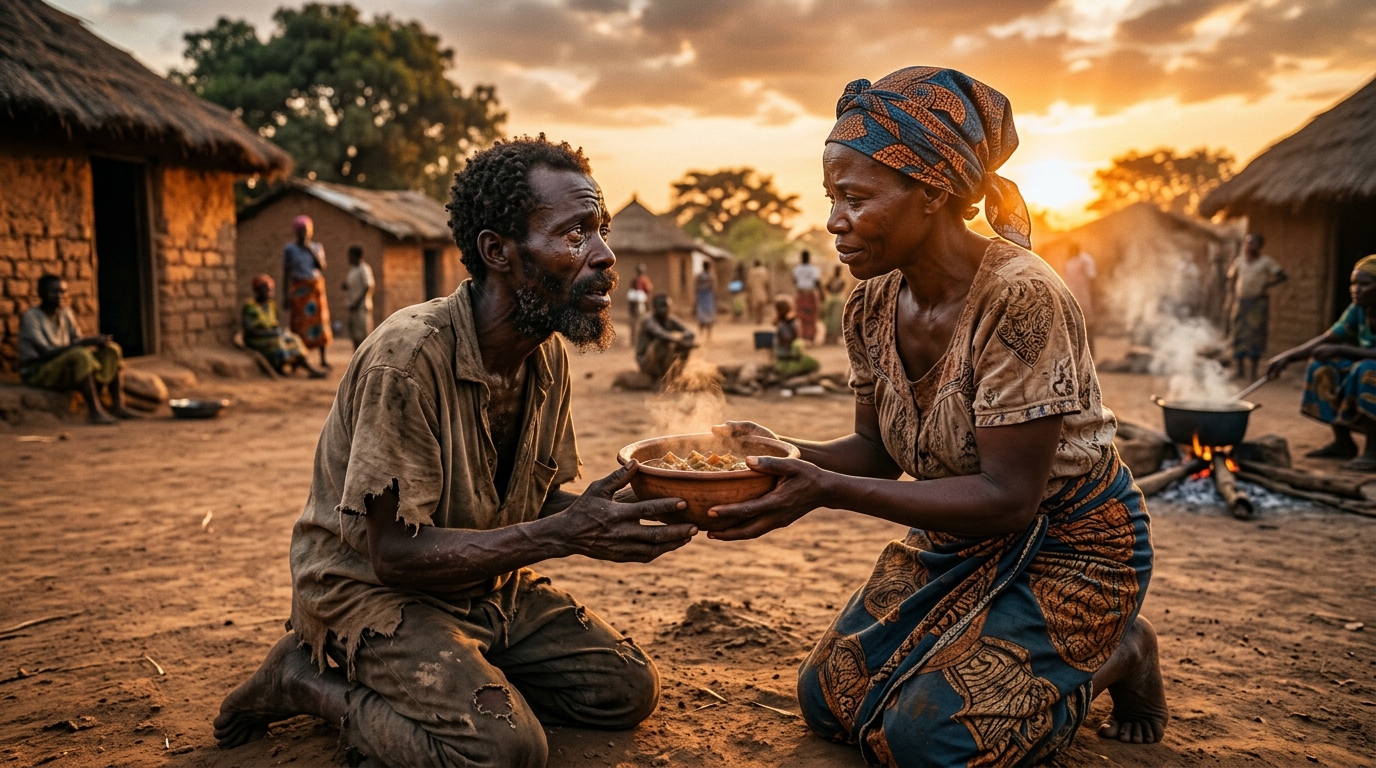
Mara held the bowl with both hands and walked toward the stranger.
The smell of hot millet rose between them.
The man looked at the food, then at her, as though he could not believe what he was seeing.
“It is little,” she said quietly. “But little can still keep a man alive.”
Taren grabbed her arm. “That food is for this house!”
Mara looked back at him, and for the first time in years, there was no fear in her eyes.
“This house,” she said, “has already taken everything from me.”
Silence fell like a stone.
Even the stranger looked stunned.
Taren released her arm slowly, more shocked than angered.
Mara turned back and placed the bowl in the traveler’s shaking hands.
His fingers closed around it carefully, almost reverently.
Then he lifted his eyes to hers and said, in a voice suddenly stronger than before, “Woman, do you know what mercy costs?”
Mara thought of her empty womb. Her empty place in her husband’s heart. Her empty future.
“Yes,” she whispered. “I do.”
The man gave the smallest nod.
Then, for one brief second, the torn cloak slipped farther open.
Mara saw more than the ring.
She saw the edge of fine cloth hidden beneath the rags.
And hanging from his neck, beneath the dust, was a seal carved in ivory and gold.
The royal seal.
Her pulse thundered.
Who was this man really?
And why was the king’s mark hidden under a beggar’s cloak?
Mara did not sleep that night.
How could she?
The image of the royal seal burned in her mind like fire in dry grass.
She sat on the edge of her mat while Taren slept with his back turned to her, breathing heavily as if nothing important had happened. As if he had not insulted a starving traveler. As if he had not watched his wife give away half her last meal. As if he had not spoken of replacing her like an old pot with a crack in it.
But Mara could not rest.
Who was that man?
Why had a person carrying the king’s seal come dressed like a beggar?
And if she had truly seen what she thought she saw… why was he alone?
Before sunrise, she heard drums in the distance.
Not village drums.
These were sharper. Stronger. Ordered.
She stood at once.
Taren woke too, annoyed at first. “What is that noise?”
Then came shouting from the road.
Men’s voices.
Soldiers.
Mara’s blood went cold.
Taren rushed outside, and she followed.
The whole village was already spilling into the paths. Women pulled wrappers over their heads. Children ran barefoot toward the center square. Old men leaned on sticks and squinted into the morning haze.
Then they saw them.
Royal guards.
Not two or three.
A full line of them.
Their spears rose bright in the morning sun. Their red-and-gold cloth moved with the wind. Behind them rode two mounted officers. And between them, under a canopy of dark blue cloth, rolled a small royal carriage.
Gasps spread through the village like a fast sickness.
“The palace…”
“What have we done?”
“Why are they here?”
Mara stood frozen.
Her mind went straight back to the traveler’s eyes.
The lead officer raised his hand, and the entire village fell silent.
“We seek the woman who shared her food with a stranger last night,” he announced.
No one moved.
No one even breathed.
Then, slowly, every eye turned toward Mara.
Her knees weakened.
Taren looked at her, then at the soldiers, then back at her again, as if seeing a different woman standing beside him.
The officer’s gaze settled on Mara. “Are you the one?”
Mara opened her mouth, but no sound came.
She forced herself to nod.
The officer stepped down from his horse. He came closer, his expression not cruel, not kind, only firm. “By order of His Majesty, you will come with us.”
The village exploded into whispers.
Taren grabbed Mara’s wrist hard enough to hurt. “For what?”
The officer looked at his hand until Taren let go.
“For an audience.”
Taren tried to laugh, but it came out weak. “There must be some mistake. My wife is only—”
He stopped just before saying it.
Only barren.
Only useless.
But the officer’s eyes had already changed. He had heard the shape of the insult even without the full words.
“Your wife,” he said coldly, “is the one we were sent for.”
Mara looked around. The women from the well were staring at her as if she had become a spirit. Taren’s mother had appeared near the crowd, her face stiff with disbelief and anger.
“Go with them,” one old man whispered.
Another muttered, “This is not ordinary.”
The royal carriage curtain moved.
A hand pulled it aside.
Mara’s heart stopped.
Inside sat the traveler from the night before.
No torn cloak now.
No dust.
No bent shoulders.
He wore deep blue robes with gold lining. Clean. Rich. Royal. A chain rested across his chest, and the seal she had seen hidden beneath rags now shone openly at his neck.
The whole village dropped to the ground.
Some screamed.
Some covered their mouths.
Taren fell to his knees so fast his palms hit the dirt.
Mara stood frozen.
The man looked directly at her.
It was the same face. The same eyes. Only now they carried the weight of command.
“I was thirsty,” he said, his voice calm but carrying over the square. “I was hungry. I was turned away from door after door. Only one person gave without asking who I was or what reward I carried.”
No one dared move.
He turned his gaze toward Taren. “And one person in this house showed more poverty in his heart than in his store of food.”
Taren’s forehead touched the ground. “Mercy, my king! Mercy!”
The women from the well began to cry and beg too. One shouted that she had not known. Another said she had children. Another blamed fear.
The king did not answer them.
He looked only at Mara.
“Will you come?” he asked.
This time, it did not sound like an order.
It sounded like respect.
Mara lowered her head. “Yes, my king.”
She climbed into the carriage with shaking hands.
And as it rolled away, the village that had mocked her watched in stunned silence while the woman they called cursed rode beside the king.
No one spoke to Taren.
No one helped him rise.
For once, he was left alone inside the shame he had given her for years.
The journey to the palace felt unreal.
Mara sat carefully, afraid to touch anything. The cushions were soft beneath her. The air inside smelled faintly of cedar and oil. Outside, horses moved in steady rhythm.
The king watched her quietly for a long moment.
“You are afraid,” he said.
Mara answered honestly. “Yes.”
“You think I brought you to punish you?”
“I do not know why you brought me, my king.”
A sad smile touched his face. “That is fair.”
He leaned back and looked out through the open side of the carriage. “I travel in disguise sometimes. My father used to do the same. A king who only listens from a throne hears polished lies. A king who walks hungry hears truth.”
Mara listened without lifting her eyes too high.
“I wanted to know how people treat weakness,” he continued. “How they treat need. How they treat someone who has nothing to offer them.”
His voice hardened a little.
“In your village, I learned much.”
Mara felt heat rise to her face, not because she was guilty, but because she knew the truth of what he meant.
The king looked at her again. “Why did you give me half of your food?”
She thought of making a safe answer. A clever answer. But she had none.
“Because you looked like you needed it more than I did.”
He waited.
Then she added softly, “And because I know what it feels like when people look at you and decide you are worth less.”
For the first time, the king’s expression broke. Not with anger. With pain.
As if her words touched an old wound in him too.
When they reached the palace gates, Mara’s breath caught in her throat.
She had never seen walls so high.
Guards lined the entrance like carved statues. Courtyards opened one after another. Fountains shone in the sun. Servants moved quickly across polished stone floors. Everywhere she looked, there was order, beauty, wealth.
And yet she felt smaller with every step.
A maid was sent to wash her, oil her hair, and dress her in a clean robe the color of soft clay after rain. Mara kept flinching each time someone touched her kindly. She was not used to care that did not hide pity.
At last she was brought into a long hall where nobles sat on either side, dressed in silk and jewels.
The king took his seat at the far end.
Mara remained standing in the center, her head lowered.
The whispers began at once.
“This is her?”
“She is only a village woman.”
“She looks ordinary.”
“Why bring such a person into court?”
Then one woman laughed lightly.
Mara glanced up and saw her.
The queen mother.
She wore silver cloth and a face as cold as sharpened stone. Her beauty had not softened with age. It had hardened.
She looked at Mara the way rich people look at mud on a fine floor.
“So,” the queen mother said, “this is the woman who fed my son a bowl of millet and now stands in the royal hall as if heaven itself invited her.”
A few nobles laughed.
Mara felt her cheeks burn.
The king did not laugh.
“She stands here because she showed honor where others showed cruelty.”
The queen mother folded her hands. “Honor? From a barren wife cast aside by her own home?”
The room went still.
Mara’s stomach dropped.
So they knew already.
Of course they knew. Palaces collected people’s pain like merchants collected tax.
The queen mother tilted her head, studying Mara with cruel amusement. “Tell me, woman. Is it true? No child? No standing? No inheritance? Not even enough worth in your own house to keep your husband’s loyalty?”
Each word hit like a slap.
Mara wanted to disappear.
But then she remembered the previous night. The bowl in her hands. The starving man before her. The moment she had stood before Taren without fear.
Something in her had already changed.
She swallowed and answered, “Yes. It is true that I have no child.”
The queen mother smiled a little, pleased by the humiliation.
But Mara continued.
“And it is true that my worth has been measured wrongly by many people.”
The smile faded.
Mara’s voice shook, but she did not stop.
“If a woman is only a womb, then kindness has no value. If a home only respects what it can count, then mercy is worthless too. I had little food. I gave it. Not because I am special. Because hunger is real.”
No one laughed now.
The hall had become very quiet.
The queen mother’s eyes narrowed. “You speak boldly for someone who came from dust.”
Mara lifted her head fully.
“We all come from dust.”
A sharp breath moved through the room.
The king’s hand tightened on the arm of his throne, but not in anger. In approval.
The queen mother’s face turned hard. “Careful.”
But the king stood.
“That is enough.”
His voice filled the hall.
He stepped down from the throne and came to stand beside Mara, not above her.
Then he turned to the court and said, “Last night I wore rags. Many doors closed. This woman opened hers with half her final meal. Yet today, in silk and gold, some among you still cannot hide your poverty.”
No one dared speak.
The king’s eyes moved across the nobles, then stopped on his mother.
“She has more nobility in one act of mercy than many born into this hall have shown in years.”
The queen mother’s face tightened, but she said nothing.
Mara could hardly breathe.
The king turned to her. “You have been stripped of dignity by small hearts. That ends now.”
Then he raised a hand to the guards.
“Bring in the husband.”
Mara’s heart lurched.
The great doors opened.
And Taren was dragged into the royal hall in chains.
Mara stared in horror.
But behind him came someone else.
A woman from the next village.
Young. Strong. Beautiful.
And very pregnant.
Taren lifted his head, and when Mara saw his face, she understood something terrible.
He was not frightened only because he had insulted a king.
He was frightened because his secret had arrived before him.
The king looked at Mara and said, “There is more you were never told.”
What secret had Taren buried so deeply that even the palace had brought witness against him?
Taren fell to his knees so hard the chains on his wrists clanged against the palace floor.
The sound echoed through the hall.
Mara stared at him, then at the pregnant woman standing behind him. The woman could not have been more than twenty. Her face was tired. Her eyes were swollen, like someone who had been crying for many nights. One hand rested protectively over her belly.
Mara’s chest tightened.
She already knew this was bad.
But she did not yet know how bad.
The king turned to the young woman. “Speak without fear. No one will harm you here.”
The woman swallowed. Her lips trembled. Then she looked at Mara with shame so deep it seemed to bend her body.
“My name is Sela,” she said softly. “I did not know he was still living with you.”
Mara blinked.
The whole court leaned in.
Sela took a shaking breath. “He came to my village many months ago. He said he was preparing to marry again because his wife had failed him.” She stopped and wiped her face. “He said his family had agreed. He said it was already settled.”
Mara felt the floor tilt beneath her.
Taren shut his eyes.
Sela continued, her voice breaking, “He promised me a home. He promised my brothers goats and coin. He said I would be the mother of his first son.”
A murmur spread through the court.
The king’s face went still with anger.
Mara could not speak. For months she had been sleeping in the same hut, cooking for the same man, hearing his cold words, not knowing that he had already gone ahead with his betrayal.
Not only in his heart.
In his actions.
Not only in secret talks.
In promises.
In flesh.
The queen mother watched with sharp interest now. Even she could smell disgrace.
The king faced Taren. “Did you deny your wife food, peace, and dignity while preparing another marriage behind her back?”
Taren bent lower. “My king, I was desperate. I wanted a child. A son.”
The king’s voice rose. “So you used one woman’s pain to feed another woman a lie?”
Taren said nothing.
The chains shook with his fear.
Mara looked at Sela again.
At first, she had felt anger. A hot, immediate anger. But now, looking at the young woman’s swollen face and frightened eyes, Mara saw something else.
Another victim.
Another person promised safety and given shame.
Sela lowered her head. “When I learned he had not truly cast his first wife aside, I refused him. But my family had already taken his gifts. And then…” She placed both hands over her stomach. “Then I learned I was carrying his child.”
The room went quiet.
Taren began crying then. Not the crying of a broken man. The crying of a man finally trapped by truth.
“I only wanted what every man wants,” he said. “A child to carry my name.”
Mara finally found her voice.
“A name?” she whispered.
He looked up at her.
She stepped forward slowly, the whole court watching her.
“You speak of your name as if it is gold,” she said. “But what is a name worth when it is carried by lies? What is a son worth if he is born from deceit? What is a house worth if the woman inside it must shrink herself to fit your pride?”
Taren’s tears kept falling.
Mara’s voice grew stronger.
“You let them laugh at me. You let them call me empty. You let your mother poison our home. And all that time, you had already gone looking for another woman while still eating the food I cooked with these hands.”
She lifted her hands as she spoke.
“They called me barren. But it was your heart that was barren.”
A shock moved through the hall.
Even the nobles felt that blow.
Taren lowered his head again, unable to answer.
The king turned to one of his officers. “Bring the healer.”
A gray-haired woman stepped out from among the palace attendants. She carried a leather pouch and wore the quiet confidence of someone used to speaking truth no one wanted to hear.
She bowed to the king, then to Mara.
“I was sent to the village two months ago,” the healer said. “I examined the records of treatments taken by this couple over the years. I spoke with herb women. I asked questions.”
Taren looked up suddenly, fear flashing in his face.
The healer continued, “The blame placed on Mara was false.”
The words hit the room like thunder.
Mara’s lips parted.
She could not breathe.
The healer looked directly at the king. “The barrenness was never hers.”
Silence.
Then one gasp.
Then many.
The healer did not stop.
“The husband received a fever in his youth, long before marriage. It left lasting damage. Quiet damage. Hidden damage. He knew enough to suspect it. But instead of admitting uncertainty, he let the village condemn his wife.”
Mara’s knees nearly gave way.
All those years.
All those names.
All those nights she cried into a mat so no one would hear.
All those visits from old women with bitter herbs, cruel advice, and sharper tongues.
And all along…
It was never her.
Taren began shaking his head wildly. “No. No, I did not know for sure.”
“But you feared it,” the healer said firmly. “And because you feared shame, you handed that shame to her.”
Mara covered her mouth.
The tears came then. Fast. Deep. Not the tears of weakness. The tears of truth finally breaking open.
She remembered every insult. Every cruel look. Every child kept from her arms because people said her emptiness might spread like a curse. Every time she blamed her own body. Every time she begged heaven in silence.
And now the truth stood in daylight.
The king’s voice dropped low and dangerous. “You made her carry your disgrace so you could walk like an innocent man.”
Taren collapsed fully to the floor.
The queen mother, who had mocked Mara only moments earlier, looked away.
For the first time in that grand hall, she had no sharp words ready.
The king turned to Mara.
His face softened.
“What was stolen from you cannot be returned in full,” he said. “Not the years. Not the sleep. Not the peace. But your name will be restored before all who shamed you.”
He raised his hand.
A scribe stepped forward.
“Write this decree,” the king commanded. “Let it be carried to every village under my authority. Mara, wife of Taren, was falsely dishonored. The charge of barrenness laid against her was a lie of cowardice and ignorance. Any mouth that repeats it now speaks against the truth of the crown.”
The scribe bowed and began to write.
The king was not finished.
“As for Taren, he will not return to his home as master. The house and the land tied to his name will be placed under royal judgment. A portion will be given for the care of the child he created through deceit. Another portion will be placed in Mara’s name, free from his control.”
The court stirred again.
Such justice was not small.
Taren lifted his head in shock. “My king—”
“Be silent,” the king said.
Taren fell quiet at once.
The king looked at Sela. “You were lied to and used. You will not be sent back in disgrace. You will be housed safely until your child is born. After that, you may choose where to live, and the treasury will provide your beginning.”
Sela burst into tears and fell at his feet in gratitude.
Then the king turned again to Mara.
This time, his voice was gentle.
“You fed me when you had almost nothing. You honored hunger because you knew pain. You saw a man, not a reward. So hear me now: you owe no loyalty to cruelty. You owe no future to a house that buried you alive.”
Mara wept openly.
Not pretty tears. Not quiet tears.
The tears of a woman who had been carrying a mountain alone and had finally been told to put it down.
The king stepped closer.
“If you wish,” he said, “the palace has a place for you. Not as a servant. Not as an object of pity. As keeper of the royal kitchens and stores for the widows and travelers who come to our gates. You know the value of little. Such people must be fed by hands that understand hunger.”
Mara stared at him.
Years ago, such an offer would have frightened her.
Now it felt like a door opening after a long dark season.
She wiped her face slowly.
Then she said the words that changed everything.
“I accept.”
The hall filled with whispers again, but this time they sounded different.
Not mockery.
Not scorn.
Respect.
The king nodded once. “Then let it be so.”
Mara turned and looked at Taren one last time.
He was still on the floor. Still chained. Still small.
This was the man whose opinion had once ruled her every breath.
Now he looked like what he truly was.
Not strong.
Not important.
Just weak.
He reached toward her. “Mara… please.”
She looked down at him, and her voice was calm.
“I shared food with a hungry stranger and found a king. I shared my life with a selfish man and found only emptiness. I know the difference now.”
Then she turned away.
And she did not turn back.
In the weeks that followed, the king’s decree spread from market to market, village to village.
People who had once lowered their voices to insult Mara now lowered them in shame.
The women at the well could not meet her eyes when she returned once, only once, to collect her few belongings.
Taren’s mother hid inside her hut.
No one laughed.
No one whispered.
Mara left that village with her back straight.
At the palace, she took charge of the store rooms for the poor. No traveler was turned away hungry. No widow left with empty hands if grain remained. No child was mocked for torn clothes at the gate.
People began to speak of her with warmth.
Not as the barren wife.
Not as the cursed woman.
But as Lady Mara of the Open Hand.
And in quiet moments, when she stood near the palace kitchens and watched bread being divided for strangers, she would remember that one small bowl of millet.
Half her meal.
That was all.
And yet it had been enough to break the power of lies, expose a cruel man, shame a cold court, and return a woman’s stolen name.
Because crowns can command fear.
But only character can command heaven’s favor.
And sometimes, the poorest hand gives the richest gift.
If this story moved you, like, subscribe, and share it with someone who needs this reminder: never measure a person’s worth by what the world says they lack.
Reader question: At what exact moment did you feel Mara stopped surviving humiliation and started stepping fully into her own worth?
Leave a Reply