
Free reader powered by your browser. Available voices may vary by device.
The Cowboy Who Hid the Apache Mother… Until Her Son Saved His Ranch
Silas Boone did not know that the woman he found bleeding in the storm would one day save his ranch.
He did not know the frightened little boy hiding behind her torn shawl would become the child his heart had secretly been mourning for years.
And he surely did not know that by opening one old barn door on a night full of thunder, he would turn the whole town against him.
All Silas knew that evening was this: the sky had gone black over the valley, the wind was screaming like a wounded animal, and something was moving near the broken trading post at the edge of his land.
At first, he thought it was a wolf.
Then lightning split the sky.
And Silas saw a woman fall to her knees in the mud.
Behind her stood a small boy, shaking, soaked, and silent.
That was the moment Silas Boone’s quiet life began to break open.
Before we continue, if this is your first time here, please like this video, subscribe to the channel, and watch this story to the very end because what happens to Silas, the mother, and that little boy will touch your heart. Also, comment where you are listening from before you share your thoughts about the story.
Silas Boone had been alone for so long that loneliness no longer felt like pain. It felt like weather. It was just there, hanging over his ranch every morning, following him through the fields, sleeping beside him at night like an old dog that refused to leave.
He was forty-eight years old, broad-shouldered, rough-handed, and quiet in a way that made people careful around him. His face was lined from sun, grief, and years of wind pushing dust into his skin. His beard had begun to turn gray at the edges, though he still carried himself like a man who could lift a sack of grain with one hand and throw a troublemaker out of a saloon with the other.
People in the town of Red Creek respected Silas.
But respect was not the same as love.
They respected him because he worked hard. They respected him because he kept his word. They respected him because his cattle were strong, his fences were straight, and he never asked another man for help unless death itself was knocking at his door.
But nobody truly knew him.
Not anymore.
Years earlier, Silas had been different. He had laughed more. He had ridden into town with flowers tucked under his arm for his wife, Mary. He had danced badly at barn gatherings and let the old women tease him for it. He had dreamed of filling his ranch house with children, noise, and warm supper smells.
Then winter came early.
It was the cruelest winter Red Creek had ever seen. Snow buried the roads. Cattle froze standing. Families burned furniture just to stay alive.
Mary had been carrying their first child.
Silas still remembered the night she grabbed his hand and whispered that the pain was coming too soon. The snow was too deep for the doctor. The horses could barely stand. Silas tried everything. He wrapped her in blankets. He prayed though he had not been a praying man. He begged the storm to stop.
But by morning, the house was quiet.
Too quiet.
Mary was gone.
The baby was gone.
And something inside Silas went into the grave with them.
After that, he stopped planting flowers. He stopped going to dances. He stopped looking at cradles in the general store. He buried himself in work until his hands cracked and his back ached. Work did not ask questions. Work did not look at him with pity. Work did not remind him of what he had lost unless he gave it permission.
So Silas made sure he was always busy.
His ranch, Boone Ridge, sat west of town where the grass rolled toward a line of red cliffs. It had once been one of the finest cattle ranches in the valley, but the years had not been kind. Dry seasons came more often. Prices fell. Thieves grew bolder. A few neighbors sold their land and moved east.
Silas refused to leave.
“This land is all I got left,” he once told his closest neighbor, Amos Reed.
Amos, a heavy man with kind eyes and a limp from an old horse accident, had answered, “Land ain’t much comfort when you’re eating supper alone.”
Silas had only looked toward the horizon and said, “It’s enough.”
But it was not enough.
He knew it when he sat at his table at night with one plate, one cup, and one chair pulled out. He knew it when he heard children laughing outside the church and had to turn away. He knew it when he walked past the locked room where Mary had planned to put the baby.
Still, Silas lived.
He woke before dawn. He fed the horses. He checked the cattle. He mended fences. He rode the ridge. He came home after sunset, cooked beans or coffee, and slept with a rifle by his bed.
That was his life.
Plain.
Hard.
Empty.
Then trouble began moving through the valley.
It started with burned wagons on the south road. Then two ranch hands disappeared near Bitter Wash. A settler family was found robbed, their horses gone, their supplies scattered. Soon after, an Apache camp far beyond the ridge was attacked in the same ugly way.
But instead of seeing the truth, people began choosing sides.
In town, fear grew faster than facts.
Some said Apache warriors were attacking settlers. Others said white thieves were dressing like Apache men to stir anger. A few whispered about an outlaw gang led by a man named Caleb Rusk, a cold-eyed killer who had once worked cattle drives before turning to robbery, murder, and stolen land.
Silas heard the rumors but kept his mouth shut.
He did not trust rumors.
He trusted tracks, weather, water, and the look in a man’s eyes when he lied.
Sheriff Nolan Price, however, seemed more interested in keeping the town calm than finding the full truth. He was a tall, sharp-faced man who liked polished boots and loud speeches. He told people what they wanted to hear.
“Stay alert,” he said one afternoon outside the general store. “Do not trust strangers. Do not hide enemies. Anyone protecting dangerous people will answer to me.”
Silas stood at the edge of the crowd with his hat low over his eyes.
A younger rancher named Cole Maddox leaned close and muttered, “You hear that, Boone? Times are changing. A man better know which side he stands on.”
Silas looked at him slowly. “A man better know what he’s talking about before he opens his mouth.”
Cole’s face hardened.
He had never liked Silas. Cole was handsome, proud, and hungry for power. His ranch was failing worse than Silas’s, but instead of working harder, he blamed everyone else. He blamed drought. He blamed cattle prices. He blamed Native families. He blamed old ranchers who refused to sell land cheap.
Most of all, he hated that people still respected Silas.
That evening, Silas rode home under a sky heavy with clouds.
By sunset, thunder rolled over the valley.
By nightfall, rain hammered the roof of his house so hard it sounded like rocks being thrown from heaven.
Silas was in the barn, calming his mare, Daisy, when he heard something through the storm.
A cry.
Not loud.
Not clear.
But human.
He froze.
The barn lantern swung in the wind. Daisy stamped nervously.
Silas took his rifle from the wall and stepped outside. Rain struck his face like cold needles. Mud sucked at his boots as he crossed the yard and looked toward the old trading post near the edge of his land.
The building had been abandoned for twenty years. Its roof had half fallen in. Its walls leaned like tired men. Nobody went there except coyotes, snakes, and boys daring each other to prove courage.
Then lightning flashed.
A shadow moved beside the ruins.
Silas lifted his rifle.
“Who’s there?” he shouted.
The wind swallowed his voice.
He moved closer, slow and careful. Another flash of lightning lit the broken doorway.
That was when he saw her.
A woman staggered out from behind the old wall. She was young, maybe in her early thirties, though exhaustion made her look older. Her dark hair clung to her face. Her dress was torn at the hem. One arm was wrapped around her side, where blood had soaked through the cloth.
Behind her, a boy no older than eight held onto the back of her dress.
The woman saw Silas and stopped.
Fear filled her face.
Not surprise.
Not confusion.
Fear.
The kind of fear that comes from already knowing what people can do.
Silas lowered the rifle just a little.
“I won’t hurt you,” he said.
She did not answer.
The boy stared at the gun.
Silas noticed and lowered it all the way.
“You’re hurt,” he said.
The woman stepped back, nearly falling.
The boy grabbed her arm. “Mama,” he whispered.
That one word struck Silas in the chest.
Mama.
He had once imagined hearing that word in his own house. He had imagined a small voice calling for Mary. He had imagined little feet running across wooden floors.
He swallowed hard.
“What’s your name?” Silas asked.
The woman hesitated.
Then she said, “Anna.”
Her voice was weak but guarded.
Silas looked at the boy. “And him?”
She pulled the child closer. “Thomas.”
The names sounded English, but Silas could see the truth in their faces, their clothing, the beadwork at the edge of the boy’s soaked wrap, the way Anna watched him like a deer watching a hunter.
They were Apache.
And they were running from something.
Silas looked toward the dark hills.
“Who did this to you?”
Anna’s lips trembled, but she did not speak.
Then the boy, Thomas, said, “Bad men.”
Anna quickly touched his shoulder, warning him to stay quiet.
Silas heard the terror beneath those two words.
Bad men.
He had heard enough.
“Come with me,” he said. “You’ll freeze out here.”
Anna shook her head. “No town.”
“I didn’t say town.”
She stared at him.
Silas pointed toward his barn. “My place. You can get dry. I’ll clean that wound.”
Anna looked at the barn, then at his rifle, then into his face.
“You will turn us in,” she said.
Silas did not answer right away.
Because the thought had crossed his mind.
Not because he wanted to. But because he knew what helping them meant. If Sheriff Nolan found out, Silas would be called a traitor. If Cole Maddox found out, the whole town would hear by morning. If the frightened ranchers discovered an Apache woman and child hidden on Boone Ridge, they might come with torches before asking a single question.
Silas had spent years avoiding people.
Now one choice could make him the center of their hate.
Anna must have seen the battle in his eyes because her face hardened.
She tried to turn away, but pain bent her body.
Thomas began to cry quietly.
That small sound broke something in Silas.
He stepped forward, removed his coat, and held it out.
“Take it,” he said.
Anna did not move.
So Silas placed the coat on the ground between them and stepped back.
The rain beat down around them.
After a long moment, Thomas picked it up and wrapped it around his mother’s shoulders.
Silas nodded toward the barn. “There’s no safety in those ruins. Not tonight.”
Anna looked at her son.
Then she walked.
Slowly.
Painfully.
Silas stayed behind them so she would not think he was forcing her. When they reached the barn, Daisy stirred in her stall. The smell of hay, leather, and rain-soaked wood filled the air.
Silas lit another lantern and pulled out a crate.
“Sit,” he said.
Anna remained standing.
“You can stand there and bleed on my floor if you like,” Silas said, his voice dry. “But I’d rather not explain that to my horse.”
For the first time, Thomas looked almost confused.
Not happy.
Not safe.
But less terrified.
Anna sat on the crate.
Silas fetched clean cloth, a basin, and the small bottle of whiskey he kept for wounds more than drinking. When he knelt near her, she flinched.
He paused.
“I need to see the cut.”
Anna slowly moved her arm.
The wound was deep but not fatal. A knife slash, maybe from a struggle. Silas cleaned it carefully. Anna clenched her jaw but did not cry out.
Thomas watched everything.
“You hungry?” Silas asked him.
The boy did not answer.
Silas reached into a feed sack and pulled out a biscuit wrapped in cloth from his own supper. He handed it over.
Thomas looked at his mother first.
Anna nodded faintly.
Only then did the boy take it.
Silas turned back to the wound. “Who are the bad men?”
Anna closed her eyes.
“They came at night,” she said softly. “Not soldiers. Not ranchers. Thieves. They wore pieces of our clothing, feathers, paint, things taken from the dead. They attacked wagons, then our people. They wanted everyone angry. Everyone blind.”
Silas’s hands stilled.
Caleb Rusk.
He did not say the name, but he felt it like a knife under the skin.
Anna continued, “My husband saw one of their faces. He knew they were not Apache. He tried to warn others.”
Her voice broke.
Silas looked down.
“They killed him?”
She nodded.
Thomas stopped chewing.
The barn seemed to grow colder.
Anna opened her eyes. “Now they hunt us because my son heard where they hide stolen cattle. And the town hunts us because they think we are the danger.”
Silas stood slowly.
Outside, thunder rolled again.
He thought of Sheriff Nolan’s speech. Do not hide enemies. Anyone protecting dangerous people will answer to me.
He thought of Cole Maddox and his hungry, angry eyes.
He thought of Mary.
He thought of the child he never held.
Then he looked at Thomas, sitting small and wet under a coat too large for his shoulders.
Silas knew what the smart choice was.
Send them away before dawn. Give them food, maybe a horse, and let them vanish into the hills.
That would keep him safe.
That would keep Boone Ridge out of trouble.
That would keep his lonely life exactly as it was.
But lonely safety suddenly felt like cowardice.
“There’s a cellar under this barn,” Silas said.
Anna’s eyes sharpened.
“My father built it for feed storage during bad winters,” he continued. “Nobody knows it’s still usable. Not even the sheriff.”
Anna stood too quickly and winced. “Why?”
Silas frowned. “Why what?”
“Why help us?”
The question hung between them.
Silas wanted to give a simple answer. Because you’re hurt. Because the boy is cold. Because no decent man leaves people to die in a storm.
But the truth was deeper and more painful.
He looked away.
“I had a son once,” he said quietly. “Almost.”
Anna’s expression changed.
Not trust.
Not yet.
But understanding moved behind her eyes.
Silas cleared his throat and walked to the back of the barn. He shifted two hay bales, lifted a hidden iron ring, and pulled open a square door in the floor. Cold air rose from below.
Thomas stood and stared.
Silas took a lantern and climbed down the wooden steps first. The cellar was low but dry, lined with old shelves and stacked grain bins. There were blankets in a trunk, a water barrel, and enough space for two people to sleep unseen.
“It ain’t much,” Silas said from below. “But it’s safer than the storm.”
Anna helped Thomas down first, then followed with difficulty. Silas gave them blankets and set the lantern on a shelf.
“You stay quiet if anyone comes,” he said. “Tomorrow I’ll bring food.”
Anna looked around the cellar, then back at him.
“You are afraid,” she said.
Silas almost laughed, but there was no humor in it.
“Any man who says he ain’t afraid is either a liar or a fool.”
“Then why still do it?”
Silas looked at Thomas.
The boy’s eyes were heavy with exhaustion. He leaned against his mother, fighting sleep like children do when fear has taught them rest is dangerous.
“Because he shouldn’t have to pay for grown men’s hate,” Silas said.
Anna’s face softened for one brief second.
Then the barn door slammed open above them.
Silas froze.
Voices cut through the rain.
“Boone!”
It was Sheriff Nolan.
Silas’s blood went cold.
Anna grabbed Thomas and pulled him close.
Silas quickly climbed the ladder and lowered the cellar door, covering it with hay just as boots stepped into the barn.
Sheriff Nolan stood near the entrance with Cole Maddox beside him and two armed townsmen behind them.
Rain dripped from their hats.
Nolan looked around the barn. “Evening, Silas.”
Silas kept his face hard and calm. “Bad night for visiting.”
Cole’s eyes moved around the barn like a rat searching for crumbs.
“We’re checking properties,” Nolan said. “Got reports of Apache tracks near the old trading post.”
Silas picked up a rag and wiped his hands. “Storm’s washed half the valley clean. You sure they were tracks and not your imagination?”
Cole stepped forward. “Careful, Boone.”
Silas looked at him. “I am careful. That’s why I don’t mistake mud for proof.”
Sheriff Nolan raised a hand. “No need for trouble. We just need to look around.”
Silas’s heart pounded once.
Hard.
Beneath the floor, Anna and Thomas were silent.
Too silent.
Silas stepped in front of the hay bales without making it obvious.
“You got a warrant?” he asked.
Nolan’s face tightened. “This is frontier law.”
“No,” Silas said. “This is my barn.”
Cole smiled coldly. “A man with nothing to hide wouldn’t mind.”
Silas took one slow step toward him. “A man with manners wouldn’t come into another man’s barn at night acting like he owns it.”
The two townsmen shifted nervously.
Sheriff Nolan stared at Silas for a long moment.
Then his eyes dropped.
A small streak of blood marked the dirt near the crate where Anna had been sitting.
Cole saw it too.
His smile widened.
“Well now,” Cole said softly. “What do we have here?”
Silas did not look down.
Nolan moved closer. “Silas?”
The barn grew so quiet that Silas could hear rain dripping from the roof.
He knew this was the moment.
One wrong word and they would search everything.
One glance toward the hay and they would find the cellar.
One mistake and Anna and Thomas would be dragged out into a storm of hatred far worse than the one outside.
Silas bent, touched the blood with his fingers, and looked at Daisy in the stall.
“Mare cut herself on a loose nail,” he said.
Cole laughed. “That so?”
Silas turned his head slowly. “You calling me a liar?”
Cole’s hand moved near his pistol.
So did Silas’s.
Sheriff Nolan noticed and stepped between them. “Enough.”
But Cole was not done. His eyes drifted again toward the hay bales.
And then, from beneath the floor, came the smallest sound.
A child’s cough.
Silas felt the whole world stop.
Sheriff Nolan’s face changed.
Cole’s eyes lit up.
“What was that?” Cole whispered.
Silas stood frozen, one hand near his gun, his heart beating like thunder inside his chest.
And beneath the barn floor, the little boy coughed again.
The child coughed beneath the barn floor.
It was small.
Soft.
Barely louder than the rain tapping through the broken places in the roof.
But in that moment, it sounded like a gunshot.
Silas Boone did not move.
Sheriff Nolan Price stood in the middle of the barn with his wet coat dripping onto the dirt, his eyes narrowing as if the whole room had suddenly become a secret. Cole Maddox’s lips curled into a slow smile, the kind of smile men wore when they believed they had finally found the weakness they had been searching for.
“What was that?” Cole asked again.
Silas kept his face still, but inside him, everything tightened.
Beneath the hay-covered cellar door, Anna was hiding with her boy. A wounded mother. A terrified child. Two lives now balanced on how steady Silas could keep his voice.
Daisy, his mare, shifted in her stall and snorted.
Silas turned toward her quickly, as if annoyed. “That was my horse.”
Cole laughed under his breath. “Your horse coughs like a child?”
Silas looked at him with cold eyes. “You spend enough time around animals, Maddox, you might learn they make all kinds of sounds.”
Cole stepped toward the hay bales.
Silas stepped in front of him.
The movement was small, but every man in that barn felt it.
Sheriff Nolan lifted one hand. “Silas, move aside.”
“No.”
The word came out quiet, but it had iron in it.
Nolan’s jaw tightened. “This is not a request.”
“And this is not your property.”
Cole’s smile faded. “He’s hiding something.”
Silas stared at him. “You came here wanting to find something before you even opened that door.”
Cole’s hand drifted near his pistol again. “Maybe because I know guilt when I see it.”
Silas leaned forward slightly. “No. You know opportunity.”
For a second, nobody breathed.
The two townsmen behind the sheriff shifted nervously. They were not cruel men. Silas knew them both. One was Henry Wilkes, a store clerk with three daughters. The other was Tom Mercer, a blacksmith who had once borrowed Silas’s wagon when his wife went into labor.
Fear had brought them here.
Not hatred.
But fear could make decent men do wicked things if someone louder guided them.
Sheriff Nolan glanced toward the floor. “We got reports of Apache fugitives near this land. A woman and a boy.”
Silas’s heart kicked, but his face did not change.
Nolan continued, “If they are here, and you are hiding them, you are putting this town in danger.”
Silas looked at Henry and Tom, then back at Nolan. “You ever ask why a wounded woman and a child would be running in a storm?”
Cole scoffed. “Because they know they’re guilty.”
“Or because fools with guns don’t care who they shoot when they’re scared.”
Cole’s face reddened.
Nolan stepped closer. “Last chance, Silas. Let us look.”
Silas looked at the hay bales behind him.
Then he looked at the men in front of him.
He thought of Anna’s face when she asked, Why help us?
He thought of Thomas wrapped in his coat, chewing that biscuit like he had forgotten what food felt like.
He thought of Mary.
He thought of the child he never got to protect.
And suddenly, Silas understood something painful and simple.
A man could lose his family once because he was helpless.
But if he lost this boy tonight because he was afraid, that would be a different kind of death.
He turned to Sheriff Nolan.
“You want to search my barn?” Silas said. “Come back in daylight with half the town watching, so everyone can see whether you’re enforcing law or chasing shadows.”
Cole snapped, “He’s buying time!”
Silas’s hand dropped to his gun. “And you’re standing too close.”
The sheriff saw the look in Silas’s eyes.
It was not rage.
It was warning.
Nolan was many things, but he was not stupid. He knew Silas Boone was not a man who bluffed often. He also knew that if blood spilled in that barn without proof, the town would divide even worse than it already had.
So he took one step back.
“We’ll be back,” Nolan said.
Silas nodded once. “I figured.”
Cole stared at the hay bales one last time. Then he leaned close enough for only Silas to hear.
“You made your choice, old man.”
Silas answered just as softly. “So did you.”
The men left.
The barn door shut.
The rain swallowed their footsteps.
For several seconds, Silas stood without moving. He listened until the horses outside faded into the distance. Only then did he cross the barn, bar the door, and drag the hay bales aside.
He opened the cellar.
Anna was standing at the foot of the ladder with one hand over Thomas’s mouth, tears running silently down her face. The boy’s eyes were wide with terror.
Silas climbed down.
Anna removed her hand from Thomas’s mouth and pulled him close.
“I am sorry,” the boy whispered. “I tried.”
Silas knelt in front of him. “A cough ain’t a crime.”
Thomas looked at him, uncertain.
Silas took off his hat and set it on the boy’s head. It slid low over his eyes.
“Besides,” Silas said, “if a man can’t out-talk Cole Maddox, he has no business owning a ranch.”
Thomas blinked.
Then, for the first time, he almost smiled.
It was small, but Silas saw it.
And that small almost-smile hit him harder than any bullet could have.
Anna watched Silas with guarded eyes. “They will come back.”
“Yes.”
“They will bring more men.”
“Most likely.”
“Then we must leave before morning.”
Silas did not answer right away.
Above them, the storm had begun to weaken, but the world still felt dangerous.
“If you leave now,” he said, “they’ll be waiting on the roads. You won’t make it five miles.”
Anna lifted her chin. “We have survived worse than roads.”
“I believe you,” Silas said. “But your wound is still bleeding, and your boy is exhausted.”
“My boy is not your burden.”
The words were sharp.
Silas accepted them because he knew sharpness was sometimes the only weapon left to people who had been hunted.
“No,” he said quietly. “But he’s under my roof.”
Anna stared at him.
Then she looked away.
Silas brought them food before dawn. Beans, bread, dried beef, and water. He also brought one of Mary’s old blankets from the house. He had not touched that chest in years. His hand shook when he opened it. The blanket still held a faint sweetness of cedar and old memories.
He gave it to Anna without explaining.
She understood anyway.
People in pain often recognized the belongings of the dead.
By morning, the storm had passed, leaving the valley washed clean and glittering under a pale sun. But peace did not come with the daylight.
Silas rode into town because staying away would look worse.
Red Creek was buzzing before he even tied his horse outside the general store.
Men stood in tight groups. Women whispered near the well. Children were pulled indoors when strangers passed. Fear had turned the town into a place where every shadow looked like an enemy.
Inside the store, Amos Reed was buying coffee.
He looked up when Silas entered.
“You got trouble on your boots,” Amos said quietly.
Silas picked up a sack of flour. “Rain made the roads muddy.”
“Don’t play clever with me.” Amos moved closer. “Nolan came through town before sunrise. Said he heard something in your barn.”
Silas kept his eyes on the shelf. “Barns make sounds.”
“Not the kind he’s talking about.”
Silas finally looked at him.
Amos lowered his voice. “Tell me true. Are they there?”
For a long moment, Silas said nothing.
Amos had been his neighbor for fifteen years. He had stood beside Silas at Mary’s funeral. He had helped dig through frozen earth when the ground did not want to open. He had never asked for more than Silas could give.
But this secret could ruin him too.
Silas shook his head once.
Not denying.
Warning.
Amos understood.
His face changed with worry. “Lord help us.”
“That boy needs more than the Lord right now.”
Amos looked toward the door, then back at Silas. “You know what people will do if they find out.”
“I know what they already did by looking away from the truth.”
Amos sighed. “Silas, listen to me. There is more going on than the town knows. Two ranches south of the creek lost cattle last night. Tracks were found heading toward Devil’s Cut.”
Silas frowned.
Devil’s Cut was a narrow canyon system west of his land. Hard country. Bad country. A perfect hiding place for men who did not want to be found.
“Rusk?” Silas asked.
Amos’s face tightened. “Folks say Apache raiders.”
“What do you say?”
“I say cattle don’t vanish that clean unless white men with brands and ropes are involved.”
Silas nodded slowly.
Before he could answer, Cole Maddox entered the store.
The room changed.
Conversations died. Eyes shifted.
Cole smiled when he saw Silas. “Morning, Boone.”
Silas picked up coffee beans and set them on the counter. “Maddox.”
Cole leaned against a barrel. “Sleep well?”
“Better than men who wander around in storms looking for ghosts.”
A few people glanced at each other.
Cole’s smile hardened. “Funny thing about ghosts. Sometimes they hide underground.”
Silas’s hand went still.
Amos stepped in quickly. “Cole, maybe you ought to spend more time watching your own fences.”
Cole ignored him. “Sheriff’s calling a town meeting tonight. Every rancher expected. We’re deciding what to do about threats in this valley.”
Silas paid for his supplies.
Cole added, “You should come. Unless you’re too busy protecting those threats.”
Silas lifted the flour sack over his shoulder and walked toward the door.
Cole called after him, “A man who chooses savages over his own people stops being one of us.”
Silas stopped.
The whole store held its breath.
Slowly, Silas turned.
“My people?” he said. “My people are honest men, hungry children, grieving mothers, and anyone trying to survive without putting a knife in another man’s back.”
Cole’s face darkened.
Silas stepped closer.
“So if you’re asking whether you’re my people, Maddox, I’d need more evidence.”
Then Silas walked out.
By the time he returned to Boone Ridge, Anna was sitting on a feed sack in the cellar, changing the cloth on her wound. Thomas was awake, watching the small square of light from the trapdoor.
Silas handed down the food.
“Town knows something,” Anna said.
“Town suspects something.”
“There is no difference when men are afraid.”
Silas could not argue.
Thomas looked up at him. “Did they ask about us?”
Silas crouched. “Yes.”
“What did you say?”
“I said enough to keep them confused.”
Thomas seemed to think about that.
Then he asked, “Why does that man hate us?”
Silas knew he meant Cole.
He sat on the ladder step and rubbed his jaw.
“Some men hate what they fear,” he said. “Some hate what they don’t understand. And some hate because it gives them a reason not to face what’s wrong inside themselves.”
Thomas looked down at his hands. “My father said angry men are easiest to fool.”
Anna’s eyes filled with pain.
Silas noticed. “Your father was wise.”
Thomas nodded proudly. “He knew the canyons. He knew water places. He said land speaks if you listen.”
Silas looked at Anna.
She quickly looked away.
Silas caught it.
There was something there. Something important.
But he did not push.
Over the next days, the hiding turned into a strange kind of living.
Silas brought food at dawn and after dark. Anna’s wound slowly began to heal. Thomas grew brave enough to climb into the barn when Silas was alone. At first, he barely spoke. He watched everything with serious eyes.
Then Daisy changed that.
The mare had always been gentle, but she took to Thomas in a way that surprised Silas. The boy would stand near her stall, whispering softly. Daisy would lower her head and breathe warm air into his hair.
“You know horses?” Silas asked one morning.
Thomas shrugged. “My father taught me to stand where they can see my hands.”
“That’s a good start.”
“Can I brush her?”
Silas handed him a brush.
Thomas worked carefully, serious as a preacher. When Daisy leaned into his touch, the boy smiled fully.
Silas had to turn away.
That smile had life in it.
The kind of life his house had been missing for years.
Later that day, Thomas helped him carry small feed buckets. He was too little to carry much, but he insisted on trying. When he nearly dropped one, Silas caught it with one hand.
“Easy,” Silas said.
“I can do it.”
“I didn’t say you couldn’t.”
“You looked like it.”
Silas raised an eyebrow. “You read faces now?”
Thomas looked up. “Yours is easy. It always looks mad.”
For one second, Silas stared at him.
Then a rough laugh escaped him.
It surprised them both.
The sound echoed in the barn like something returning after a long absence.
Anna heard it from below.
That evening, when Silas brought supper, she looked at him differently.
“You laughed,” she said.
Silas grunted. “Wasn’t on purpose.”
Thomas smiled into his cup.
Days passed, but danger only grew.
Wells around Red Creek began dropping earlier than usual. The spring behind Miller’s place turned to mud. Grass yellowed under a hard sun. The storm that had brought Anna and Thomas had been violent, but it had not been enough. The land was thirsty.
Cattle began wandering farther for water.
Tempers grew worse.
Then the first fire came.
It started east of the church, burning dry brush before men beat it back with wet sacks and shovels. No homes were lost, but fear spread. If a real wildfire came from the canyon, the valley would burn like paper.
At the town meeting, Silas stood in the back of the church hall while Sheriff Nolan spoke.
“We must secure Red Creek,” Nolan said. “No more softness. No more secrets. Anyone hiding fugitives will be treated as an enemy of this town.”
Murmurs filled the room.
Cole stood near the front. “We all know who needs searching.”
Eyes turned toward Silas.
Amos stood too. “And I say we also need to talk about stolen cattle and Caleb Rusk.”
Cole snapped, “This is not about fairy tales.”
Amos pointed at him. “It is not a fairy tale when good men lose livestock and you keep blaming people who ain’t been seen near the herds.”
Nolan slammed a hand on the pulpit. “Enough!”
Silas said nothing.
But he watched Cole.
And he saw something.
When Amos mentioned Rusk, Cole’s face had flickered. Just once. Fast enough that most people missed it.
Silas did not.
That night, on his way home, Silas took the ridge trail instead of the road. He stopped above Devil’s Cut and looked down into the dark canyon.
Far below, a tiny light moved.
Then another.
Campfires.
Hidden deep in the rocks.
Silas’s stomach tightened.
Outlaws.
The next morning, he told Anna.
She sat very still. “My husband found them there.”
“In Devil’s Cut?”
She nodded. “He saw stolen cattle. Wagons. Supplies. He followed them too close. They caught him.”
Silas’s eyes narrowed. “Did he know their leader?”
Anna looked at him. “Caleb Rusk.”
Silas exhaled.
Thomas stepped forward. “There is water there too.”
Silas looked down. “What?”
Thomas swallowed. “Not in Devil’s Cut. Past it. Through the red canyon. My father showed me once. A spring under stone. He said old water runs beneath your grazing land and comes out where the cliff splits.”
Silas stared at him.
A hidden spring.
Under Boone Ridge.
For years, Silas had watched drought eat at his land. For years, he had prayed over wells that grew weaker each season. If Thomas was telling the truth, that spring could save his cattle.
Maybe more than his cattle.
Maybe the valley.
Anna touched Thomas’s shoulder. “Your father told you not to speak of that place.”
Thomas looked at her. “Father is gone.”
Anna flinched as if struck.
Thomas’s eyes filled. “But he said water belongs to life. Not only one people.”
Silas looked at the boy, and something deep inside his chest hurt.
Not from grief this time.
From hope.
Before he could speak, a rider appeared in the distance.
Then another.
Then several more.
Silas moved to the barn door.
A group was coming fast from town.
Sheriff Nolan rode at the front.
Cole Maddox rode beside him.
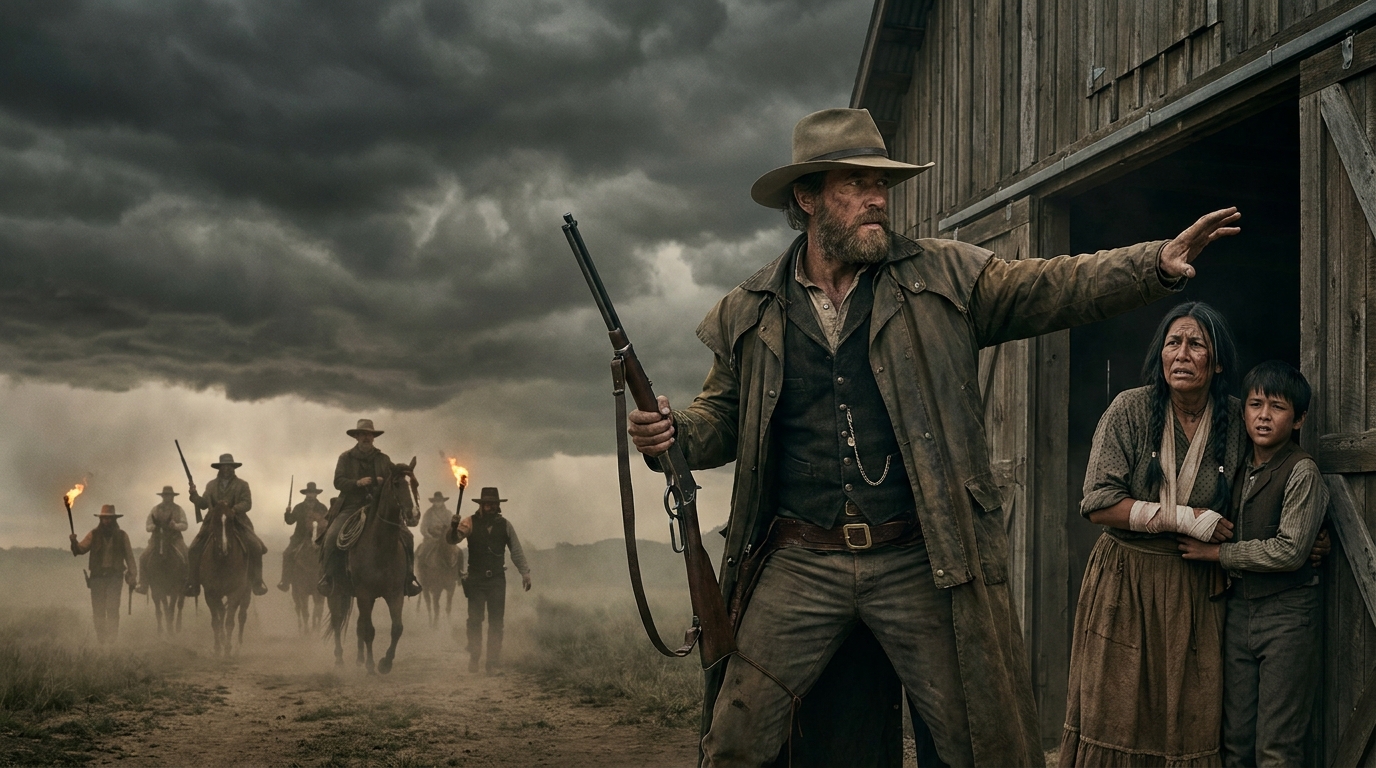
Behind them came men with rifles, ropes, and torches.
Anna climbed up from the cellar, fear already on her face.
Silas turned sharply. “Get below.”
She did not move. “They know.”
Thomas grabbed her hand.
Silas looked out again.
The riders crossed his lower field like a storm made of men.
Cole was smiling.
And beside him, tied across the back of one horse, was a blanket Silas recognized.
Mary’s old blanket.
The one he had given Anna.
Somehow, they had found proof.
Silas’s hand closed around his rifle.
Outside, Sheriff Nolan shouted, “Silas Boone! Come out with your hands where we can see them!”
Anna whispered, “This is because of us.”
Silas looked at her, then at Thomas.
“No,” he said quietly. “This is because of them.”
The riders stopped in front of the barn.
Cole lifted Mary’s old blanket high for everyone to see.
“Open the barn,” he shouted. “Or we burn it down.”
Thomas began to shake.
Silas stepped between the boy and the door.
And for the first time in many years, Silas Boone did not feel like a lonely man protecting an empty ranch.
He felt like a father standing in front of his family.
And outside, the torches came closer.
The torches came closer.
Their flames moved through the night like angry eyes, bright and restless against the black fields of Boone Ridge. The men holding them did not look like neighbors anymore. They looked like a mob wearing familiar faces.
Silas Boone stood inside the barn with his rifle in his hand and the weight of every choice he had ever made pressing against his chest.
Behind him, Anna held Thomas close.
The boy was shaking.
Not loudly. Not in a way that begged for pity. He shook quietly, the way children do when they have already learned that fear does not always make grown people kinder.
Silas saw it.
And something in him hardened.
For years, he had believed grief had emptied him. He had believed Mary’s death and the loss of their unborn child had taken the father out of him forever. He had believed there was nothing left in his heart but dry land, old regrets, and stubborn survival.
But standing there with a wounded mother behind him and a boy looking at him like he was the last wall between life and cruelty, Silas understood the truth.
Fatherhood was not only blood.
Sometimes fatherhood was a door you stood in front of.
Sometimes it was a lie you refused to tell.
Sometimes it was a gun held steady while the whole world called you wrong.
Outside, Sheriff Nolan shouted again.
“Silas Boone! Bring them out!”
Cole Maddox raised Mary’s old blanket in the firelight. “We know they’re in there! You hid them under your own roof like a traitor!”
The word struck the crowd hard.
Traitor.
Men who had once borrowed Silas’s tools now looked at him with suspicion. Men whose cattle he had helped pull from flood mud now gripped rifles like he had become a stranger overnight. Even Tom Mercer, the blacksmith, stood with shame in his eyes, holding a torch he did not seem proud to carry.
Amos Reed pushed through the crowd on his horse.
“Put those torches down!” Amos shouted. “You burn that barn, you burn his feed, his horses, and maybe innocent people too!”
Cole turned on him. “Innocent? You call hiding enemies innocent?”
Amos pointed at the blanket. “You stole that from his house, didn’t you?”
A ripple moved through the men.
Cole’s face twitched. “Found it where it mattered.”
Silas stepped out of the barn.
The movement silenced everyone.
He stood under the lantern above the door, rainwater still dripping from the roof though the storm had passed days earlier. His face was tired, but his eyes were clear.
Sheriff Nolan aimed his rifle low. “Silas, don’t make this worse.”
Silas looked at him. “You brought torches to my barn and call me the danger?”
Cole laughed. “You chose them over us.”
Silas looked across the crowd slowly.
Henry Wilkes. Tom Mercer. Old Mr. Granger. Two Miller boys barely old enough to shave. Mrs. Bell standing behind her wagon with tears in her eyes. People he had known for years. People he had greeted at church. People who had smiled at him in daylight and now came to drag a mother and child into darkness.
“No,” Silas said. “I chose not to hand a wounded woman and a boy to men too scared to ask questions.”
Sheriff Nolan’s mouth tightened. “They are Apache.”
“They are people.”
Cole spat into the dirt. “That kind of softness gets men killed.”
Silas turned to him. “No. Men like you get men killed.”
The crowd murmured.
Cole’s eyes flashed. “Careful, Boone.”
Silas stepped farther into the open. “I watched you flinch when Amos named Caleb Rusk. I saw your face in town. I saw your fear, not of Apache raiders, but of the truth catching up to you.”
Sheriff Nolan looked sharply at Cole. “What is he talking about?”
Silas kept going. “Rusk’s gang is hiding in Devil’s Cut. Stolen cattle are down there. Wagons too. Maybe supplies from the families who were robbed. Anna’s husband saw them. That is why they killed him. That is why they hunted her and the boy.”
Cole shouted, “Lies!”
Anna appeared in the barn doorway.
Every rifle lifted.
Silas raised his own. “Lower those guns.”
Anna stood pale but strong, one hand against her bandaged side. Thomas stood half behind her.
The sight of the boy made some of the men hesitate.
He was not a warrior.
He was not a threat.
He was a child wearing clothes too large for him, with fear in his face and dust on his boots.
Anna looked at the crowd.
“My husband was killed by white outlaws,” she said. “They wore stolen clothing to make you hate my people. They attacked your wagons. They attacked our camps. They wanted your anger. And you gave it to them.”
Her voice was not loud, but it cut deeper than shouting.
Cole moved quickly.
Too quickly.
His hand dropped toward his pistol.
Silas saw it and fired first.
Not at Cole’s chest.
At the ground beside his boot.
The shot cracked through the night.
Cole stumbled back, cursing.
Silas’s rifle stayed trained on him. “Next one will not be dirt.”
Sheriff Nolan finally turned his gun toward Cole. “Maddox, keep your hands where I can see them.”
Cole looked around and realized the crowd had shifted. Not completely. Not with trust. But with doubt.
And doubt was dangerous to a liar.
Then came a sound from the west.
At first, it was faint.
A low thunder.
Not from the sky.
From the canyon.
Silas turned his head.
Amos did too.
A rider came racing over the ridge, bent low over his horse. It was Jacob Miller, one of the young ranch hands from the south range. His shirt was blackened with smoke. His face was streaked with ash.
“Fire!” he screamed. “Fire from Devil’s Cut! Wind pushed it east! It’s coming fast!”
The crowd broke into panic.
Men turned their horses. Women cried out. Someone shouted about cattle. Someone else yelled about children near the lower creek.
Then Jacob pointed toward the darkness. “Rusk’s men are driving stolen cattle ahead of the flames! They’re using the fire to cover their escape!”
Silas looked toward the west.
A red glow had begun to rise behind the ridge.
The wildfire was coming.
And it was coming for all of them.
For one terrible moment, every argument died.
There was no time left for fear dressed as justice.
No time for speeches.
No time for old hatred.
Only fire.
Sheriff Nolan looked lost. “The wells are low. We can’t stop a canyon fire with dry buckets.”
Men began shouting over each other.
“The cattle will scatter!”
“The creek’s half mud!”
“My children are at the house!”
“The wind will take the whole valley!”
Then Thomas stepped forward.
His small voice shook, but he spoke.
“There is water.”
Everyone turned.
Anna’s face tightened. “Thomas—”
The boy looked up at her with tears in his eyes. “Mama, Father said water belongs to life.”
Silas knelt slightly. “Thomas, where?”
The boy pointed toward the red cliffs behind Boone Ridge. “Under the split canyon. There is a spring. My father showed me. It runs under stone. It comes out beyond the dry wash.”
Cole barked, “A child’s story!”
But Silas was already moving.
He grabbed his saddle.
Anna caught his arm. “The route is dangerous.”
“So is staying here.”
Thomas stepped closer. “I can show you.”
“No,” Anna said immediately.
The boy looked at her. “Mama, if I do not, everyone burns.”
The words landed heavy.
Anna’s face broke with pain. She had already lost her husband. Now the same cruel world was asking her to risk her son.
Silas saw it and spoke softly.
“I’ll ride with him. I swear to you, I’ll bring him back.”
Anna looked into his eyes.
For the first time, she did not see only a white rancher.
She saw a man who had stood between her child and guns.
She saw a man who had lied to protect them, fought for them, and carried grief like an old wound.
Still, trust was not easy.
It had to be dragged out of pain.
Finally, Anna touched Thomas’s face. “You stay close to him.”
Thomas nodded.
Silas lifted the boy onto Daisy, then swung up behind him. Amos rode beside them. Sheriff Nolan followed with a group of men, while others rushed back to move families and cattle away from the fire line.
Cole hung back.
Too quiet.
Silas noticed.
But there was no time.
They rode hard toward the red cliffs.
The night grew hotter as they moved west. Smoke thickened in the air. Sparks drifted above the brush like burning insects. In the distance, cattle bawled in terror, and men shouted somewhere inside the canyon.
Thomas clung to the saddle horn but kept pointing.
“Not that trail,” he said. “Left. Through the rocks.”
Silas obeyed.
The path narrowed until horses had to move single file between stone walls. Branches scratched their legs. Smoke made every breath bitter. Behind them, the glow grew brighter.
Amos coughed. “If that boy’s wrong, we’re riding into an oven.”
Silas looked down at Thomas. “He ain’t wrong.”
Thomas glanced back at him.
Something passed between them.
Not words.
Something stronger.
Trust.
They reached a dry wash beneath a cliff shaped like a broken tooth. Thomas slid from the horse before Silas could stop him and ran toward a wall of stone covered in brush.
“Here!” he shouted.
Silas jumped down and pulled the brush aside.
At first, there was nothing.
Only rock.
Then Thomas placed his small hand against a narrow crack.
“My father said listen.”
Silas leaned close.
At first, he heard only fire wind.
Then—
A whisper.
Water.
Running behind stone.
Amos’s eyes widened. “Lord above.”
Sheriff Nolan stared, stunned.
Silas grabbed a pickaxe from his saddle pack. “Dig!”
Men rushed forward. They hacked at loose rock. They pulled brush, mud, and packed clay away from the crack. Smoke rolled over them. The fire was closer now. Heat pushed against their backs.
Then the stone broke open.
Water burst through.
Cold, clear, and strong.
It spilled down the wash, first as a stream, then as a rushing flow. Men shouted in disbelief. Some dropped to their knees. The hidden spring poured into the dry channel like the earth itself had decided to forgive them.
Silas grabbed Thomas and lifted him high.
“You did it, boy!”
Thomas’s face lit with wonder.
But the joy lasted only a second.
Gunshots cracked from above.
A man fell near the water.
Silas shoved Thomas behind a rock.
From the ridge, riders appeared.
Caleb Rusk’s gang.
A dozen outlaws, dirty and armed, with stolen horses and cattle moving behind them. At their front rode Caleb Rusk, a lean man with a scar along his jaw and dead eyes beneath his hat.
Beside him rode Cole Maddox.
The betrayal hit the men like another fire.
Sheriff Nolan stared upward. “Cole?”
Cole pointed his pistol down. “Should’ve burned the barn when we had the chance.”
Rusk laughed. “You town men are easy. Wave a little fear in your faces and you’ll chase mothers while thieves ride through your back door.”
Silas’s eyes locked on Cole. “You sold out your own valley.”
Cole’s face twisted. “This valley never gave me what I deserved.”
Amos shouted, “So you helped murder people?”
Cole looked away.
That was answer enough.
Rusk raised his rifle. “Step away from that water. We’re taking the herd and riding south.”
Sheriff Nolan lifted his gun, but Rusk’s men already had the high ground.
The valley’s only hope had become a battlefield.
Silas looked at the water, then at the fire behind them, then at Thomas hiding near the rocks.
He knew what had to happen.
“Amos,” he said quietly.
Amos glanced at him.
“Get the boy back.”
“No.”
“Do it.”
Before Amos could argue, Silas stepped into the open.
Rusk aimed at him. “Brave man.”
Silas walked slowly toward the stream. “Not brave. Just tired.”
“Tired men die easy.”
Silas looked up. “Maybe. But greedy men get careless.”
Then he fired at the rocks above Rusk.
The shot struck a loose shelf of stone.
For years, Silas had ridden these cliffs. He knew which parts held firm and which parts waited for one hard strike.
The stone cracked.
Amos understood instantly.
He fired too.
Then Sheriff Nolan.
Then Henry.
Then Tom.
Bullets slammed into the weakened rock. The ledge broke with a deep groan.
Rusk’s horse reared.
The ridge collapsed beneath the outlaws.
Men shouted as stone and dust crashed down, cutting off the high trail. Some horses bolted. Some riders fell. The stolen cattle scattered away from the fire and toward the water.
Cole tried to ride out, but his horse slipped in loose rock. He fell hard, his pistol flying from his hand.
Silas ran through smoke and grabbed him by the collar.
Cole swung at him.
Silas hit him once.
Cole dropped to the ground.
Rusk, however, was not finished.
He staggered from the dust with blood on his face and a knife in his hand. His eyes fixed on Thomas, who had moved from behind the rocks.
“If the boy found the water,” Rusk snarled, “then the boy dies.”
He lunged.
Silas turned too late.
Anna appeared from the smoke.
She had followed them.
Wounded, limping, but fierce as a storm.
She threw herself between Rusk and her son, striking his arm aside with a branch. Rusk cursed and shoved her down.
Thomas screamed, “Mama!”
Silas tackled Rusk.
They hit the ground hard. The knife sliced Silas’s arm, but he held on. Rusk was strong, desperate, and wild. They rolled in the dirt beside the rushing water while smoke burned their lungs.
Rusk reached for the knife again.
Then Sheriff Nolan fired.
Rusk jerked, fell back, and did not rise.
For a moment, there was only the sound of water and fire.
Silas pushed himself up, bleeding from his arm.
Anna was on the ground, holding Thomas.
He ran to them.
“Anna?”
She looked up, breathing hard. “I am alive.”
Thomas clung to her, sobbing.
Silas dropped beside them and pulled them both close without thinking.
Anna stiffened for half a second.
Then she let him.
The fire roared nearby, but the water now rushed through the wash toward the lower fields. Men worked fast, digging channels, breaking banks, guiding the stream. The hidden spring spread across dry earth. Steam rose where fire met wet ground. Cattle were driven toward the safe side. Families were moved. Wagons rolled through smoke.
By dawn, the fire had not vanished.
But it had been stopped from swallowing Red Creek.
And the valley knew why.
Not because of Sheriff Nolan.
Not because of Cole Maddox.
Not because of the men with torches.
Because of a boy they had wanted to throw away.
Because of a mother they had feared.
Because of a lonely cowboy who chose compassion when fear would have been easier.
By sunrise, Cole Maddox sat tied beside the sheriff’s wagon, his face gray with defeat. The surviving outlaws were bound near him. Caleb Rusk was dead. The stolen cattle were gathered. Supplies from robbed wagons were found hidden in Devil’s Cut, along with clothing and items taken from Apache families to frame them.
There was no hiding the truth anymore.
The town had been fooled.
Worse than that, the town had been willing to be fooled.
Sheriff Nolan approached Silas near the spring. His hat was in his hands.
“I was wrong,” he said.
Silas looked at him. “Wrong nearly got a child killed.”
Nolan lowered his eyes. “I know.”
“No,” Silas said. “You don’t. But you can start by saying it where everyone can hear.”
So that afternoon, in the middle of Red Creek, Sheriff Nolan stood before the town and told the truth.
He spoke of Rusk’s gang.
He spoke of Cole’s betrayal.
He spoke of the stolen cattle, the false tracks, the attacks meant to stir hatred.
Then he turned toward Anna and Thomas, who stood beside Silas.
“These people were not our enemies,” Nolan said, his voice heavy. “They were victims. And when this valley needed saving, this boy led us to water.”
The crowd was silent.
Shame moved through them slowly.
Mrs. Bell began to cry.
Tom Mercer removed his hat. Henry Wilkes stepped forward and looked at Thomas.
“I carried a torch to your hiding place,” Henry said, his voice breaking. “I am sorry.”
Thomas looked at his mother.
Anna’s face was unreadable.
Then Thomas said softly, “You were afraid.”
Henry nodded. “Yes.”
Thomas looked at the ground. “I was too.”
That simple answer broke more hearts than anger could have.
One by one, people apologized. Some with words. Some only with lowered eyes. Apologies did not erase what had happened. Silas knew that. Anna knew it too.
But truth had finally entered the town.
And truth, like water, could begin cutting new paths.
Weeks passed.
The hidden spring changed everything.
With careful channels and shared labor, Boone Ridge became the center of a new water route. Silas could have claimed it for himself. Many expected him to. It ran beneath his land, after all.
But Silas remembered Thomas’s words.
Water belongs to life.
So he made a choice no one expected.
He opened the spring to families who needed it—settler and Apache alike.
At first, people came cautiously. A few ranchers brought cattle. Then Apache families came to fill water skins and trade herbs, tools, and blankets. Suspicion did not vanish overnight, but hunger and thirst had a way of humbling proud men.
Anna healed slowly.
She and Thomas remained at Boone Ridge, though Silas never asked them to stay in a way that sounded like ownership. He simply made space.
He repaired the small room near the kitchen. He built a new bed for Thomas. He left Mary’s blanket folded at the foot of Anna’s bed.
One evening, Anna found him outside the old nursery room, standing with his hand on the door.
“You never opened it?” she asked.
Silas shook his head.
“Not since Mary.”
Anna stood beside him.
The sunset turned the windows gold.
After a long silence, Thomas came running from the barn, laughing as Daisy trotted behind him. He had grown stronger in only a few weeks. His cheeks had color again. His eyes had lost some of their fear.
Some.
Not all.
Children carried scars too.
But now he also carried hope.
Silas watched him.
Anna watched Silas.
“You lost a son,” she said softly.
Silas swallowed. “I lost the chance to be his father.”
Anna’s voice became gentle. “Maybe not forever.”
Silas looked at her.
Thomas ran up, breathless. “Mr. Boone! Daisy followed me all the way to the porch!”
Silas tried to look stern. “That’s because you keep sneaking her apples.”
Thomas grinned. “She looked hungry.”
“She’s always hungry.”
Anna smiled.
It was the first full smile Silas had ever seen on her face.
And just like that, the porch of Boone Ridge no longer felt empty.
The town had called Anna and Thomas dangerous.
But they had saved the valley.
The town had called Silas a traitor.
But he had become a bridge.
And Boone Ridge, once known as the loneliest ranch in Red Creek, became something far greater than a cattle ranch.
It became a safe place.
A place where thirsty travelers found water.
A place where frightened families found shelter.
A place where children from both sides of the valley learned to ride horses, mend fences, and listen before they judged.
And every evening, when the sun touched the red cliffs and the hidden spring whispered through the land, Silas Boone would stand on his porch with Anna beside him and Thomas laughing near the barn.
He would remember the storm that brought them.
He would remember the night he almost lost them.
Then he would look at the family he never expected to have.
And for the first time since Mary died, Silas Boone would smile without pain.
Because sometimes, the life a man loses is not the end of his story.
Sometimes, if his heart stays open long enough, love finds another road home.
Reader question: At what exact moment did you feel Silas stopped protecting strangers and started protecting family?**
Leave a Reply