
Free reader powered by your browser. Available voices may vary by device.
The Boy Who Stopped the Train.
The Boy Who Stopped the Train.
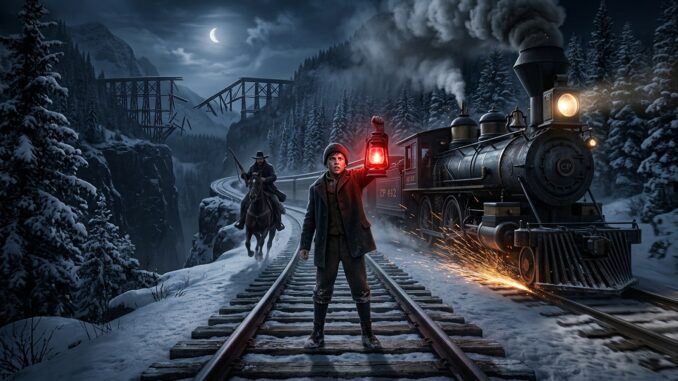
Samuel Reed stood in the middle of the railway tracks, holding a burning lantern above his head.
Behind him, the bridge had been torn apart.
Ahead of him, somewhere beyond the dark mountains, a passenger train was racing toward certain disaster.
Its whistle screamed through the night.
The sound grew louder.
The iron rails beneath Samuel’s boots began to shake.
Then he heard another sound—the pounding of horse hooves behind him.
Samuel turned.
A rider was coming through the darkness, bent low over a black horse. Moonlight flashed across the revolver in the man’s hand.
“Get off those tracks, boy!” the rider shouted. “Or I will put you beneath them!”
Samuel’s hands trembled, but he did not move.
The train whistle cried again.
The rider raised his weapon.
And fourteen-year-old Samuel Reed understood that he had only seconds to choose how he would die.
Before we continue, please like, subscribe, and share this story with someone who loves tales of courage, justice, and ordinary people doing extraordinary things.
Two days earlier, Samuel’s greatest worry had been an empty stomach.
He lived in a small railway town called Cedar Crossing, hidden between the forests and mountains of British Columbia. Nearly every building stood close to the tracks: the general store, the hotel, the sheriff’s office, the church and the wooden station where trains stopped for water and coal.
Samuel had no family in Cedar Crossing.
His mother had died when he was eight. His father, a railway worker, had disappeared during a winter storm two years later. Searchers found his torn coat beside a frozen river, but they never found his body.
Since then, Samuel had survived alone.
He slept in the hayloft above Mr. Bell’s stable and earned a few coins cleaning stalls, carrying water and brushing horses. Some days Mr. Bell gave him stew. Other days Samuel ate bruised apples meant for the animals.
People in town knew him as the quiet orphan.
They rarely used his name.
“Stable boy,” they called.
“Move aside, stable boy.”
“Take my horse, stable boy.”
“Do not touch that, stable boy.”
Samuel had learned that poor children were often seen but seldom heard.
Still, he noticed things.
He noticed which travelers were afraid.
He noticed which horses had been pushed too hard.
He noticed when men smiled in public but became cruel when they thought no one was watching.
That was how he came to fear Mr. Silas Vale.
Vale owned the Cedar Crossing Hotel, half the warehouses beside the railway and a large piece of forestland north of town. He wore polished boots, a silver watch and a smile that never reached his eyes.
Everyone respected him.
The sheriff drank with him.
The mayor asked his advice.
Even the railway officials stayed in his hotel without paying.
His closest friend was Edwin Mercer, a land businessman who had recently arrived from Victoria. Mercer claimed he wanted to build a lumber mill and bring jobs to Cedar Crossing.
But there was one problem.
The best land near the river belonged to the Kettle River community, whose families had hunted, fished and lived there long before Cedar Crossing existed.
Vale and Mercer had offered to buy it.
The community refused.
On a cold Tuesday evening, Samuel was brushing Vale’s black horse when the stable doors opened.
Vale entered with Mercer.
Neither man noticed Samuel behind the wooden stall wall.
“Are you certain the night train will be full?” Mercer asked.
“More than sixty passengers,” Vale replied. “Families, workers and two railway inspectors.”
Samuel froze.
There was something strange in Vale’s voice.
Mercer lowered his tone. “And the bridge?”
“Old enough to fail without raising questions. We weaken the center supports tomorrow night. When the train goes down, we leave evidence pointing toward the Kettle River men.”
Samuel stopped brushing.
His breath caught in his throat.
Mercer began walking back and forth. “What kind of evidence?”
“Tools marked with their family symbols. A torn blanket. Perhaps an old hunting knife.”
“And the town will believe it?”
“The town will be angry,” Vale said. “Angry people believe whatever gives them someone to punish.”
Samuel’s fingers tightened around the brush.
Mercer gave a nervous laugh. “Once violence begins, the government will remove them.”
“And their land will be sold,” Vale answered. “You will build your mill. I will control the railway contracts. By spring, we will be the richest men in this valley.”
Samuel felt sick.
Sixty passengers.
Children might be on that train.
Mothers. Fathers. Men returning home.
Vale and Mercer were planning to destroy them all for land and money.
A floorboard creaked beneath Samuel’s boot.
The two men fell silent.
Vale stepped toward the stall.
Samuel dropped to his knees and crawled beneath the dividing rail just as Vale looked inside. He pressed himself against the warm side of a large brown mare.
The horse shifted.
Vale stared into the shadows.
“Something wrong?” Mercer asked.
“Probably a rat.”
Samuel covered his mouth, afraid they would hear his breathing.
Vale remained there for several long seconds.
Then he turned away.
“Tomorrow,” he said. “Just before midnight.”
The stable doors closed behind them.
Samuel waited until their footsteps disappeared.
Then he ran.
He crossed the muddy street, nearly collided with a wagon and burst through the sheriff’s office door.
Sheriff Amos Pike sat behind his desk eating beef and potatoes. He was a broad man with gray whiskers and heavy eyes.
“What is the meaning of this?” Pike demanded.
Samuel tried to speak, but he had run so hard that only broken breaths came out.
“The bridge,” he gasped. “Mr. Vale and Mr. Mercer—they are going to destroy it.”
The sheriff slowly placed down his fork.
Samuel told him everything.
He repeated the words he had heard. He described the plan, the false evidence and the night train filled with passengers.
Sheriff Pike listened without interrupting.
For one hopeful moment, Samuel believed him.
Then the sheriff leaned back and laughed.
“Silas Vale plans to destroy the railway?” he said. “The same railway that made him wealthy?”
“I heard him.”
“You heard wrong.”
“I did not.”
Pike’s expression hardened. “Be careful, boy. Accusing respected men of murder can place you inside a jail cell.”
“But the train—”
“That is enough.”
Samuel stood his ground. “Please inspect the bridge.”
The sheriff rose.
“You clean horse stalls,” he said. “You do not investigate crimes. Go back to the stable before I speak to Mr. Bell about sending you away.”
Samuel felt every bit of hope leave him.
He walked toward the door.
As his hand touched the handle, Pike spoke again.
“And Samuel?”
The boy turned.
The sheriff’s eyes had changed. There was no amusement in them now.
“Forget what you think you heard.”
Samuel stepped into the cold evening.
He did not return to the stable at once.
Instead, he slipped behind the sheriff’s office and crouched beneath the window. He did not know what he expected to hear.
For several minutes, there was only silence.
Then the rear door opened.
Samuel heard Sheriff Pike walking toward the alley.
Another pair of footsteps approached.
“Did the boy believe you?” Silas Vale asked.
“He believes I dismissed him,” Pike answered.
Samuel’s heart stopped.
Vale spoke quietly.
“Good. The telegraph line will be cut tomorrow evening. Once that is done, no warning can leave Cedar Crossing.”
“And the boy?” Mercer asked.
Sheriff Pike paused before answering.
“We will deal with Samuel Reed before midnight.”
Samuel remained beneath the sheriff’s window, afraid even to breathe.
“We will deal with Samuel Reed before midnight.”
The words seemed to freeze the blood inside him.
He had come to Sheriff Pike for help.
Instead, he had placed himself in greater danger.
Samuel backed away from the wall, moving slowly so his boots would not scrape the gravel. Once he reached the corner, he turned and ran.
He did not return to the stable.
He crossed behind the general store, slipped through a narrow lane and hid inside an abandoned tool shed near the railway yard.
Rain began tapping against the roof.
Samuel sat in darkness, hugging his knees while fear pressed against his chest.
He could leave Cedar Crossing.
He could take food from the stable, follow the old wagon road south and disappear before Vale found him.
No one would blame him.
No one had ever protected Samuel. Why should he risk his life protecting people who treated him like dirt?
Then he remembered a woman who had stepped from the train the week before with two little girls. One child had laughed when Samuel helped carry their bag. The other had secretly placed a piece of candy in his hand.
Passengers like them would be aboard the midnight train.
They did not know the bridge was waiting to kill them.
Samuel closed his fingers around the memory of that candy.
“I have to stop it,” he whispered.
But how?
The telegraph operator was loyal to Vale. Sheriff Pike was part of the plan. The nearest railway station lay more than twenty miles away.
Samuel suddenly remembered Thomas Greywolf.
Thomas lived with his family beside the Kettle River community. He was sixteen, tall and calm, and often came to Cedar Crossing to trade animal hides. Unlike most townspeople, Thomas always called Samuel by his name.
Samuel left the shed and followed the forest path north.
Rain fell harder.
Branches struck his face as he ran. Mud pulled at his boots. Every shadow seemed to hide one of Vale’s men.
After nearly an hour, Samuel reached the first cabins near the river.
Dogs barked.
A man stepped from the trees carrying a hunting rifle.
“Who is there?”
“It is Samuel Reed!”
Thomas came running from a nearby cabin.
He wore a wool coat over his nightshirt. “Samuel? What happened?”
Samuel told him everything.
Thomas’s face changed as he listened.
“My father warned the council that Vale wanted our land,” he said. “But we did not think he would go this far.”
An older man appeared behind him. His name was Jacob Greywolf, Thomas’s father.
“Where will they damage the bridge?” Jacob asked.
“The Eagle Gorge crossing.”
Jacob looked toward the mountains. “The midnight train reaches that bridge shortly after one.”
“Can we send someone to warn it?”
“The northern road is flooded,” Jacob said. “A horse might reach Black Pine station, but not before the train leaves.”
Thomas grabbed his coat. “Then we go to the bridge.”
Jacob stopped him. “Vale may already have men there.”
“We cannot do nothing.”
Jacob looked at Samuel. “Did anyone see you come here?”
“I do not think so.”
A horse neighed somewhere beyond the trees.
Then another answered.
Thomas moved to the window.
Lantern light appeared through the rain.
Riders were approaching.
Jacob immediately blew out the cabin lamp.
“Into the forest,” he said.
Samuel, Thomas and Jacob slipped through the rear door as three mounted men entered the clearing.
Sheriff Pike’s voice carried through the rain.
“We are looking for the Reed boy!”
No one answered.
Pike rode closer to the cabins.
“Anyone hiding him will be arrested for helping a railway thief.”
Samuel’s stomach turned.
“They are making me the criminal,” he whispered.
Jacob placed a hand on his shoulder. “That is what frightened men do when truth threatens them.”
They moved deeper into the trees.
After several minutes, Jacob stopped beside a narrow trail.
“Thomas, take Samuel to the bridge,” he said. “I will warn our families and gather witnesses. If we survive tonight, Vale will try to blame us.”
Thomas nodded.
Jacob looked at Samuel. “Do not trust the main road. Follow the old logging trail.”
“What if the bridge is already damaged?” Samuel asked.
“Then the train must be stopped before it enters the gorge.”
Thomas and Samuel reached a small pasture hidden among the trees. Two horses stood beneath a shelter.
Thomas saddled a gray mare for Samuel and mounted a strong chestnut gelding.
Samuel had ridden many horses around the stable, but never through a mountain storm.
They raced into the night.
The logging trail climbed sharply through wet forest. Thunder rolled above them. Roots and stones flashed beneath the horses’ hooves.
After several miles, Thomas raised his hand.
They stopped.
Ahead, an orange glow moved between the trees.
Men with lanterns were standing near the telegraph poles.
Samuel and Thomas dismounted and crawled toward the edge of the trail.
Silas Vale stood beneath the wires with Edwin Mercer and two hired men.
One wire already hung loose.
Mercer held a heavy cutting tool.
“The line is dead,” he said.
“Good,” Vale replied. “Now finish the bridge.”
One of the hired men pointed toward the forest. “I heard something.”
Samuel’s horse shifted behind the trees.
Vale turned.
“Search the trail.”
Samuel and Thomas ran back to the horses.
A gunshot cracked through the rain.
The gray mare reared, throwing Samuel into the mud.
Thomas pulled him up.
“Can you ride?”
Samuel nodded, though pain burned through his shoulder.
They mounted and raced away as Vale’s men followed.
The chase tore through the forest.
Branches whipped Samuel’s face. His horse slipped twice but recovered. Thomas guided them onto a steep deer path where the pursuing riders could not move as quickly.
For several minutes, the sounds behind them faded.
Then Thomas’s horse stumbled.
The chestnut fell to its knees.
Thomas jumped down and examined its front leg.
“It is injured,” he said.
Samuel looked back. Lantern light was approaching again.
“Take my horse,” he said.
Thomas shook his head. “You are the one they want.”
“And you know the forest better.”
Thomas stepped close. “Listen to me. You heard their plan. You must reach the bridge. I will lead them away.”
“They will catch you.”
“Only if they can follow.”
Thomas slapped the gray mare’s side.
The horse surged forward with Samuel in the saddle.
Samuel twisted around.
Thomas disappeared into the rain, limping beside the injured chestnut as the lanterns moved toward him.
Samuel wanted to turn back.
But the distant whistle of the midnight train echoed through the mountains.
He rode harder.
At twelve forty-five, Samuel reached Eagle Gorge.
The bridge stretched across a deep black ravine. Far below, a river crashed against stone.
Two figures were leaving the bridge on horseback.
Vale and Mercer had finished their work.
Samuel waited until they disappeared before approaching.
Several wooden supports had been cut nearly through. Iron bolts lay scattered on the tracks. The center section sagged over the gorge.
The bridge could not hold a train.
Samuel searched desperately for a warning lantern.
There was one inside the railway maintenance box, but the glass was broken and the fuel nearly gone.
He poured in the last drops, lit the wick and climbed onto his horse.
The train whistle sounded again.
Closer now.
Samuel rode west along the tracks, holding the lantern against the rain.
He needed to reach the straight section before the final curve. If the engineer saw him too late, the train would not have enough distance to stop.
The mare’s breathing became rough.
“Please,” Samuel begged. “Just a little farther.”
Behind him came the sudden pounding of another horse.
Samuel looked back.
Silas Vale was riding from the bridge.
He must have seen the lantern.
Vale drew his revolver.
“Stop!” he shouted.
Samuel leaned forward and urged the mare onward.
A shot struck the ground beside him.
The horse panicked and threw Samuel from the saddle.
He landed hard between the rails.
The lantern rolled away but remained burning.
Vale’s horse slowed as he approached.
Samuel tried to stand, but pain shot through his ankle.
Vale dismounted and walked toward him.
“You should have left town,” he said.
Samuel crawled toward the lantern.
Vale raised the revolver.
Then a powerful white light appeared around the curve ahead.
The train was coming.
The rails began to shake.
Samuel grabbed the lantern and forced himself upright.
Vale smiled coldly.
“You cannot stop it now.”
Samuel turned toward the approaching engine.
Its whistle screamed.
He stepped into the center of the tracks and raised the lantern above his head.
Behind him, Silas Vale pulled back the hammer of his revolver.
The locomotive burst around the curve like a black iron beast.
Its headlamp flooded the tracks with white light.
Samuel stood between the rails, holding the lantern above his head while the ground shook beneath his injured foot.
The engineer pulled the whistle.
One long, terrible scream split the night.
“Move!” Silas Vale shouted.
Samuel did not move.
Vale stood several yards behind him with the revolver aimed at his back. Rain streamed from the brim of his hat. His polished coat was covered in mud, and the friendly smile he wore in town had disappeared.
“Put down the lantern,” Vale said. “The engineer will think you are a foolish child.”
Samuel waved the light from side to side.
The train kept coming.
Its wheels hammered the rails.
Vale stepped closer. “No one believed you before. No one will believe you now.”
Samuel’s fear suddenly became anger.
All his life, people had spoken around him as if he were invisible. They had called him stable boy, beggar and orphan. They had decided that his empty pockets made his words worthless.
But the lives inside that train did not depend on whether anyone respected him.
They depended on whether the engineer saw him.
Samuel raised the lantern higher.
Vale fired.
The bullet shattered the lantern handle.
Flames spilled onto Samuel’s sleeve.
He cried out, dropped to one knee and slapped at the fire. The lantern struck the wet ground but continued burning.
The locomotive was less than a quarter mile away.
Samuel grabbed the broken lantern with both hands.
Then another gunshot echoed from the forest.
Vale’s revolver flew from his grip.
Thomas Greywolf stepped onto the tracks, holding a rifle.
Behind him came Jacob Greywolf and six men from the Kettle River community. Sheriff Pike was tied across the saddle of one of their horses.
Vale stared at them in disbelief.
Thomas’s face was bruised, but he remained standing.
“You should have followed me more carefully,” he said.
Vale lunged for his revolver.
Jacob raised his rifle. “Do not.”
Samuel turned back toward the train.
It was still coming too fast.
The engineer had seen him, but the heavy cars could not stop at once.
Samuel ran toward the locomotive, dragging his injured foot and swinging the lantern in a wide circle.
The brakes screamed.
Sparks flew from the wheels.
The train shuddered, but its speed remained frightening.
“Jump!” Thomas shouted.
Samuel kept running toward it.
If he left the tracks too soon, the engineer might release the brakes. He had to make the danger clear.
The engine grew larger until it filled the entire world.
Samuel could see the engineer’s pale face through the glass.
At the last possible second, Thomas rushed forward, caught Samuel around the waist and threw both of them down the rocky slope beside the tracks.
The locomotive thundered past.
Wind and steam crashed over them.
Car after car rolled by, shaking the earth.
Samuel lifted his head.
The train was slowing.
But the damaged bridge was only a short distance ahead.
The final passenger car passed them.
The brakes continued screaming.
Everyone watched in silence.
The engine stopped with its front wheels less than twenty feet from the first broken support.
For one breath, no one moved.
Then frightened passengers began leaning from the windows.
The engineer climbed down, his legs trembling.
“What happened?” he shouted.
Samuel pointed toward the gorge.
The engineer walked to the bridge and raised his lamp. When he saw the cut supports and missing bolts, he removed his cap.
“My God,” he whispered.
A little girl climbed down from the carriage, clutching her mother’s hand. Samuel recognized her as the child who had given him candy. She looked at his burned sleeve and muddy face, then wrapped her arms around him.
“You saved us,” she whispered.
Samuel could not answer. For the first time since losing his parents, he cried without hiding it.
Several other passengers came forward. Among them were two railway inspectors, a newspaper writer from Vancouver and a judge traveling with his wife.
Silas Vale immediately changed his expression.
“This boy damaged the bridge,” he said. “I followed him here to stop him.”
Samuel stared at him.
Even now, Vale believed people would choose the rich man’s word over the orphan’s.
Sheriff Pike began shouting through the cloth tied across his mouth.
Jacob pulled it free.
“They attacked me!” Pike cried. “Arrest them all!”
Thomas laughed bitterly. “He was carrying these.”
He opened Pike’s saddlebag.
Inside were tools marked with Kettle River symbols, a torn woven blanket and an old hunting knife.
The judge examined the items.
“Why would the sheriff be carrying this evidence before the crime was discovered?”
Pike’s face went gray.
Mercer suddenly appeared from the direction of the bridge. He had tried to escape through the trees, but two men escorted him back.
His courage broke the moment he saw the stopped train.
“It was Vale’s plan,” Mercer shouted. “He forced me to help!”
Vale rushed at him.
The railway inspectors seized both men.
Samuel told the entire story.
This time, everyone listened.
He described the stable conversation, Sheriff Pike’s betrayal, the cut telegraph line and the damaged bridge. Thomas and Jacob confirmed what they had witnessed. The engineer explained that without Samuel’s lantern, the train would have entered the gorge at full speed.
By sunrise, Vale, Mercer and Pike were locked inside the Cedar Crossing jail.
The newspaper writer sent the story across British Columbia as soon as the telegraph line was repaired.
The truth spread faster than Vale’s lie ever could.
Government investigators found forged land papers, secret payments and plans for taking the Kettle River property. The land was protected, and Vale’s businesses were sold to repay the railway and the families he had cheated.
Samuel expected life to return to normal.
Instead, the railway inspectors came to the stable one morning.
“We owe you more than thanks,” one of them said. “We would like to send you to school and train you for railway work.”
Samuel looked at Mr. Bell, unsure what to say.
The stable owner wiped his eyes. “Go on, boy. You were never meant to spend your whole life cleaning after other men’s horses.”
Thomas’s family also made Samuel a promise.
“You will always have a place at our table,” Jacob told him. “A person does not need the same blood to become family.”
Years later, a new steel bridge crossed Eagle Gorge.
Beside it stood a small signal house operated by a young railway engineer named Samuel Reed.
On stormy nights, Samuel sometimes stepped outside with a lantern and remembered the frightened orphan who had stood alone on the tracks.
He no longer hated the people who had refused to believe him.
But he never forgot the lesson they had taught him.
Truth does not become weak because it comes from a poor mouth.
Courage does not wait for permission.
And sometimes the person everyone overlooks is the only one brave enough to see the disaster coming.
If Samuel’s courage moved you, please like, subscribe and share this story. And remember: one small light, held by one determined person, can save more lives than anyone may ever know.
What are your thoughts about this story? Share your thoughts in the comments below.
Leave a Reply