
Free reader powered by your browser. Available voices may vary by device.
They Dragged Her Through the Mud by Her Hair, and No One in Deadwood Moved
They dragged her through the mud by her hair, and no one in Deadwood moved.
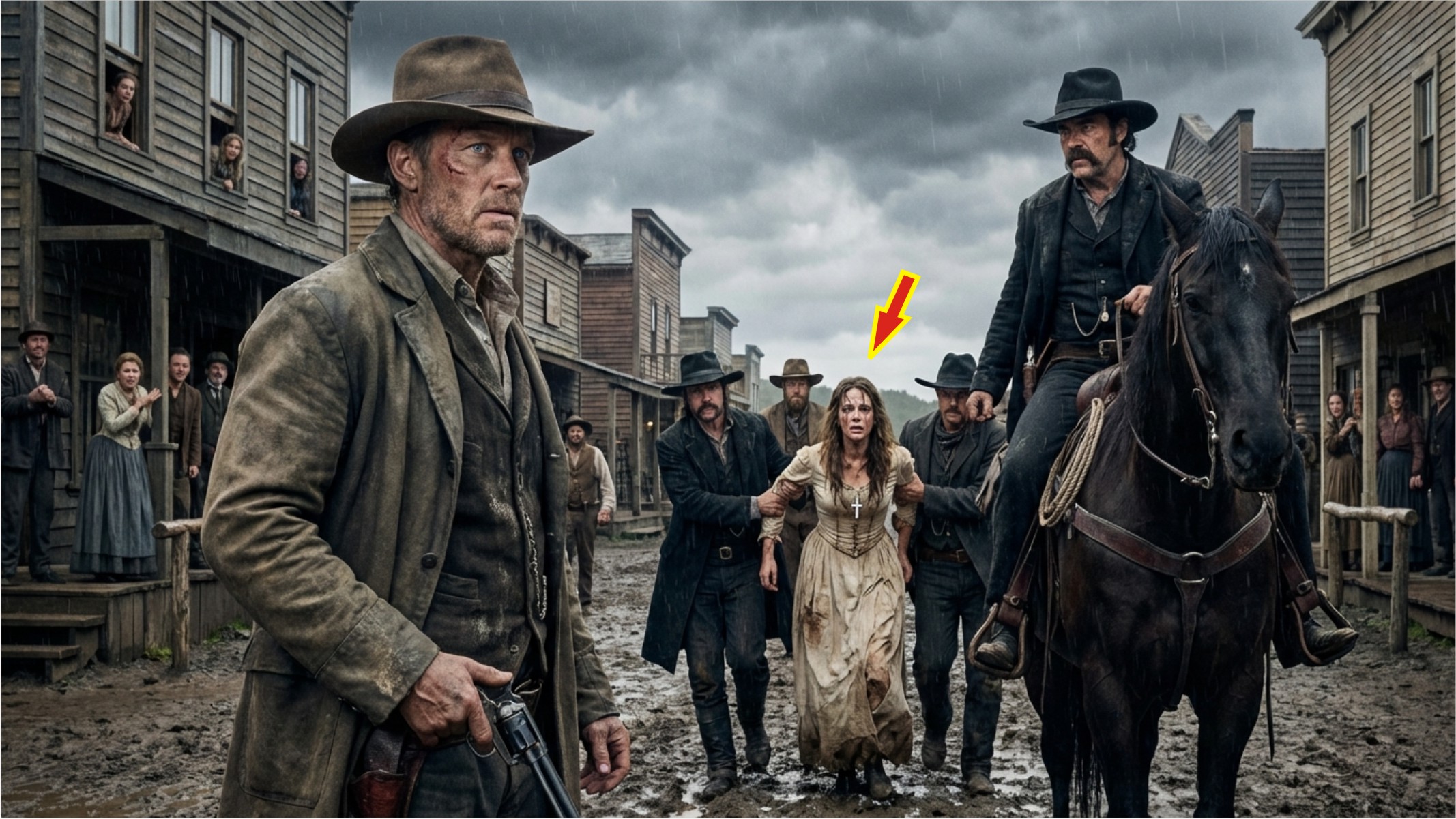
It was midday, but the sky hung low and gray over Main Street, the kind of sky that made the whole town feel like it was holding its breath. The mud was thick from last night’s rain, black and stinking with horse piss and whiskey spill. Three men on horses rode slow, laughing, while the fourth walked behind, his fist wrapped tight in the girl’s brown hair. She was maybe nineteen, dress torn at the shoulder, boots lost somewhere behind her, her knees scraping raw with every step. She did not scream anymore. She had screamed at the north end of town. Now she just whimpered, trying to keep her face out of the mud.
If you are new to my channel, please like, subscribe and turn on the bell notification icon so you will be the first to be notified any time I drop a new story.
Let’s continue..
Doors stayed shut. Curtains twitched. At the Gem Saloon, Walt the barkeep wiped the same glass for the third time and did not look up. At the mercantile, Mrs. Adler pulled her two boys behind the flour sacks. Preacher Jonah stood on the boardwalk with his Bible clutched to his chest, his lips moving without sound. Everyone knew the men. Silas McCready’s boys. The most notorious killers in the Dakota Territory. They had burned two ranches in Spearfish last month, shot a sheriff in Lead for looking at them wrong, and took what they wanted in Deadwood because nobody left alive could stop them.
Deadwood had seen enough blood to know when death was near.
That is why nobody noticed the rider at first.
He came in from the south trail on a tired dun horse, coat the color of dust, hat pulled low, shoulders bent under a duster that had seen too many winters. He did not ride fast. He did not ride proud. He just came steady, like a man who had nowhere to be and no reason to hurry. Dust clung to his beard. His eyes were the pale blue of winter sky, and they took in everything without settling on anything.
He stopped at the trough outside the livery. The horse drank. He did not.
He heard the girl whimper.
He turned his head.
Across the street, Silas McCready rode a big black stallion, a silver-toothed grin under his mustache. Beside him, Boone laughed too loud, Creed cracked his knuckles, and Jeb the Knife dragged the girl. Silas saw the stranger and tipped his hat mockingly.
“New in town?” Silas called. “Best keep your eyes down, friend. This ain’t your business.”
The stranger did not answer. He watched the girl’s hand claw at the mud, trying to find purchase. He watched her other hand clutch a small silver cross at her throat, the way someone else had once clutched his sleeve.
Something old and buried woke up in his chest, hard and painful, like a rusted nail being pulled free.
Before Deadwood
He was not always nameless.
Twenty-two years earlier, in a dry stretch of Texas near the Red River, he was Eli Carter, a boy with his mother’s soft eyes and his father’s steady hands. His father, Thomas Carter, was not a gunfighter. He was a carpenter who could shoot a rabbit at eighty yards because food was food. He taught Eli two things every evening on their porch: “A gun is a tool, not a promise. And a man who cannot keep his word is worse than a thief.”
Eli had a sister, Lila. She was four years younger, all freckles and wild hair, following him everywhere. When their mother died of fever in the winter of ’58, Lila was eight. She would crawl into Eli’s bed at night crying, and he would hold her hand and whisper the same thing: “I got you, Lila-bug. I ain’t never letting go.”
He meant it then.
When he was seventeen, the war talk turned to war walking. Men in gray coats rode through their valley recruiting. Thomas told Eli no. Eli told his father he wanted more than a hammer and a small plot of dirt. He wanted to be somebody. He wanted money to buy Lila a real dress and his father a new mule. Silas McCready rode through that spring with ten hard men, promising pay, promising glory, promising a future that did not smell like sawdust.
Eli went against his father’s word. He left at night with a note under Lila’s pillow: “I’ll be back by harvest. Keep the porch light on.”
He rode with McCready for fourteen months. He learned how fast a man could turn a tool into a promise he could not keep. He learned to shoot men, not rabbits. He learned to drink to forget the faces. He learned that Silas liked fire more than money, and that Boone liked hurting women because it made them quiet. The first time Eli saw Boone drag a girl from a homestead in Kansas, he told himself it was war. The second time, he told himself he would speak up next time. The third time, he did speak up, and Silas put a pistol to his head and laughed.
“You got a soft heart, Carter,” Silas said. “Soft hearts get buried.”
Eli left that night. He deserted. He rode three days without sleep back to the Red River, the note to Lila burning in his pocket like a prayer.
The farm was ash.
Neighbors said raiders came through two weeks earlier. Thomas tried to fight with his old squirrel rifle. They shot him on the porch. They took Lila. They took the mule. They took everything but the light Eli had told her to keep on.
Eli found her three days later in a ditch twenty miles west, half-dressed, throat cut, the small silver cross their mother gave her still clutched in her hand. She had kept his promise even when he did not keep hers.
He buried his father and sister under the big oak. He took his name off the wooden markers and carved only “Forgive Me.” Then he took his father’s pistol, his coat, and left Texas. He did not use the name Eli Carter again. Names belonged to men who kept promises. He was just a shadow that drifted from town to town, doing small work, stopping fights when he could, never staying long enough for anyone to ask where he came from.
For twelve years he wandered. He carried the weight like a stone in his gut. Every time he saw a girl with brown hair, every time he heard a woman cry, every time he saw men like Silas laugh while the world looked away, the stone got heavier.
Until Deadwood.
He worked in Dodge as a hand, and left after breaking a man’s jaw for beating his wife. He rode shotgun for Wells Fargo, and quit after shooting two bandits. He dug graves in Abilene, mended fences in Cheyenne, carried water for a preacher in Laramie though he no longer believed. Every town was the same. Good people locked doors early. Bad men took what they wanted. And a man like him learned to be invisible.
He told himself staying alive was punishment enough. That if he never drew first again, God might forget.
But God did not forget. Neither did Lila.
Deadwood was meant to be water and one night out of wind. He had heard about the gold, about the marshal who was bought and buried, about men who owned streets because no one stood up. He did not plan to stay.
Walt had told him that Sarah McAllister taught children to read in the church. That her father died owing Silas for a claim. That Silas had circled her for weeks. That the town loved her courage but loved their lives more.
He listened, left a coin, and walked out.
He had not expected to see her on her knees in mud, a cross at her throat, her eyes holding the tired light Lila had in that ditch.
He had not expected his past to ride back on a black stallion, wearing the grin that ordered his home burned.
Silas had aged, but his eyes were the same cruelty. The same eyes that watched Boone hurt a Kansas girl. The same eyes that put a gun to Eli’s head and said hearts get buried.
Seeing him again felt like a debt coming due.
The dun horse lifted its head from the trough. Water dripped from its muzzle. The stranger’s hand rested lightly on the saddle horn. He was not shaking. That was the strange thing. Inside, his heart was hammering against his ribs like a fist on a door, but his hand was steady.
Jeb jerked the girl up by her hair. She gasped, mud on her cheek, tears cutting clean lines through the dirt. Her eyes found the stranger’s across the street. They were not begging. They were tired. That was worse.
“Please,” she mouthed, not to him, just to anyone, to God.
Release Her. Now.
Silas saw the look. He kicked his horse forward a step, blocking the view.
“You deaf, drifter?” Silas said, his voice carrying easy over the mud. “I said this ain’t your business. This here is Sarah McAllister. She owes us for her daddy’s debt. We’re just collecting. Town law says we can.”
Preacher Jonah finally found his voice, thin and shaking. “There ain’t no law that says you can take a child, Silas.”
Boone turned his pistol toward the preacher. Jonah went silent.
Walt at the saloon finally looked up, his old eyes meeting the stranger’s for half a second. Walt had seen a hundred gunmen pass through Deadwood. He knew the look of the ones who would die for pride and the ones who would live with shame. This one was different. He was not measuring odds. He was remembering.
The stranger stepped off the boardwalk into the mud. His boots sank an inch. He walked slow, not toward Silas, but toward the girl. Each step was deliberate, like a man walking to his own grave and accepting the distance.
Jeb grinned, showing missing teeth. “Look at this hero. You lost, grandpa?”
Creed laughed. “He walks like his knees hurt.”
The girl, Sarah, stared at him now, confused, afraid for him too. She shook her head just barely. Don’t.
The stranger stopped ten feet away. Close enough to see the bruise blooming on her jaw. Close enough to see the silver cross at her throat, identical to Lila’s. Close enough to smell the whiskey on Jeb’s breath.
For twelve years he had told himself he could not change what happened at the Red River. For twelve years he had told himself keeping his head down was penance. For twelve years he had been a coward dressed as a ghost.
No more.
His voice, when it came, was low, dusty, and calm. It was not loud, but the whole street heard it because the laughter stopped to listen.
“Release her. Now.”
Three words.
The wind seemed to hold them for a second.
Then Boone barked a laugh that broke the quiet. Creed joined him. Jeb yanked Sarah harder, making her cry out, just to prove he could.
Silas McCready did not laugh. He studied the stranger’s face under the hat, the pale blue eyes, the beard gone gray at the chin, the scar at the left temple that had not been there twenty years ago.
Silas tilted his head. His grin faded a fraction.
“Well now,” he said softly, almost curious. “I know those eyes.”
The stranger’s hand hovered near his coat, not on the gun, just near it. His heart was not hammering anymore. It was still. Quiet. Ready.
Sarah looked between them, mud on her lips, the cross shaking in her fist.
Walt set the glass down behind the bar and reached under the counter for the shotgun he had not touched in three years. Tommy, the livery boy, ducked behind a barrel but did not run. Preacher Jonah started praying out loud this time.
Silas leaned forward in his saddle, his voice dropping so only the front of the street could hear.
“Eli?” he whispered, and the name hit the muddy air like a gunshot. “Eli Carter? You son of a bitch, I thought you were dead.”
The stranger flinched. Just once. Just enough.
And in that flinch, twelve years of running, of burying his name, of failing Lila, of watching doors stay shut, all of it cracked open.
He lifted his chin. The hat shadow fell away from his eyes.
“Release her,” he said again, and this time it was not a request. It was a promise kept too late for one girl, but maybe not for this one. “Now.”
Jeb’s knife was already half out of its sheath. Boone’s thumb found his hammer. Creed spread his feet.
Silas smiled wide, silver tooth flashing.
“Boys,” he said, never taking his eyes off the nameless gunslinger, “we got ourselves a ghost.”
The street held its breath.
Sarah closed her eyes tight around her cross.
And the gunslinger, who had not spoken his own name in twelve years, finally remembered how to stand between cruelty and the helpless, even if it cost him everything.
The First Shot
The first shot did not come from Eli.
It came from Jeb.
Jeb the Knife had held Sarah by her hair so long his fingers were white. When Silas said the word ghost, Jeb saw his chance to prove he was still the meanest thing in Deadwood. He let go of her hair, pulled his long skinning knife, and pressed it hard under her jaw. A thin red line appeared.
“Drop it, old man,” Jeb hissed, “or I open her throat.”
Sarah did not move. Her hands stayed around her mother’s cross. Her eyes were on Eli, not the knife. She was not begging. She was watching to see what kind of man he was.
Eli did not drop anything. His hand had hovered near his coat for what felt like an hour. Inside his chest everything was quiet. The twelve years of running were gone. There was only this girl, this knife, and the memory of another girl in a ditch with a cut throat.
He drew.
No one in Deadwood could agree how fast it was. Walt would swear the gun was just suddenly in his hand. Tommy would say he never saw the coat move. Preacher Jonah would say it was like a prayer answered before you finished it.
The Colt cleared leather smooth. Eli did not aim for the chest first. He aimed for the hand.
The shot cracked the street.
The bullet took Jeb through the wrist. Bone shattered. The knife fell in the mud. Jeb screamed and reached for his pistol.
Eli shot him again, center chest. Jeb fell backward, eyes open at the gray sky.
For half a breath the street was silent.
Then Boone roared and fired.
Boone was a butcher, not a marksman. His first shot splintered the trough where Eli’s dun stood. The horse bolted. The second shot was closer. It tore through Eli’s left side under the ribs, hot and deep. Eli grunted and stepped back, but he did not fall. Blood spread fast across his shirt.
Creed stepped wide for a clear angle and thumbed his hammer back.
He never fired.
From the Gem doorway Walt lifted the shotgun he kept under the bar and pulled both triggers. The roar shook windows. The load caught Creed in the thigh and hip and spun him into a rain barrel. Creed howled and clawed at the wood, leaving red on the staves.
People behind curtains screamed. Mrs. Adler gasped.
Silas McCready had not drawn. He sat his black stallion in the middle of it all, watching. He watched Eli bleed. He watched Jeb die. He watched Walt’s hands shake.
Sarah tore free and ran to Eli. She pressed both hands hard against his side. Her fingers shook but her voice was steady.
“Stay up,” she whispered. “Please stay up.”
Eli looked down. The cross at her throat was smeared with mud and blood. Up close she did not look like Lila. Lila had freckles. Sarah had a scar above her eyebrow. But the way she held on, refusing to let another person slip away, that was the same.
“Get back,” Eli told her. “He ain’t done.”
Silas laughed, a low sound with no joy.
“God Almighty,” Silas said. “Eli Carter. I buried you twelve years ago. You ran out on us in Kansas like a whipped dog. I told the boys you starved in a ditch. And here you are, playing savior.”
Eli lifted his Colt again with his right hand, though his side burned. He kept it on Silas.
“Release her,” Eli said. “You heard me.”
Silas leaned on his saddle horn, casual.
“I heard you,” Silas said. “I just don’t take orders from deserters. Especially ones who left their little sister to get cut up.”
The words hit Eli harder than the bullet. His arm trembled once.
Sarah felt it.
“Don’t listen,” she said quickly. “He lies.”
Silas’s eyes flicked to her.
“You got spirit, girl. Just like your daddy before I put two in his lungs last winter. He begged. Said you were all he had. Debt’s a debt.”
Preacher Jonah stepped off the boardwalk, Bible clutched to his chest, his face pale but his feet moving.
“That is a lie before God, Silas,” Jonah said, louder than anyone had heard him in months. “Thomas McAllister owed you nothing. You forged that paper after you shot him for seeing you kill Marshal Cobb.”
The street went still again.
Walt lowered his shotgun an inch. Mrs. Adler gasped.
Silas’s smile thinned.
“You should have kept your mouth shut, preacher,” he said.
Boone, bleeding from a cut on his forehead, grabbed Sarah by the arm and yanked her from Eli. She cried out as her hands slipped off Eli’s wound.
“Enough talk,” Boone snarled. “We take the girl.”
Eli tried to turn, but pain buckled his knee. He caught the hitching post.
Tommy, the livery boy who was fourteen and skinny as a rail, darted from behind his barrel and swung firewood at the back of Boone’s knee. Boone stumbled. It was enough for Sarah to pull free.
Boone spun and brought his pistol down across Tommy’s head. The boy dropped without sound. Sarah screamed and fell to her knees beside him.
That sound tore the last twelve years off Eli.
He pushed off the post and fired from the hip. The bullet caught Boone in the throat. Boone’s eyes bulged. He tried to speak, but only blood came. He fell face first into the mud next to Jeb.
Three of Silas’s men down in less than a minute.
Silas finally drew. He did not aim at Eli’s head. He aimed at Eli’s gun hand and fired.
The shot was perfect. The bullet struck Eli’s Colt and ripped it from his grip, tearing skin. The pistol spun into the street. Eli’s hand went numb.
Silas walked his horse forward until he towered over Eli, who was on one knee, bleeding, empty handed.
“Pick it up,” Silas said.
Eli looked up, breathing hard.
“Pick up your gun, Carter,” Silas repeated. “I want you to have it when I tell you the truth.”
Sarah held Tommy’s head in her lap, crying silently. Walt was reloading with shaking hands. Jonah knelt praying.
Eli reached with his good hand, dragged his Colt through mud, and stood. He swayed but stayed up.
Silas reached into his vest and pulled something out. He tossed it down. It landed at Eli’s boots.
It was a small silver cross, tarnished, the loop bent where it had been ripped.
Eli knew that cross before his brain made words. He had buried it with Lila under the oak in Texas twelve years ago.
“No,” Eli whispered.
“Oh yes,” Silas said, his voice full of the old cruelty. “After you ran, I got curious. I rode to the Red River myself. Found your daddy on the porch. Found your sister hiding in the root cellar. She fought. Kept saying her brother would come back. She held that cross just like this teacher holds hers.”
Sarah made a broken sound.
Eli’s vision went red. The pain in his side vanished under bigger pain.
“You,” Eli said.
He could see her again as clear as that morning under the oak. Her small hands clutching the cross, her hair tangled, her lips blue from cold. He had knelt in that Texas dirt and promised the ground he would never let another innocent pay for his cowardice. For twelve years he had kept that promise by doing nothing, telling himself that doing nothing was safer than doing wrong again. Now Silas stood above him with that same cross, proving that doing nothing had been the worst wrong of all.
“I kept it,” Silas said. “Thought maybe you’d turn up. Now you know. You didn’t just fail her, Eli. You led me right to her.”
Eli raised his pistol with a shaking hand. He aimed at Silas’s face.
Silas did not flinch.
“Shoot me and the ten men I got camped at the ravine ride in tonight and kill every soul in Deadwood,” Silas said calmly. “Starting with her. Or you do what I say and maybe just you die.”
Eli’s finger tightened.
“Sunrise,” Silas said. “Gallows Hill, behind the cemetery. You come alone. No shotgun preacher, no barkeep. Just you and me and the debt you owe. You come, I let the town live. You don’t, I nail this girl to the church door the way we nailed your sister to that barn wall before we cut her.”
Sarah sobbed once.
Walt raised his shotgun, but Silas turned his pistol toward Sarah’s head.
“Try it, old man,” Silas said.
Walt froze.
Silas looked back at Eli.
“Sunrise, Carter. Bring that cross. You want redemption, you crawl for it.”
He reached down, grabbed Sarah by the wrist, and hauled her up onto his horse. She struggled, kicking, but he was too strong. He wrapped an arm around her throat.
Eli stepped forward, gun up, but his legs gave. He fell to one knee, blood pouring between his fingers.
“Eli!” Sarah screamed, reaching for him.
The Promise in the Church
Sarah fought the whole way down Main Street, kicking at the stallion’s flanks, clawing at Silas’s arm around her throat. The rain hit her face and mixed with tears and mud. She twisted back once more to see Eli on his knees, and in that look she gave him not fear but faith, the same stubborn faith that made her teach reading to miner’s children in a town that had forgotten how to hope.
It was the first time she said his name.
Silas kicked his horse and turned down Main Street, dragging the wounded Creed up by his belt as he passed.
He called over his shoulder, “You let three die for nothing twelve years ago, Eli. Let’s see if you learned how to watch it again!”
The black stallion trotted away, Sarah twisting to look back, her hands now tied with leather, her cross gone, lost in the mud where Eli knelt.
The town was silent except for Creed’s whimpers and Tommy’s soft breathing.
Walt watched the horse disappear and felt shame burn hotter than whiskey, for he had waited too long to act finally.
Eli did not feel the hands helping. He stared at the small silver cross in the mud, Lila’s cross, the one he buried, the one Silas kept as a trophy.
He picked it up with bloody fingers and closed his fist until the edges cut his palm.
Inside the Gem, someone cried. Outside, the gray sky finally broke and rain began to fall, washing Jeb’s and Boone’s blood into the ruts.
Eli lifted his face to the rain. His eyes were no longer the pale blue of a man trying to disappear. They were the eyes of a man who stopped running.
“Get me to the church,” he told Jonah, his voice low and clear despite pain. “Clean this wound. I need to stand by sunrise.”
Jonah nodded, tears on his cheeks. “Son, you can’t fight ten men alone.”
Eli looked down the empty street where Silas had taken Sarah.
“I ain’t been alone for twelve years,” he said. “I’ve been carrying them. My father. Lila. Every person I didn’t help. Tomorrow I put it down.”
Walt stepped closer. “We’ll stand with you.”
Eli shook his head. “No. He wants me alone. If you come, he kills her fast and burns the town. This is my debt.”
He tried to stand and nearly fell. Tommy, his head bleeding but awake, pushed up and put his thin shoulder under Eli’s arm.
“I’ll help you walk,” the boy said.
Eli looked at the boy, at Mrs. Adler holding rags, at Jonah praying, at Walt gripping his shotgun.
For twelve years doors had stayed shut. For twelve years eyes had looked away.
Today in Deadwood, one boy swung wood. One barkeep fired. One preacher spoke truth.
It was not enough to win. But it was a start.
They half-carried Eli toward the church as rain fell harder, washing mud from Sarah’s lost boots in the street, washing blood from Eli’s hands but not from memory.
Behind them at the north end, a rider in oilskin watched from shadows, then turned and rode fast toward the ravine to tell Silas the ghost was still alive.
Inside the church, Jonah laid Eli on the front pew and cleaned the wound. Eli kept his fist closed around Lila’s cross.
He stared at the wooden cross above the altar and whispered the promise he broke at seventeen and would keep at sunrise.
“I got you,” he said, not to Lila, not to God, but to Sarah, miles away. “I ain’t never letting go.”
Outside, thunder rolled over Gallows Hill, where Silas tied Sarah to a post in the rain and told his ten men to load their rifles.
And in Deadwood, the nameless gunslinger finally remembered his name, and knew he would likely die with it on his lips.
Gallows Hill
Sunrise did not come gentle to Deadwood.
It came thin, bleeding pale light over Gallows Hill behind the cemetery, where the wind cut through wet grass and the old hanging tree stood black against the sky. Rain from the night before dripped from the branches. Ten men in oilskins sat their horses in a half circle, rifles across their laps, breath smoking. In the middle, tied to the post where they used to tie horse thieves before the rope, was Sarah McAllister.
Her hands were bound behind the post with the same leather Silas had used in town. Her dress was torn and muddy, her hair hung wet, her lips were cracked. She had not slept. She had prayed, then stopped praying, then prayed again. She kept her eyes on the trail down the hill because she knew he would come.
Silas McCready stood ten feet in front of her, his black stallion stamping, his silver tooth catching the early light. Creed sat slumped on a mule beside him, his leg wrapped in a bloody bandage, his face white with pain and hate. The other nine were men Silas had bought with gold and fear.
“He ain’t coming,” Creed muttered. “He’s gutshot. He bled out in that church.”
Silas did not turn. “He’s coming. Eli Carter never knew when to quit. That’s why he ran. That’s why he came back.”
Sarah lifted her head. “He will come. And you will lose.”
Silas laughed softly. “Girl, I killed your daddy for looking at me wrong. I killed Eli’s family for sport. I burned this territory for twelve years. No one man stops that.”
“You didn’t kill his family for sport,” Sarah said, her voice shaking but clear. “You killed them because he left you. Because even then he was better than you.”
Silas’s smile vanished. He stepped close and put his pistol under her chin. “Say it again when he’s dying in front of you.”
Down the hill, a single horse walked slow through the mist.
It was the tired dun. On its back, swaying with each step, was Eli.
He had left the church at four in the morning while Jonah slept in the pew beside him. Mrs. Adler had cleaned and stitched the wound in his side with shaking hands, packing it with yarrow and whiskey. It still burned with every breath. His left hand was wrapped where Silas’s bullet had torn the skin. His right hand held the reins lightly. In his coat pocket he carried two silver crosses. Lila’s, bent and tarnished. And Sarah’s mother’s, which Tommy had found in the mud after the rain and pressed into his palm in the church doorway.
“She’ll need it back,” the boy had whispered.
Walt had tried to give him the shotgun. “Take it, Eli. Ten against one ain’t justice.”
Eli had shaken his head. “A gun is a tool, not a promise. My father told me that. I broke my promise once with a gun. Tomorrow I keep it with one.”
Jonah had grabbed his arm. “You can’t walk up that hill alone.”
“I have to,” Eli said. “If you come, he kills her first. But if I fall, you make sure Deadwood don’t shut its doors again.”
He rode now without hurry, the same steady pace he had ridden into town the day before. He wore the same duster, the same hat low. The only difference was his eyes. They were not the eyes of a ghost. They were awake.
He stopped twenty yards from the half circle. The ten rifles lifted.
Silas spread his arms wide. “Well, look. The dead man walks.”
Eli slid down from the dun. His legs nearly gave. He locked his knees and stood.
“Release her,” he said. His voice carried in the cold air, low, dusty, and calm. “Now.”
The same three words.
Some of the men laughed nervously. Creed cursed.
Silas stepped away from Sarah and walked toward Eli, stopping ten feet away.
“You brought the cross?” Silas asked.
Eli reached into his pocket with his good hand and pulled out Lila’s silver cross. He held it up. It caught the sunrise.
“I brought it,” Eli said.
“Good,” Silas said. “Now get on your knees.”
Eli did not move.
Silas cocked his pistol. “On your knees, Carter. You want her to live, you crawl like you should have twelve years ago.”
Sarah strained against the ropes. “Eli, don’t!”
Eli looked at her, then at Silas, then at the ten men.
He knelt. Slowly. The pain in his side made his vision swim, but he went down into the wet grass on both knees. The mud soaked through his trousers.
A murmur went through Silas’s men. This was what they had come to see.
Silas walked closer, enjoying it. “That’s it. The great Eli Carter, who thought he was better than us. On his knees in the mud.”
Eli kept his head up. “I ain’t better. I was a coward. I left my sister. I left my father. I rode with you and watched you hurt people and said nothing. For twelve years I told myself that made me less guilty. It didn’t. It made me the same.”
He opened his hand. Lila’s cross lay in his palm.
“But yesterday I remembered what my daddy taught me. A man who cannot keep his word is worse than a thief. I gave Lila my word. I broke it. I give Sarah my word now. I ain’t never letting go.”
Silas sneered. “Pretty speech. Don’t change nothing.”
He raised his pistol to Eli’s forehead.
From behind the post, Sarah screamed, “NO!”
Deadwood Woke Up
The shot never came.
A rifle cracked from the cemetery ridge to the left. Not from Eli. From Walt, lying prone behind a headstone with his old Sharps, the shotgun left behind because he could finally aim steady.
The bullet took the man farthest to the right clean out of his saddle.
Chaos.
Another shot came from the right, from Preacher Jonah, who had never fired a gun in his life but who held Tommy’s father’s squirrel rifle with both hands shaking and praying at the same time. He hit a horse, not a man, but the horse reared and threw its rider.
Silas spun, furious. “You brought them!”
Eli was already moving. He lunged forward from his knees and drove his shoulder into Silas’s legs, knocking the bigger man backward into the mud. Silas’s pistol fired wild into the sky.
Eli rolled, grabbed Silas’s wrist, and slammed it against a rock until the pistol fell. He was bleeding again, the stitch in his side torn open, but he did not stop.
“You said alone!” Silas roared, punching Eli in the wounded side with his free hand.
Eli grunted and nearly blacked out. He held on.
“I came alone,” Eli gasped. “They chose to come. That’s the difference between you and this town. You rule by fear. I stood up first.”
On the hill, the fight was not a gunfight anymore. It was Deadwood waking up.
Mrs. Adler’s two boys, only fifteen and sixteen, ran from behind the hanging tree with kitchen knives and cut Sarah’s ropes while the men were distracted. Tommy, his head bandaged, swung the same piece of firewood he had used in town and cracked Creed across the temple, dropping him off his mule.
Walt shot again and dropped a second rider. Jonah, crying now, fired again and this time hit a man in the arm.
The nine remaining outlaws had expected one wounded ghost. They had not expected a whole town that had finally remembered to be brave. Two turned their horses and ran. Three more were shot from their saddles by miners who had followed Walt up the back trail with old rifles.
Silas threw Eli off and scrambled for his pistol in the mud. He found it, turned, and aimed at Sarah, who was now free and running toward Eli.
Eli saw it. He had no gun in his hand. He had only the crosses.
He stepped between.
Silas fired.
The bullet hit Eli high in the chest, left side, exactly where his heart beat. The impact spun him half around. He fell to his knees, then forward onto his hands.
Sarah caught him before his face hit the mud.
“Eli!” she cried, holding him up.
Silas stood over them, pistol smoking, grinning with that silver tooth.
“Should have stayed dead, Carter,” he said.
Eli coughed blood. His hand fumbled inside his coat. He pulled out the two silver crosses, now pressed together. Lila’s bent one had taken the bullet, flattened against Sarah’s mother’s cross. Both were hot, both were dented, but they had slowed the lead enough.
He was alive.
Silas’s eyes widened in disbelief.
Eli looked up at him from Sarah’s arms. “My father said a gun is a tool,” he whispered. “Not a promise. This is.”
He lifted his right hand. In it was not a pistol. It was Silas’s own knife, the one Jeb had dropped in town, which Eli had picked up before he rode out.
With the last strength in his arm, Eli drove it forward.
The blade sank deep into Silas’s thigh, cutting the artery.
Silas screamed, a sound Deadwood had waited twelve years to hear. He staggered back, clutching his leg, blood pumping between his fingers. He tried to raise his pistol again, but his hand shook.
Walt walked up from the ridge, his Sharps empty, and kicked the pistol from Silas’s hand.
“You’re done, Silas,” Walt said.
Preacher Jonah came next, Bible in one hand, rifle in the other. “By the authority of the people of Deadwood, and of God Almighty.”
Silas fell to his knees in the same mud where he had made Eli kneel. He looked up at Eli, bleeding out fast.
“You,” Silas choked. “You were supposed to be like me.”
Eli, held by Sarah, shook his head slowly. “I was. Then I remembered who I wanted to be.”
Silas McCready, the most notorious killer in the Dakota Territory, died on Gallows Hill as the sun cleared the ridge, not with a gunfight, but bleeding out in the mud while the town he terrorized watched and did nothing to save him.
The remaining outlaws who had not run dropped their weapons. The miners tied their hands.
Silence fell, broken only by wind and Sarah’s sobbing.
Eli tried to stand and could not. Sarah held him tighter, pressing her mother’s cross, now dented, back into his palm.
“You kept your word,” she whispered. “You came.”
Eli closed his eyes. The pain was everywhere, but the stone in his gut that had been there twelve years was gone.
“I got you, Lila-bug,” he whispered, not to Sarah, but to the memory he had carried. “I ain’t never letting go.”
He Lived
Jonah knelt and put a hand on Eli’s shoulder. “Son, let us take you home.”
They carried him down Gallows Hill on a door taken from the old gallows itself, an irony no one missed. Walt walked on one side, Jonah on the other, Tommy and the Adler boys taking turns, Sarah never letting go of his hand. Behind them, the people of Deadwood came out of hiding and followed, more than fifty strong, men and women who had shut their doors the day before.
At the bottom of the hill, Mrs. Adler waited with hot water and bandages. The town doctor, who had hidden for three years, finally came out of his house.
Eli lived.
It took three weeks before he could walk the length of Main Street without help. In that time, Deadwood changed. The Gem Saloon became a school two mornings a week, with Sarah teaching and Eli sitting in the back, listening. Walt hung his shotgun back under the bar but never needed it again. Preacher Jonah preached about courage instead of endurance. Tommy was given a job at the livery with pay.
On the first Sunday he could stand, Eli walked with Sarah to the cemetery behind Gallows Hill. They stopped at two fresh wooden markers he had carved himself. One read THOMAS MCALLISTER – FATHER, TEACHER, BRAVE. The other read LILA CARTER – SISTER, LOVED, REMEMBERED.
Between them, Eli placed the two dented silver crosses, wired together.
Sarah slipped her hand into his.
“You ever think about leaving?” she asked softly.
Eli looked out over Deadwood, at the town that had learned to open its doors, at the people who now nodded to him not with fear but with thanks.
He thought about Texas, about the oak tree, about the note he left under a pillow. He thought about twelve years of running.
“I did my leaving,” he said. “I’m good at staying now.”
Sarah leaned her head on his shoulder. The wind moved through the grass on Gallows Hill, gentle for once.
The nameless gunslinger had finally found a name worth keeping, not because he had killed the most notorious thugs in Deadwood, but because he had spoken three simple words when no one else would, and then proved he meant them.
Release her. Now.
And in a town once ruled by terror, those words became a promise everyone remembered.
Reader question: At what moment did you feel Deadwood finally stopped being a town of shut doors and became a town willing to stand up?
Leave a Reply