
Free reader powered by your browser. Available voices may vary by device.
Rancher Story: The Rancher Beneath the Gallows
Wild West Story
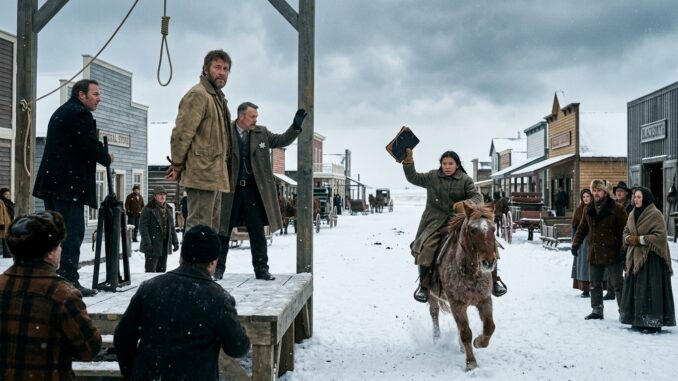
The rope was already around Elias Boone’s neck when the girl came riding through the snow.
She was small, no more than twelve, bent low over a brown pony whose sides were white with frost. One hand gripped the reins. The other held a torn leather ledger against her chest.
“Stop the hanging!” she screamed.
The crowd turned.
The executioner did not.
His gloved hand rested on the iron lever beside the trapdoor. Below Elias’s boots, the wooden boards creaked in the cold. Above him, the rope groaned like an old tree branch.
Sheriff Mercer raised one arm. “Hold!”
But the executioner had already begun to pull.
Elias closed his eyes.
In that final breath, he did not think of the dead railway contractor. He did not think of the angry town or the watch found beneath his bed.
He thought of his younger brother, Jonah.
Then the girl shouted six words that made Elias open his eyes.
“I saw who killed him!”
Before we continue, please like this story, subscribe, and share it with someone who enjoys powerful frontier mysteries.
Three weeks earlier, Elias Boone had been mending a fence along the southern edge of his ranch when he saw black smoke rising beyond the poplar trees.
Smoke was not unusual on the Saskatchewan plains. Settlers burned brush. Railway crews burned old ties. But this smoke rose in one thick column, dark and heavy.
Elias dropped his hammer and climbed onto his horse.
He was a quiet man of thirty-eight, broad in the shoulders, with a weathered face and dark hair touched by early gray. Most people in Willow Creek respected him, though few could say they truly knew him. Elias kept his words short and his promises long.
He rode hard toward the smoke.
Near the old trading road, he found a wagon burning in a ditch. One wheel spun slowly. A team of frightened horses had torn free and vanished.
A man lay beside the wagon.
Elias jumped down and rolled him onto his back.
The man was Silas Crowe, the wealthy contractor building the new railway line west of town. His fine coat was open. Blood soaked his white shirt.
Elias pressed two fingers to his neck.
Nothing.
Then he saw the knife.
It lay in the snow near Crowe’s hand. Elias recognized the carved bone handle at once.
It belonged to Jonah.
A sound came from the trees.
Elias stood and turned.
For one second, he saw a small figure between the poplars—a girl in a red wool shawl. Then she disappeared.
“Niska?” Elias called.
No answer.
He knew the child. Niska often crossed his land with her grandmother, gathering medicines near the riverbank. Elias had once repaired their wagon without asking payment.
He took one step toward the trees.
Then riders thundered over the hill.
Sheriff Mercer arrived with two deputies and half a dozen railway men. Behind them rode Gideon Vale, Crowe’s business partner, dressed in a black coat too clean for the trail.
Vale looked at the body, then at Elias, then at the knife in the snow.
His face hardened.
“You killed him.”
Elias said nothing.
The sheriff dismounted. “Step away from the body.”
“I found him like this.”
“Then why is your hand covered in his blood?”
Elias looked down. Crowe’s blood covered his fingers.
One deputy picked up the knife.
“Sheriff,” the man said, “this has Boone’s mark.”
Not Elias’s mark.
Jonah’s.
But Elias did not correct him.
That silence became the first nail in his coffin.
The second came that evening.
The sheriff searched Elias’s ranch house while half the town watched from the yard. Elias stood in irons near the barn. His old dog, Patch, barked until a deputy kicked dirt at him.
Inside, drawers slammed. Chairs scraped. Boots crossed the floor.
Then Gideon Vale stepped out of the house holding a gold pocket watch.
Silas Crowe’s initials were carved into its cover.
“Found beneath his bed,” Vale announced.
The crowd began to murmur.
Sheriff Mercer took the watch and stared at Elias. “You still say you found him dead?”
“Yes.”
“Crowe bought the east pasture from the land office last month. Land you said belonged to your family.”
“It does belong to my family.”
“You threatened him in front of witnesses.”
“I told him I would fight him in court.”
Vale gave a cold laugh. “Crowe said you promised to put him in the ground.”
Elias remembered the argument outside the hotel. He had been angry. Crowe had waved false deeds in his face and told him the railway would take whatever land it needed.
But Elias had never threatened murder.
Not in those words.
Sheriff Mercer lowered his voice. “Tell me about the knife.”
Elias looked toward the dark road.
Jonah had left the ranch two nights earlier after another bitter fight. He was twenty-six, hot-tempered, proud, and tired of living in his older brother’s shadow. He blamed Elias for every hard winter, every failed crop, and every acre their father had lost before his death.
The knife belonged to Jonah.
The sheriff asked again. “Whose knife is it?”
Elias felt the whole town waiting.
If he spoke, men would ride after Jonah.
If he lied, the rope might tighten around his own neck.
He lifted his eyes. “Mine.”
That became the third nail.
The trial lasted two days.
Gideon Vale testified that Elias hated Crowe. A railway clerk claimed Elias had been seen near Crowe’s office. The watch was shown to the jury. So was the knife.
No one had seen the murder.
No one needed to.
The evidence formed a path straight to Elias.
His lawyer begged him to explain the knife, but Elias refused. He also refused to mention Jonah.
“Your brother may already be gone,” the lawyer whispered. “Why die for a man who ran?”
Elias looked through the courtroom window at the empty road.
“Because he is my brother.”
The jury returned before sunset.
Guilty.
The judge sentenced Elias to hang in fourteen days.
That same night, far north of Willow Creek, Niska crawled beneath the broken floor of an abandoned trading post.
She had returned to the place where she had hidden after the murder. Fear had kept her silent. She had seen men with rifles. She had heard Crowe begging. She had watched someone place the gold watch inside a saddlebag.
Now she searched by moonlight for something she had dropped while running—her grandmother’s silver pin.
Instead, her fingers touched leather.
She pulled out a torn ledger wrapped in oilcloth.
Inside were lists of land parcels, payments, false names, and marks beside farms taken from settlers and Indigenous families. Crowe’s name appeared again and again.
So did Gideon Vale’s.
Then, near the final page, Niska found a signed agreement dated the night of the murder.
She read the last name slowly.
Boone.
Her heart began to pound.
The signature did not belong to Elias.
It belonged to Jonah.
And beneath it, written in Crowe’s own hand, were five words:
Payment after Elias Boone is dead.
Niska stared at the sentence until the letters blurred. If the page told the truth, Jonah had not betrayed Elias. He had sold him.
Niska carried the ledger home beneath her coat.
Snow swept across the plains, hiding the road and filling her footprints almost as soon as she made them.
Her grandmother, Sela, was waiting beside the stove when Niska entered their small cabin.
“You went back,” Sela said.
Niska placed the torn ledger on the table.
Sela opened it carefully. Her eyes moved over the names, numbers, and false land claims. She recognized families forced from river camps. She recognized settlers who had lost farms after Crowe’s men appeared with papers no one had seen before.
Then she reached Jonah Boone’s signature.
Sela looked up. “Did you see him that night?”
Niska’s throat tightened.
She had told no one the whole truth.
“I saw three men at the trading post,” she whispered. “Crowe, Vale, and Jonah Boone.”
“Was Elias there?”
“No.”
“Then you must tell the sheriff.”
Niska shook her head. “One of Vale’s men saw me.”
She pulled back her sleeve. A dark bruise circled her wrist.
“He caught me near the trees. I bit him and ran. He said if I spoke, they would burn our cabin with us inside.”
Sela’s face hardened, but fear entered her eyes.
“They killed Crowe,” Niska said. “They can kill us too.”
Sela closed the ledger.
“And if we remain silent, they will kill Elias.”
The next morning, Sheriff Mercer visited Elias in jail.
The cell was narrow, with stone walls and one small window. Elias sat on the cot, repairing his boot as if he had months left to live.
Mercer placed a folded paper between the bars.
“Sign it.”
“A confession?”
“Gideon Vale is demanding one before the hanging. Says the railway company wants the matter settled.”
Elias raised his eyes. “Since when does a business partner decide what justice needs?”
Mercer glanced toward the hallway.
“Vale pays the hotel, the freight office, and half the deputies’ wages through railway contracts. People listen when he speaks.”
“You listen too?”
The sheriff’s jaw tightened.
“You never believed I killed Crowe,” Elias said.
“I believed the evidence.”
“That is not the same thing.”
Mercer lowered his voice. “Tell me whose knife it was.”
Elias turned away.
“Your silence is protecting someone. Your father had two sons. Where is Jonah?”
“I do not know.”
The sheriff slid the confession through the bars.
“Then decide whether protecting him is worth your life.”
After Mercer left, Elias read the paper. It said he had attacked Crowe over disputed land, stabbed him, stolen his watch, and burned the wagon.
All Elias had to do was sign.
He tore it in half.
That afternoon, a guard brought him a visitor.
Jonah stepped into the corridor wearing a heavy coat and a hat pulled low. His lower lip was split. Dried blood marked his collar.
Elias moved closer to the bars. “Who did that?”
“Vale’s men.”
“Why?”
“Because I tried to leave.”
Elias’s hands closed around the iron. “Tell me everything.”
Jonah looked toward the guard. Elias pushed his last silver coin through the bars, and the guard walked away.
“Crowe hired me months ago,” Jonah said. “He needed someone who knew the ranch boundaries. I thought I was helping survey the railway.”
“You signed land papers.”
“I did not know they were false at first.”
“And later?”
Jonah looked down. “Later, I knew.”
The words hurt more than the guilty verdict.
“Crowe and Vale were stealing land,” Jonah continued. “Crowe began keeping records because he did not trust Vale. The night he died, Crowe called me to the trading post. He wanted to give me the ledger and testify against Vale.”
“Did Vale follow you?”
“Yes.”
“Did you kill Crowe?”
“No. Vale shot him during the argument. Crowe was still breathing when Vale’s man stabbed him with my knife. They had taken it after beating me.”
“And the watch?”
“They planted it in your house.”
Elias closed his eyes.
“Why me?”
“Crowe planned to return the east pasture to you. Vale needed you gone before the land hearing.”
Jonah began to cry.
“I signed an agreement,” he said. “Vale told me it was payment for guiding the crew. I did not read all of it. Later, I saw the words about your death.”
“Where is the ledger?”
“I thought Crowe hid it.”
“A girl may have found it.”
Jonah’s head snapped up. “Niska?”
“You saw her?”
“Vale saw her too.”
“Where is she?”
“I do not know.”
Jonah reached through the bars and seized his brother’s sleeve.
“Vale said if I testified, he would kill Niska and her grandmother. He would make it look like a stove fire.”
Elias looked at his younger brother.
“What do you want me to do?”
“Confess.”
The word hung between them.
“Vale promised that if you confess, he will leave them alone. He will let me disappear.”
Elias stared at him. “You came to ask me to die.”
“I came because I do not know how to save anyone.”
“You could tell the sheriff.”
“Vale owns one of the deputies. Maybe both. We would never reach the courtroom.”
Elias stepped away.
He remembered Jonah as a boy following him through tall grass. He remembered carrying him home after he broke his leg. He remembered promising their dying mother that he would never abandon him.
But the man before him was no longer a child.
“You helped steal those farms,” Elias said.
“Yes.”
“You stayed silent while they blamed me.”
“Yes.”
“And now you ask me to confess.”
Jonah’s voice broke. “Yes.”
Elias wanted to hate him.
Instead, he saw a frightened man buried beneath years of envy and bad choices.
“Go,” Elias said.
“Elias—”
“Go before I forget you are my brother.”
That night, Elias asked for Sheriff Mercer.
When the sheriff arrived, Elias placed a new sheet of paper on the table.
“I will confess,” he said.
Mercer stared at him. “Why?”
“You wanted the case settled.”
“I want the truth.”
“The town will have its truth.”
Elias signed his name.
Before Mercer could take the paper, Elias leaned close and whispered, “Find Niska. Vale is hunting her.”
By morning, copies of the confession were nailed outside the hotel and general store. People gathered beneath them, reading Elias’s words aloud. Some called him a coward. Others said the hanging should happen before noon.
Gideon Vale stood across the street, smiling.
Sheriff Mercer watched him from his office window. The confession had given Vale exactly what he wanted, yet Vale did not look relieved. He looked victorious.
Mercer opened his desk drawer and placed Elias’s torn first confession beside the signed one. Then he loaded his revolver.
If Elias had lied to save someone, Mercer intended to learn who before the rope fell.
At that same moment, flames rose from Sela’s cabin.
Niska woke choking on smoke.
She crawled toward her grandmother’s bed, but it was empty.
Outside, horses circled the burning cabin.
A man shouted, “Find the girl!”
Niska clutched the ledger beneath her dress and slipped through a broken rear window.
She ran barefoot into the snow.
Behind her, one rider lifted a lantern, and in its light Niska saw the face beneath the hat.
It was Jonah Boone.
Niska froze in the snow.
Jonah Boone sat on the nearest horse, his face lit by the burning cabin. Behind him, two of Vale’s men searched the yard with rifles.
For one terrible moment, Niska believed Jonah had come to kill her.
Then Jonah looked toward the broken rear window and saw her crouching beneath the woodpile.
He did not point.
Instead, he turned in the saddle and shouted, “She ran toward the river!”
The riders cursed and followed him into the darkness.
Niska remained still until the hoofbeats faded.
Then a weak voice called from behind the barn.
“Niska.”
She found Sela lying beside a water barrel. Her grandmother’s hands were burned, but she was alive. Jonah had pulled her from the cabin before the roof collapsed.
“He told me to send you to town,” Sela whispered. “He said the hanging will happen at noon.”
By sunrise, Niska had wrapped Sela’s hands and borrowed a pony from a nearby family. She placed the ledger beneath her coat and rode toward Willow Creek.
She knew Vale’s men would search the roads.
So she crossed frozen fields, creek beds, and narrow trails used by hunters. Snow struck her eyes until she could barely see. Twice, the pony stumbled. Once, Niska fell and nearly lost the ledger beneath a drift.
Each time, she rose.
At the Willow Creek jail, Elias heard men building the gallows in the square.
Hammer blows carried through the stone walls.
Sheriff Mercer entered the cell with two cups of coffee.
“I found Niska’s cabin,” he said. “Burned to the ground.”
Elias slowly stood. “Was she inside?”
“No bodies.”
Elias released a breath.
Mercer handed him a cup. “Your brother disappeared again.”
“He may be trying to help her.”
“Or silence her.”
Elias looked through the small window toward the gray morning.
“I spent half my life protecting Jonah,” he said. “After our father died, he became my responsibility. Every time he lied, I covered it. Every time he failed, I carried the cost.”
“Why?”
“Because I promised my mother.”
Mercer studied him. “A promise should not demand your death.”
“No. But guilt can make a man confuse sacrifice with love.”
The sheriff opened the cell.
“I can delay the hanging.”
“For how long?”
“An hour, perhaps.”
“Vale will use that hour to find Niska.”
Mercer hesitated. “Then what do you want?”
“Take me to the gallows.”
By eleven-thirty, the square was packed.
Men stood on wagon beds. Women gathered near the church steps. Railway workers filled the front rows. Gideon Vale watched from beneath the hotel awning, calm and confident.
Elias climbed the wooden steps without resistance.
The executioner tied his hands.
Sheriff Mercer read the sentence aloud, but Elias barely heard it. He searched the crowd for Jonah.
He saw no sign of him.
The rope was placed around his neck.
“Any final words?” Mercer asked.
Elias faced the townspeople.
“I confessed to killing Silas Crowe,” he said. “That confession was a lie.”
Angry voices rose at once.
Elias continued.
“I lied because a child’s life was threatened. I lied because my brother helped wicked men and was too afraid to tell the truth. I thought dying would protect what remained of my family.”
Vale stepped forward. “Sheriff, this is another trick.”
Elias looked directly at him.
“But silence does not protect people like Gideon Vale. It feeds them.”
Vale’s hand moved beneath his coat.
Then a cry came from the far end of the street.
“Stop the hanging!”
Niska raced into the square carrying the ledger.
The executioner began to pull the lever.
“Hold!” Mercer shouted.
The trapdoor dropped less than an inch before the sheriff seized the iron handle and forced it back.
Niska jumped from the pony and ran toward the platform.
“I saw who killed Crowe,” she cried.
Vale drew his revolver.
A shot cracked from the roof of the feed store.
The gun flew from Vale’s hand.
Jonah stood above the square holding a rifle.
“Do not move,” he shouted.
Vale’s men reached for their weapons, but Mercer’s loyal deputy and several ranchers surrounded them.
Niska climbed the gallows steps and gave the ledger to the sheriff.
She told the town everything.
She had followed Crowe’s wagon because she had seen Vale’s men take Sela’s land papers. At the trading post, Crowe accused Vale of stealing from families and threatened to expose him. Vale shot Crowe. One of his men stabbed the dying contractor with Jonah’s knife. Then they burned the wagon and planted the watch in Elias’s home.
Niska pointed at Jonah.
“He was there.”
The crowd turned toward the rooftop.
Jonah lowered his rifle.
“Yes,” he said. “I was there.”
Mercer ordered him down.
When Jonah reached the platform, Elias looked at his brother through the rope.
“You saved Niska and Sela.”
“Too late to undo the rest.”
Vale laughed bitterly. “The boy signed every deal. He helped us take the land. Ask him.”
Jonah faced the crowd.
“He is telling the truth.”
Mercer opened the ledger. Jonah’s signature appeared beside false surveys, illegal payments, and the agreement concerning Elias’s death.
The town fell silent.
Elias understood the price of his freedom.
To clear his own name, he had to let the law take the last member of his family.
Jonah stepped beside him.
“Tell them,” he whispered.
Elias’s eyes filled with tears. “You are my brother.”
“And you have paid for me long enough.”
Elias looked at Sheriff Mercer.
“Arrest him.”
The words nearly broke him.
Mercer removed the rope from Elias’s neck and placed irons on Jonah’s wrists.
Vale lunged for the executioner’s pistol, but Niska kicked the weapon through the open trapdoor. Mercer struck Vale to the boards and arrested him before the crowd could tear him apart.
In the months that followed, Vale was convicted of murder, fraud, and attempted killing. He received the same sentence once prepared for Elias.
Jonah pleaded guilty to fraud and conspiracy. His testimony returned thousands of acres to settlers and Indigenous families. Because he had saved Niska and helped expose Vale, the judge spared his life, but sentenced him to ten years in prison.
Before Jonah was taken away, Elias met him beside the jail wagon.
“I am sorry,” Jonah said.
Elias embraced him despite the chains.
“When you return,” Elias whispered, “we rebuild honestly.”
Niska and Sela received their river land back. Elias repaired their new cabin himself. Above its door, Sela hung the silver pin Niska had once gone searching for.
On clear evenings, Elias sometimes watched the northern lights above the restored ranch and thanked the brave child whose voice had stopped the rope forever.
Years later, people still spoke about the winter Elias Boone walked away from the gallows.
But Elias remembered something else.
He remembered the moment he finally understood that love was not hiding another person’s guilt.
Sometimes love meant telling the truth, accepting the wound, and leaving the door open for them to become better.
If this story moved you, please like, subscribe, and share it with someone who believes truth can still find its way through the darkest storm.
Share Your Thoughts
What are your thoughts about this story? Share your thoughts in the comments below.
Leave a Reply