
Free reader powered by your browser. Available voices may vary by device.
The Widow and the Frozen Mountie
Wild West Story
The Widow and the Frozen Mountie
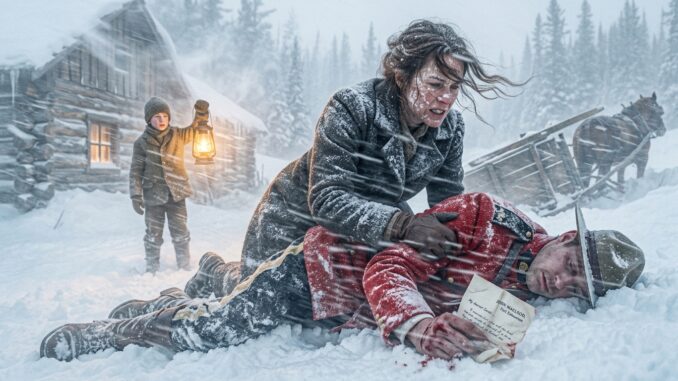
The frozen man grabbed Margaret Hale’s wrist just as she tried to pull the bloodstained letter from his coat.
His eyes remained closed.
His face was pale beneath the ice clinging to his beard, and his body felt colder than the floor of her cabin. Yet his fingers tightened around her wrist with surprising strength.
“Don’t…” he whispered.
Margaret froze.
Outside, the blizzard screamed against the walls. Wind pushed snow through cracks around the door, and the flames inside the iron stove trembled as though even the fire was afraid.
Margaret looked down at the letter sticking halfway out of the stranger’s red uniform coat.
Written across the front in dark, hurried letters was a name she had not seen in three years.
Thomas Hale.
Her dead husband.
The Mountie’s grip weakened.
“They know…” he murmured. “They know where you live.”
Then his hand fell away.
Margaret stared at him, unable to breathe.
Thomas had died three winters earlier.
At least, that was what everyone had told her.
Before we continue, please take a moment to like, subscribe, and share this story with someone who enjoys powerful tales of courage, mystery, and survival.
Only an hour earlier, Margaret had believed the worst thing waiting outside her cabin was the storm.
She had been wrong.
The winter of 1892 had arrived early and cruel across the Alberta plains. Snow covered the fields in hard white waves, hiding fences, trails, and frozen cattle bones beneath its surface.
Margaret’s small farm stood alone at the edge of open country. It consisted of a narrow wooden cabin, a leaning barn, a chicken house, and enough frozen land to remind her every morning how much she still owed the bank.
Her ten-year-old son, Samuel, stood beside the stove, wrapping a worn blanket around his shoulders.
“Do you think Daisy will survive the night?” he asked.
Daisy was their last milk cow.
Margaret looked toward the wall as if she could see through it to the barn.
“If we keep her warm and fed, she will.”
Samuel studied his mother’s face.
“You always say that.”
“Because it is usually true.”
“Usually?”
Margaret forced a smile. “Go put another piece of wood in the stove.”
She did not tell him they had only enough firewood for two more days.
She did not tell him the flour barrel was nearly empty.
And she did not tell him that someone had cut the northern fence again, allowing three of their cattle to disappear before the storm arrived.
The thieves had been taking animals from farms across the district for months. They came at night, leaving hoofprints, broken locks, and frightened families behind.
No one had seen their faces.
The neighbors blamed wandering outlaws. Others believed a powerful rancher was paying men to drive small farmers from the land.
Margaret only knew that each missing cow brought her closer to losing the farm Thomas had built with his own hands.
A sudden pounding came from outside.
Not at the door.
From somewhere near the barn.
Margaret lifted the lantern.
Samuel moved closer. “What was that?”
“Probably a loose board.”
The sound came again.
Three heavy knocks.
Then silence.
Margaret reached for Thomas’s old rifle above the fireplace.
“Stay here.”
“No.”
“Samuel.”
“I’m coming with you.”
“You will stay beside the stove, and you will not open that door unless you hear my voice.”
Fear filled his eyes, but he nodded.
Margaret tied a scarf around her face, pulled on her coat, and stepped into the storm.
The wind struck her so hard she nearly fell backward. Snow whipped across the yard, erasing her footprints almost as quickly as she made them.
She held the lantern low and fought toward the barn.
“Hello?”
Only the wind answered.
She reached the barn door and found it swinging on one hinge.
Inside, the horses kicked nervously against their stalls.
Margaret raised the lantern.
The feed sacks had been disturbed.
One had been sliced open.
Grain covered the floor.
Then she noticed the blood.
Small red drops crossed the wooden boards and disappeared beneath the rear door.
Margaret’s fingers tightened around the rifle.
Someone had been inside.
Perhaps he was still nearby.
She followed the trail around the barn. The storm quickly covered the blood, but several deep marks remained in the snow, as though a wounded man had dragged himself across the ground.
Margaret found him beside the cattle fence.
At first, she thought the red cloth showing beneath the snow was a torn blanket. Then the figure moved.
He wore the uniform of the North-West Mounted Police.
One leg was trapped beneath a fallen fence post. Blood had frozen along the side of his coat. His hat was gone, and ice covered his dark hair.
Margaret knelt beside him.
“Can you hear me?”
The man gave no answer.
She pressed two fingers against his neck.
A weak pulse beat beneath his skin.
Margaret looked back at the cabin. It was less than fifty yards away, but in the storm, it seemed a mile.
She could leave him and get help after the blizzard.
But he would be dead within minutes.
“Samuel!” she shouted.
The cabin door opened.
Her son appeared holding a rope.
“I told you to stay inside!”
“I saw you kneel down!”
“Bring the sled!”
Together, they tied the Mountie onto the small wooden sled used for hauling firewood. Margaret pushed while Samuel pulled.
The storm fought them the entire way.
By the time they reached the cabin, Margaret’s hands were numb and Samuel was crying from the cold.
They dragged the Mountie inside and laid him near the stove.
Margaret removed his gun belt first.
Then she cut away the frozen cloth around the wound in his side. A bullet had passed through his coat and torn into the flesh below his ribs.
Samuel stared at the blood.
“Is he going to die?”
“Not if I can stop it.”
She heated water, cleaned the wound, and pressed folded cloth against it. The man groaned but did not wake.
Samuel pointed toward the red uniform.
“Mother, look.”
A small silver badge was pinned beneath the torn coat.
The name engraved upon it read:
Constable Daniel Reid.
“He’s a real Mountie,” Samuel whispered.
Margaret searched his pockets for anything that might identify where he had come from.
She found cartridges, a pocket watch, two coins, a small photograph of an older woman, and the bloodstained letter.
The sight of Thomas’s name made her hands tremble.
She remembered the day her husband disappeared.
Thomas had ridden north to help a neighbor search for stolen cattle. His horse returned two days later with blood on the saddle.
A search party found signs of a struggle near the frozen river. They found Thomas’s scarf trapped beneath the ice.
They never found his body.
The local constable said no man could survive those temperatures.
Margaret had buried an empty coffin.
She had stood beside the grave holding Samuel’s hand while the preacher spoke of heaven.
For three years, she had forced herself to believe Thomas was gone.
Now his name was written on a letter carried by a wounded Mountie who had appeared near her barn in the middle of a blizzard.
Margaret opened it.
The letter was short.
Constable Reid,
The man you seek is alive. Thomas Hale is being held at the abandoned mission beyond Black Pine Ridge. The cattle raids are paying for something much larger. Trust no one in Willow Creek, especially the man wearing the silver wolf.
Come alone before the next full moon, or Hale dies.
There was no signature.
Margaret read it again.
Then a third time.
Samuel watched her.
“What does it say?”
She folded the letter quickly.
“Nothing you need to worry about.”
“It has Father’s name on it.”
Margaret looked at him.
Samuel’s face had changed. He was no longer the small boy who had waited at the window every evening for his father to return.
But hope entered his eyes with the same painful innocence.
“Is Father alive?”
Before Margaret could answer, Constable Reid gasped.
His eyes opened.
They were gray, sharp, and filled with fear.
He tried to rise, but pain forced him back.
“Where am I?”
“You are in my cabin,” Margaret said. “My name is Margaret Hale.”
At the sound of her name, Reid became still.
His gaze moved to Samuel, then to the open letter in Margaret’s hand.
“You read it.”
“My husband is alive?”
Reid looked toward the window.
“You must put out the lamp.”
“Answer me.”
“They may have followed me.”
Margaret grabbed his coat.
“Is Thomas alive?”
Reid closed his eyes for a moment.
“He was alive six weeks ago.”
Samuel made a broken sound behind her.
Margaret felt the room tilt beneath her.
“Where is he?”
“The letter tells you where they claim he is.”
“Claim?”
“It may be a trap.”
“Who sent it?”
“I don’t know.”
“Why would cattle thieves keep my husband alive for three years?”
Reid opened his eyes again.
“Because your husband saw something the night he disappeared.”
“What?”
Reid hesitated.
The fear on his face was not caused by the men outside.
It was caused by the truth he was about to speak.
“I was there that night,” he said.
Margaret slowly released his coat.
Samuel stepped closer to her.
“You knew my father?”
Reid looked at the boy, and guilt filled his expression.
“Yes.”
Margaret’s voice became cold.
“Then tell me what happened.”
A horse neighed outside.
Not one of theirs.
All three turned toward the door.
Through the screaming wind came the faint sound of men’s voices.
Reid reached weakly for his missing gun belt.
Margaret lifted the rifle.
“How many?”
“At least four,” Reid whispered.
A shadow moved past the frosted window.
Then someone knocked on the cabin door.
Three slow, heavy knocks.
A man called from outside.
“Mrs. Hale, we know the Mountie is in there.”
Samuel gripped his mother’s dress.
The stranger continued.
“Send him out, and you and the boy may live.”
Margaret looked at Reid.
He stared back at her, breathing hard.
“Before you decide,” he whispered, “there is something else you must know.”
Another blow shook the door.
Reid’s next words struck Margaret harder than the storm.
“Your husband did not disappear because of the cattle thieves.”
He swallowed painfully.
“He disappeared because of me.”
Mountie Story
The first bullet tore through the cabin wall and shattered a tin cup beside the stove.
Samuel screamed.
Margaret threw him to the floor as another shot punched through the window, spraying glass across the room. The lamp flame jumped.
“Put it out!” Daniel shouted.
Margaret grabbed the lamp and smothered the flame beneath a blanket. Darkness swallowed the cabin.
Outside, the storm roared.
Inside, the only light came from the red glow of the stove.
A man shouted, “Last chance, Mrs. Hale!”
Margaret crawled toward the rifle.
“Samuel, get behind the wood box.”
“But—”
“Now.”
He obeyed.
Daniel dragged himself upright against the wall, one hand pressed over his wound.
“You cannot fight four men alone,” he said.
“I am not sending you out.”
“You do not know what I did.”
“I know they plan to kill us whether I do or not.”
A shadow passed the broken window.
Margaret fired.
A man cursed outside and fell into the snow.
The others answered with gunfire.
Wood splintered above Margaret’s head.
Daniel reached for his revolver on the table, but his fingers shook too badly to close around it.
“Back door,” he whispered. “Is there another way out?”
“The root cellar.”
Margaret pointed toward a trapdoor beneath the table.
Daniel looked at Samuel.
“Take the boy and go.”
“What about you?”
“I will keep them here.”
Margaret stared at him.
“You can barely stand.”
“That may be enough.”
Another bullet struck the stove, filling the room with sparks.
Daniel looked at her.
“I failed your husband once. I will not fail his family too.”
Margaret’s anger rose hotter than fear.
“You do not get to die before telling me the truth.”
She pulled the table aside, opened the cellar door, and pushed Samuel toward the steps.
“Wait below.”
“I am not leaving you.”
“You are not leaving me. You are helping me.”
His face tightened, but he climbed down.
Margaret turned back to Daniel.
“Talk.”
He looked at the door, then at her.
“Three years ago, I was new to the Mounted Police. I believed orders mattered more than judgment.”
“What orders?”
“To watch Thomas.”
Margaret felt cold despite the fire.
“Why?”
“Someone accused him of helping cattle thieves.”
“That is a lie.”
“I know that now.”
Outside, boots crunched against the porch.
Daniel lowered his voice.
“My superior was Inspector Silas Vane. He wore a silver wolf pin on his coat.”
Margaret remembered the warning in the letter.
Trust no one in Willow Creek, especially the man wearing the silver wolf.
Daniel continued.
“Vane said Thomas was leading thieves through hidden trails north of the river. He ordered me to follow him and report where he went.”
“And you did.”
“Yes.”
A heavy object struck the door.
The hinges groaned.
Daniel flinched.
“That night, Thomas met two settlers near the river. They were collecting proof. Brands cut from hides. False sale records. Names of farmers who had been threatened.”
“Proof against whom?”
“Vane.”
The room seemed to tighten around Margaret.
Daniel looked ashamed.
“Vane was leading the thieves. He used the uniform to control searches and frighten witnesses. Thomas had discovered it.”
Another blow shook the door.
Margaret heard the wood crack.
“What happened to my husband?”
“I sent a signal.”
Her grip tightened on the rifle.
Daniel’s voice nearly disappeared beneath the storm.
“Vane told me the signal would bring honest officers to arrest Thomas. Instead, men came from the trees.”
Margaret saw it in her mind.
Thomas beside the frozen river.
Horses rushing from darkness.
Daniel watching.
“They attacked him,” she whispered.
“Yes.”
“And you did nothing.”
“I tried.”
“After you betrayed him.”
Daniel did not defend himself.
“I shot one of Vane’s men. Thomas was wounded. We reached the river, but the ice broke beneath us. I pulled myself out. Thomas was carried under.”
Margaret refused to look away.
“You left him there.”
“I believed he drowned.”
“So did I.”
“I searched for two days without telling Vane. I found Thomas’s scarf and blood on the bank. Nothing else.”
The door cracked again.
A man called, “Burn them out!”
Samuel’s frightened voice rose from below.
“Mother!”
Margaret knelt by the cellar.
“Stay down!”
Smoke drifted through the broken window.
They had thrown something burning against the outer wall.
Daniel tried to stand and nearly collapsed.
“The cellar tunnel,” he said. “Where does it lead?”
“Behind the barn.”
“Then go now.”
Margaret shook her head.
“The barn is where they expect us.”
“Not if they see me inside.”
He picked up the lamp blanket and held it close to the stove until one edge began to smoke.
“What are you doing?”
“Giving them the fire they came for.”
He tossed the smoking blanket onto the bed.
Flames climbed the dry wool.
Margaret stared at him.
“You will burn us alive.”
“Only if we stay.”
He dragged the table over the open trapdoor, leaving just enough room to slip beneath it.
“Take Samuel through the tunnel. I will fire from the window, then follow.”
Margaret grabbed his arm.
“You are wounded.”
“And they think I am the reason you are still here.”
He pressed his revolver into her hand.
“If I do not come, go north to Black Pine Ridge.”
“Why should I trust you?”
“You should not.”
The answer stopped her.
Daniel’s face twisted with pain.
“But Thomas trusted me before I betrayed him. I have spent three years trying to earn back the trust of a man I thought was dead.”
The cabin door burst inward.
Margaret fired the revolver.
A man stumbled backward from the doorway.
Daniel fired from the floor.
The remaining attackers scattered.
“Go!” he shouted.
Margaret dropped into the cellar and pulled the trapdoor nearly closed.
Samuel was waiting beside the narrow tunnel Thomas had dug years earlier for storing winter vegetables.
Behind them, gunfire exploded.
Smoke filled the cabin.
Margaret and Samuel crawled through frozen dirt while flames cracked above.
“Is Father really alive?” Samuel asked.
“I do not know.”
“You think he is.”
Margaret could not answer.
They emerged behind the barn into waist-deep snow.
The storm hid them.
Margaret pulled Samuel toward the horse shed, where their old mare trembled beneath a blanket.
A figure appeared through the snow.
Margaret raised Daniel’s revolver.
“Wait,” the figure gasped.
Daniel stumbled toward them, blood spreading across his side.
He had escaped.
Then another man stepped from behind the barn and pressed a gun to Daniel’s head.
He was tall, broad-shouldered, and wore a silver wolf pin.
Inspector Silas Vane smiled at Margaret.
“Thank you for bringing me the letter,” he said.
Margaret aimed at his chest.
Vane did not move.
“Shoot me,” he said, “and you will never learn where Thomas Hale is.”
Daniel’s face hardened.
“You do not know.”
Vane smiled wider.
“Oh, I know exactly where he is.”
He looked at Samuel.
“And I know why Thomas never came home.”
Margaret’s finger tightened against the trigger.
Vane leaned closer to Daniel and spoke the truth that shattered what little hope she had left.
“Thomas was not our prisoner for three years.”
His eyes settled on Margaret.
Fear gripped Margaret.
“He was working with us.”
Margaret kept the revolver aimed at Inspector Vane.
“You are lying.”
Vane’s smile did not change.
“Thomas helped move stolen cattle through the mountains. He gave us the hidden trails. He warned us when settlers were searching.”
Samuel shook his head.
“My father would never steal.”
Vane looked at the boy almost kindly.
“Every man has a price.”
Daniel suddenly drove his elbow into Vane’s stomach.
The inspector’s gun fired into the air.
Margaret shot the silver wolf pin from Vane’s coat. He fell backward into the snow while Daniel grabbed his arm.
“Run!” Daniel shouted.
Margaret lifted Samuel onto the old mare. Daniel pulled himself into the saddle behind him, and Margaret climbed onto the second horse.
They raced into the blizzard.
Vane’s men fired from the barn, but the storm hid the riders within seconds.
They traveled north through the night.
Daniel could barely remain upright. Margaret wanted to stop, but orange flames rising behind them showed that her cabin and barn were burning.
Her farm was gone.
Everything Thomas had built had disappeared in fire and smoke.
Samuel looked back only once.
“Where will we live now?”
Margaret forced herself to keep riding.
“First, we find your father.”
The storm weakened before dawn.
Black Pine Ridge appeared ahead, a dark line of trees and stone rising above the white wilderness.
Daniel led them toward a narrow trail between the cliffs.
“Vane said Thomas worked with them,” Margaret said. “Was it true?”
Daniel did not answer immediately.
“Partly.”
Margaret turned toward him.
Daniel’s voice was weak.
“Thomas survived the river. Vane’s men found him downstream. They kept him alive because he knew every trail through this country.”
“So he joined them?”
“He pretended to.”
Margaret felt anger mix with relief.
“Why did he not come home?”
“He tried during the first year. Vane caught him and threatened to kill you and Samuel. After that, Thomas remained close to the gang so he could learn their names and protect the families they planned to attack.”
Margaret stared ahead.
For three years, she had believed herself abandoned by death.
Now she understood that Thomas had stayed away because he believed distance would keep them alive.
“He could have sent word.”
“He did.”
Daniel reached beneath his shirt and removed a small leather pouch.
Inside were three folded letters.
Margaret recognized Thomas’s handwriting.
Her hands trembled.
“Why do you have these?”
“Because I was afraid.”
Daniel looked ashamed.
“Thomas gave them to me during secret meetings. He asked me to deliver them if I reached you safely. But Vane watched every road near your farm. I kept telling myself I was protecting you by waiting.”
“You kept my husband’s words from me for three years.”
“Yes.”
“Why bring the bloodstained letter now?”
“Thomas sent a final warning. Vane had discovered he was helping me gather evidence. They moved him to the abandoned mission and planned to kill him before sunrise.”
Margaret wanted to hate Daniel.
Part of her did.
But she saw a man who had allowed fear to control him once and had spent years walking toward the danger he had created.
Hoofbeats sounded behind them.
Vane was following.
Black Pine Ridge
They reached the mission at midday.
The building stood beneath the ridge, half buried in snow. Its roof sagged, and smoke rose from a broken chimney.
Daniel pointed toward a narrow opening behind the chapel.
“A storage tunnel leads beneath the building.”
Margaret gave Samuel the revolver.
“You stay here with the horses.”
“No.”
“Samuel—”
“I waited three years too.”
Margaret looked into her son’s face.
He was frightened, but he was no longer a child who could be protected by silence.
“Stay behind me,” she said.
They entered the tunnel.
Voices echoed above.
Margaret climbed a wooden ladder and pushed open a trapdoor.
The mission’s main room smelled of smoke, horses, and unwashed men. Stolen saddles and cut cattle brands covered the tables.
A man sat tied to a chair near the fireplace.
His hair had turned gray at the sides. A scar crossed his cheek, and his body was thin beneath a heavy coat.
But Margaret knew him.
“Thomas.”
His head lifted.
For one long moment, neither moved.
Then Samuel ran.
“Father!”
Thomas’s face broke apart.
“My boy.”
Samuel wrapped his arms around him. Thomas pressed his face against his son’s shoulder and wept.
Margaret cut the ropes.
When Thomas stood, he looked at her as if she were something he had dreamed about during every lonely night.
“I am sorry,” he whispered.
Margaret struck him across the face.
The sound filled the room.
Thomas did not move.
Then she pulled him into her arms.
“You should have trusted me.”
“I wanted to.”
“You should have come home.”
“I wanted that more than anything.”
“But you did not.”
Thomas closed his eyes.
“If Vane had seen me near the farm, he would have killed you.”
A gun clicked behind them.
Inspector Vane stood in the doorway with two armed men.
“And now,” he said, “I can kill all of you together.”
Daniel stepped in front of Margaret.
Vane laughed.
“Still trying to become a hero, Reid?”
“No,” Daniel said. “Just trying to stop being a coward.”
He fired.
The shot struck one of Vane’s men. Thomas tackled the other.
Margaret dragged Samuel behind the stone fireplace as gunfire filled the mission.
Daniel and Vane fired at the same moment.
Daniel fell.
Vane staggered but remained standing. Blood darkened his shoulder.
He aimed at Thomas.
Margaret saw a chain hanging beside the fireplace. It held an iron bell above the old chapel entrance.
She pulled it with all her strength.
The bell crashed through the rotten ceiling.
Vane looked up too late.
The heavy iron bell struck him and drove him to the floor.
Silence followed.
Thomas took Vane’s gun and kicked it away.
Daniel lay near the wall, holding his bleeding chest.
Margaret knelt beside him.
“Stay with us.”
Daniel looked toward Thomas.
“I should have refused Vane’s order that night.”
Thomas lowered himself beside him.
“You came back.”
“Too late.”
“No,” Thomas said. “You brought my family.”
Daniel’s eyes moved to Margaret.
“The evidence is beneath the altar. Names, payments, land deeds. Enough to destroy everyone who helped Vane.”
His breathing became shallow.
“I am sorry about the letters.”
Margaret took his hand.
“You gave us the truth in the end.”
A faint smile touched his face.
Then Constable Daniel Reid closed his eyes.
By spring, Vane’s records had exposed corrupt officers, cattle buyers, and wealthy ranchers across the territory. Stolen land was returned, and several families received money for the animals they had lost.
Daniel was buried near the mission beneath a simple wooden marker.
It read:
He returned to make things right.
Margaret’s farm could not be saved, but the government awarded the Hale family part of Vane’s seized land.
Thomas built a new cabin there.
He worked beside Samuel every day, slowly becoming a father again.
Trust returned more slowly.
Some nights, Margaret woke angry over the lost years. Some mornings, Thomas stood outside, afraid he would never deserve forgiveness.
But love did not erase pain.
It taught them how to carry it together.
Years later, a silver wolf pin hung above their fireplace—not as a symbol of fear, but as proof that cruel men could be defeated by ordinary people who refused to remain silent.
And whenever winter covered the Alberta plains, Margaret remembered the frozen stranger she had pulled from the snow.
A frightened man had arrived at her door carrying guilt, danger, and three unopened letters.
Yet because she had chosen mercy during the storm, he had led her back to the husband she believed winter had taken forever.
If this story moved you, please like, subscribe, and share it with someone who believes courage can survive even the coldest season.
What are your thoughts about this story? Share your thoughts in the comments below.
Leave a Reply